In the vast sea of an online store and commerce, e-commerce business models are the ships to navigate. But, are you sailing the right one?
Anchored in profit-generating potential, types of e-commerce models can be game-changers for your digital venture. Unveiled here are the lesser-known models that can charge ahead of the usual suspects, opening up promising avenues you may not yet have set sail on.
This isn’t just linear theory – think lifeboats saving you from turbulent tides. Don’t settle for a dinghy when you can command a battleship. Now, let’s steer to those uncharted waters.
The E-Commerce Explosion 💥
Global retail e-commerce sales reached an astonishing $5.7 trillion in 2022, and are projected to soar by 43% to approximately $8.1 trillion by 2026.
Online Retail's Rising Tide 🌐
20% of worldwide retail sales were conducted online, with expectations to grow to nearly 25% by 2026.
Boost customer satisfaction with just a few clicks
Most-Loved Features:
- On-demand drivers
- Real-time GPS tracking
- Delivery confirmation photos
- Over 50% of customers report a smoother delivery experience
Unraveling the Ecommerce Business Models: A Comprehensive tGuide
Cornerstones of ECommerce Business Models
In e-commerce, certain core principles or “cornerstones” determine your model. First, your revenue streams: how does your ecommerce business generate income? This element defines your pricing, subscription plans, or sales strategies. Next is the customer segment: finding your perfect customer demographic is crucial as different groups have various buying habits. Lastly, the value proposition: What sets your products or services apart from your competitors? Understanding these cornerstones is the first step toward choosing the ideal model for your e-commerce business. If you’re aiming to create a digital shopping empire, this comprehensive guide on ecommerce covers the essentials on selecting the most suitable ecommerce platform, establishing an online store, and much more.
Examining the Various Ecommerce Business Models
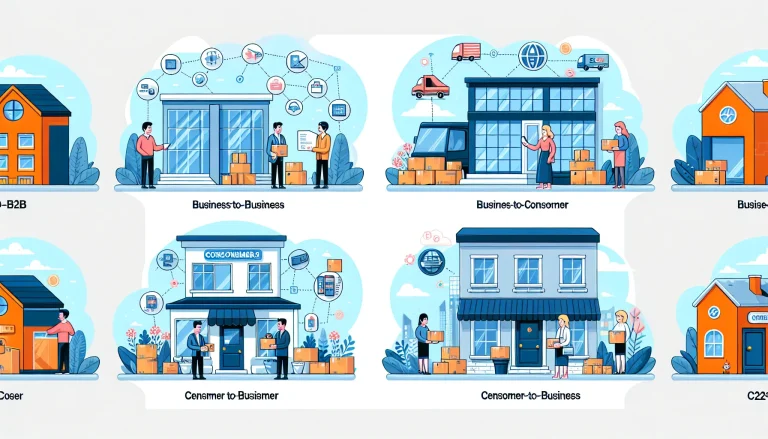
There are varied ecommerce models in existence, each with its strengths and drawbacks. We’ll delve into the four major types of ecommerce here: B2C (Business-to-Consumer), B2B (Business-to-Business), C2C (Consumer-to-Consumer), and C2B (Consumer-to-Business).
B2C – Business to Consumer Model
Business to consumer B2C is the most commonly recognized model. This involves businesses selling products or their services online directly to consumers. Think Amazon, eBay, or any online retailer that sells goods directly to you. Discover the growing shift towards direct-to-consumer e-commerce (D2C) as businesses embrace selling directly to their customers online, bypassing traditional retail intermediaries.
B2B – Business to Business Model
B2B models deal with strictly business-to-business transactions – one business selling goods or services to another business. An example is a SaaS company selling a consumer to business c2b or AI ecommerce software subscriptions to businesses.
C2C – Consumer to Consumer Model
C2C, on the other hand, through online marketplaces allows consumers to sell directly to other consumers. Common examples include eBay or Craigslist. Marketplace management software helps streamline the process by enabling sellers to manage their listings, transactions, and customer service efficiently on such platforms.
C2B – Consumer to Business Model
Lastly, C2B flips the script on traditional business models with consumers selling their services or goods to businesses. Sites like Upwork or Freelancer are perfect examples of the C2B model.
The Importance of Choosing the Right ECommerce Model
Choosing the right e-commerce model can be the difference between success and failure. Your ecommerce business model informs your marketing strategies, customer acquisition, partnership opportunities, and overall business direction. To streamline your customer support as your business grows, consider utilizing some of the top free ticketing systems to manage inquiries efficiently and enhance customer satisfaction. Therefore, make the right choice from the onset – the results can be game-changing. Unlock your business’s full potential by discovering the top ecommerce platforms, tailored to elevate your sales and operational efficiency.
B2B Ecommerce Models: Unlocking Business-to-Business Potential
B2B or Business-to-Business E-commerce models involve transactions between companies, unlike transactions between a company and an individual consumer. It’s an evolving domain that capitalizes on the ease and efficiency of digital platforms to streamline business dealings. Sizeable deals, bulk orders, and often, long-term contracts typically characterize B2B E-commerce.
Common Types of B2B Ecommerce Models
1. Product-centric Models: Businesses sell physical goods directly to other businesses for resale or business operations.
2. Service-centric Models: Firms offer services to other firms, like digital marketing agencies, consulting firms, etc.
3. Software-centric Models: Companies sell SaaS (Software as a Service) products, IT services, or digital goods to other businesses.
To leverage these models to their full potential, informed decision-making, based on a deep understanding of your business type, needs, and market trends is critical.
The Colossal B2B Market 🚀
The global B2B e-commerce market was valued at USD 7,432.12 billion in 2022, with projections to reach USD 36,107.63 billion by 2031.
Advantages of B2B Ecommerce Models
B2B E-commerce models make business transactions smoother, faster, and more efficient. Their potential, however, goes far beyond that.
Expanding Reach and Accessibility
B2B E-commerce models allow businesses to break geographical and time barriers, providing access to wider markets and enabling round-the-clock transactions. The internet plays a crucial role here, eliminating the need for physical outlets and enabling global business reach.
Saving Costs and Enhancing Efficiency
By minimizing the need for paper processes, manual tasks, in-person meetings, and physical stores, ecommerce businesses also can save significant costs. Online systems facilitate better stock management, advanced ordering systems, and can help you succeed with customer experience automation.
Personalization and Customer Relationship
The ability to collect, analyze, and implement customer data allows for personalized, targeted marketing and services, ultimately improving customer relationships and loyalty. By understanding purchasing patterns, businesses can anticipate customer requirements and deliver tailored experiences.
Understanding B2B e-commerce dynamics is not just crucial but beneficial from a growth perspective. As businesses continue to harness digital technologies, such as Big Data, Data Warehouse, managed DevOps, the B2B e-commerce sphere is set to expand, diversify, and create novel opportunities. Inline with this, many companies are turning to data warehouse consultants to effectively manage and streamline their data for enhanced business outcomes.
The B2B Digital Preference 💡
By 2027, US B2B e-commerce sales are expected to hit $3 trillion, a significant jump from $1.7 trillion in 2021.
B2C Ecommerce Models: Connecting Businesses Directly to Consumers
The Booming B2C E-Commerce Sphere 🛒
The global B2C e-commerce market is on track to reach US$ 8299.5 million by 2028.
Exploring B2C Ecommerce Models
B2C E-commerce models have established themselves as undisputed heavyweights in the world of commerce. Formulating an impactful online presence, these models equip businesses to generate sales directly with consumers.
The transactional B2C model stands as a popular model within this realm. With this model, businesses sell products or services directly to the consumer over the Internet. A prime example to understand this model is Amazon.
Similarly, the Subscription B2C model has been obtaining traction in recent times. Services like Netflix and Spotify operate under this model, where consumers pay a regular subscription fee for ongoing access to a product or service.
Other Notable B2C Models
Freemium and advertising models add diversity to B2C e-commerce. The Freemium model, adopted by businesses like LinkedIn, provides basic services for free but charges for premium features. Conversely, an advertising model like Google capitalizes on ad revenues.
Benefits of B2C Ecommerce Models
B2C (business to consumer) E-commerce models offer a slew of benefits. Among these is the ability to conduct business 24/7, thus fostering increased sales opportunities. The geographical constraints are obliterated, empowering businesses to reach a global audience.
Personalization stands as another compelling benefit of B2C E-commerce. By harnessing consumer data, businesses can offer personalized shopping experiences. This strategy propels customer loyalty and concurrently ameliorates conversion rates.
Consumer Engagement & Feedback
Interactivity with B2C models is commendable—the seamless engagement between businesses and their customers strengthens brand loyalty. Moreover, this interaction yields beneficial consumer feedback, guiding businesses to enhance their offerings and customer service.
Despite the alluring advantages, businesses must be aware of the challenges B2C models present, such as escalating competition and maintaining consumer trust. Comprehensive strategies and vigilant problem-solving are integral to maneuvering these challenges successfully.
The future for B2C e-commerce models looks bright—with ongoing technological advancements, businesses are expected to unearth innovative B2C strategies that deliver unrivaled service to consumers.
C2C Ecommerce Models: Empowering Consumer-to-Consumer Transactions
Consumer-to-consumer, or C2C, is an e-commerce model where consumers trade products, services, and information via the Internet. Essentially, C2C encourages a ‘marketplace’ setup, where the platform facilitates and supports individuals to sell directly to other consumers. Popular examples include eBay, Craigslist, and car boot sale apps like Depop. Put simply, consumers become both sellers and buyers, enhancing competitiveness.
The C2C ECommerce Surge 🌊
The C2C e-commerce market size is expected to reach USD 11,216.30 billion by 2032, with a CAGR of 23.6% from 2024 to 2032.
How C2C Works
The C2C model comprises three critical components of an online marketplace – sellers, buyers, and a facilitating platform. Individuals list their goods or services on the platform, where other consumers can browse and purchase. The platform typically profits from transaction fees or commissions. For instance, eBay charges a final value fee upon a completed sale.
Pros of C2C Ecommerce Models
The C2C model packs numerous benefits for both buyers and sellers. Let’s put a spotlight on some of these advantages.
Benefits for Sellers
Sellers get an accessible, user-friendly platform to sell their goods, without the need for owning a physical store. C2C opens up opportunities to small-scale sellers or individuals looking to declutter or earn a side income. Price setting is flexible, and sellers can engage directly with buyers – creating a sense of community while also getting firsthand consumer feedback.
Benefits for Buyers
From a buyer’s perspective, C2C platforms offer a vast array of unique, often cheaper products, embodying the thrill of a virtual ‘flea market’. They bring the charm of secondhand or handmade items just a few clicks away. Additionally, there’s a certain level of reassurance in dealing directly with the actual owner of the product.
A well-functioning C2C platform can build a trusted community of sellers and buyers, encouraging ongoing transactions and strengthening the bond between consumers.
D2C E-commerce Models: Bridging the Gap between Manufacturers and Consumers
The D2C E-Commerce Evolution 🌟
In the United States, D2C e-commerce sales are projected to near 213 billion dollars in 2024.
Understanding D2C Ecommerce Models
In the vast expanses of the e-commerce landscape, Direct-to-Consumer (D2C) models are becoming increasingly popular, providing an exciting cornerstone for many businesses. In a nutshell, D2C e-commerce revolves around the strategy where manufacturers or producers sell their products directly to consumers, bypassing all intermediaries. This essentially means that the seller completely owns the sales process from production to the point of sale. Eager to launch your own D2C digital store? Read on for a comprehensive guide on navigating the e-commerce waters, from crafting your online presence to optimizing your direct sales strategies.
From an operational perspective, D2C requires building up one’s e-commerce operations, and managing marketing and customer relations while handling the logistics and distribution. Thanks to advancements in technology, it’s now easier than ever for manufacturers to embark on the D2C model, overhauling retail norms and forging new consumer relationships.
Advantages of D2C Ecommerce Models
Selling directly to consumers has numerous advantages that can manifest into substantial benefits for both, the business and the end-user. Chief among these are lower costs, greater control, and improved customer relationships.
Lower Costs
The most immediately apparent advantage of the D2C model is the cost savings. By removing intermediaries, businesses can control costs and keep more of the profit margin. This also means that businesses don’t have to share data and customer insight with anyone else, affording them more opportunities to glean insights from their data.
Greater Control
Another key upside to the D2C model is the level of control it provides. Businesses can customize their user journey, manage their branding consistently, and control the after-sales experience. This results in a far deeper connection with customers and helps to build strong brand loyalty.
Improved Customer Relationships
Building on the theme of control, D2C equips businesses with the ability to develop enhanced customer relationships. Interacting directly with customers allows businesses to collect valuable data, feedback, and insights, all of which can be leveraged to fine-tune business practices, product offerings, and overall customer experience.
Every e-commerce model has a charm of its own, opening up a constellation of possibilities and D2C is no exception. As businesses embrace new ways of interacting with customers and delivering value, the D2C model remains an increasingly enticing option, offering a suite of benefits to both businesses and consumers alike.
Hybrid Ecommerce Models: Combining the Best of All Worlds
The Hybrid E-Commerce Future 🔄
The global hybrid e-commerce market is poised to reach USD 2,152.25 billion by 2028, growing at a CAGR of 14.7% during the forecast period.
Exploring Hybrid Ecommerce Models
Haven’t considered Hybrid E-commerce models yet? It might be time to reconsider. Not restricted by the boundaries that traditional models pose, hybrid models offer flexibility and diversification in the highly volatile e-commerce market. They work by combining aspects of differing business models – B2B, B2C, and D2C – each adding a unique edge to a business’s strategy.
For instance, a company may operate a B2C model for its core products but employ B2B strategies for its complimentary services. Alternatively, it might utilize D2C marketing for brand consistency while reaching wholesalers via B2B practices. The combinations are as numerous as they are rewarding.
Who are Hybrid Models Suited to?
Primarily, hybrid models favor those willing to expand beyond a single revenue stream or customer base. They are a fitting choice for businesses wanting to grow, diversify, and make their mark in the competitive e-commerce landscape. That said, hybrid models can benefit anyone, from small-scale sellers aiming to scale up, to established enterprises looking to optimize their reach target market further.
Benefits of Hybrid Ecommerce Models
Why consider hybrid models? It’s simple – they promise benefits at four levels: flexibility, diversity, resilience, and profit.
Hybrid models ensure flexibility. Because they aren’t restricted by a single frame, businesses can adapt to market changes with ease. They are poised to tap into varying consumer groups, exploring the potential each holds.
Equally important is the diversity they bring to a business’s revenue source. In contrast to the ‘all-eggs-in-one-basket’ approach, hybrid strategies foster multiple income streams. Here, each component – be it B2B, B2C, or D2C – acts as a safeguard even if one should falter.
Resilience is another merit that looms large. The ability to pivot amidst crises like the recent pandemic can ensure business continuity. In these instances, hybrid models prove to be particularly invaluable.
Profit, of course, lies at the heart of any business decision. Hybrid models offer great earning potential. By appealing to consumers and businesses alike, they amplify both revenue and customer reach.
Hybrid Shopping: The New Norm 🛍️ + 💻
A survey by IBM revealed that 73% of customers prefer a hybrid shopping experience, blending online research with in-store purchases.
Online Research Fuels In-Store Purchases 🔍🏪
According to a report by NRF, 69% of customers research products online before buying them in-store, underscoring the hybrid e-commerce model's significance.
Examples of Successful Hybrid Ecommerce Models
To paint a clearer picture, consider these examples. Amazon triumphs in B2C with its retail platform yet simultaneously facilitates B2B operations through its web services. Or take Warby Parker, which found success with its D2C model but also operates physical stores – showcasing a winning B2C strategy.
In conclusion, evaluating your business needs against the capabilities of a hybrid model could prove highly beneficial. Remember, having multiple irons in the fire could mean the difference between surviving and thriving in the dynamic e-commerce landscape.
Choosing the Right Ecommerce Model for Your Business
Factors to Consider When Choosing an Ecommerce Model
Your e-commerce model should suit your business like a glove.
1. Customer Base: Where is your audience located? What are their buying habits? Understanding your customer base will help you pick an e-commerce model that matches their purchasing habits.
2. Product or Service: The type of product or service you offer can heavily influence your choice. For instance, a subscription model may be best for services or consumable products.
3. Tech Capabilities: Your e-commerce model should align with your company’s tech skills. If your team is mostly non-tech, a simpler, user-friendly model may be more suitable.
4. Budget and Resources: Lastly, consider what resources you have at your disposal. Custom-made e-commerce models can be cost-heavy whereas pre-made platforms can be budget-friendly.
Case Study: Successful Businesses and Their Ecommerce Models
Amazon’s Hybrid Model
Amazon started as a B2C model but now operates on a hybrid model, running both B2C and B2B operations. Leveraging technological advancements, the company has managed to transition seamlessly between the models.
Alibaba’s B2B Model
Alibaba, on the other hand, chose a different path. Operating as a B2B model, it connects businesses directly, effectively eliminating the middleman.
Exploring Tomorrow: Types of Ecommerce Models
The world of e-commerce is dynamic and ever-evolving. Looking ahead, we’re likely to see an even greater integration and cross-selling within models. For instance, hybrid models that blend B2C, B2B, and consumer-to-consumer (C2C) strategies can provide better shopper experiences.
Another trend to anticipate is AI-based e-commerce models. AI can offer personalized shopping experiences, AI in customer service for improved support, and efficient operations.
Lastly, keep in mind the growing emphasis on sustainability. Future models may incorporate green business practices like carbon neutrality, delivery methods, or sustainable product sourcing. Your e-commerce model should remain flexible to adapt to these trends.
Bringing the Spotlight to Unexplored Ecommerce Avenues
So we’ve journeyed through the less noticed but potent e-commerce business models–from ‘Consumer-to-Consumer’ (C2C) to ‘Business-to-Government’ (B2G). We’ve explored their operational dynamics, strengths, and how they carve out their niche in the vast e-commerce landscape.
Remember, these hidden gems offer the potential to transform your online business journey and make it more lucrative. The less-explored lanes of e-commerce can bring opportunity knocking at your doorway.
Right now, consider which, of the models discussed, aligns best with your business goals. Start thinking of ways to implement it, or maybe a mix of them, into your current strategy.
Before we wrap up, put your thoughts on ‘Consumer-to-Administration’ (C2A) into perspective. How would you conceptualize this model playing out in your industry?
Brace up to challenge the status quo, and let these lesser-known models carve out their space in the e-commerce industry’s growth narrative. Your digital venture might just be the next big thing to hit the e-commerce world. So, dive in and beat the odds!