The instinct, when revenue is flat, is to brew more. It is usually the most expensive option on the table and the slowest to pay back.
The cheaper question is what each barrel you already brew is worth. A pint poured in your taproom and the same beer sold through a distributor are the same liquid at wildly different prices. Industry analysis puts on-premise taproom gross revenue at roughly $350 to $550 per barrel, several times what the same barrel returns wholesale (DojoBusiness, 2026). Shift the mix and revenue moves without a single new fermenter.
This page is about the earn side: which revenue streams you can add or grow on today’s production, and roughly what each one brings in. What to spend getting people to show up is a different question, covered in the brewery marketing budget guide, and the full menu of ways to bring them in is in the brewery marketing guide.
The Bottom Line
- Revenue per barrel beats barrels brewed. Moving beer from wholesale to on-premise is the single largest lever most breweries have.
- Craft production fell 4% in 2025, but taprooms and brewpubs held up better than distribution-focused breweries (Brewers Association), which is a mix story, not a demand story.
- Merchandise carries reported gross margins of 70-80% and roughly $8-15 per unit, making it the highest-margin thing in the building after beer.
- Memberships work when they raise visit frequency. Measure spend per member before and after they join.
- Food and to-go attach raise the average check faster than any pricing change you will be comfortable making.
Save 80% of delivery management time
We handle everything:
- Dedicated operations manager
- Real-time tracking dashboard
- Automated customer notifications
- Urgent issue resolution
Why revenue per barrel beats barrels brewed
The Brewers Association reports that about 70% of US breweries now sell more than a quarter of their beer at their own taproom or pub (Brewers Association). Taproom revenue typically lands between 25% and 50% of total sales for an independent brewery, with the smallest breweries often above 50% and regional breweries with real distribution usually below 30% (DojoBusiness, 2026).
That split is the most important number in your business, because it sets your revenue per barrel before any other decision.
The 2025 industry data shows what happens when the mix is wrong. Overall craft production fell 4% to 22 million barrels, with declines concentrated in distribution: microbreweries down 8.9% and regional breweries down 5.9%, against brewpubs at 1.7% and taprooms at 3.9% (Brewers Association, 2026). Retail dollar sales fell less than volume did, partly because of the continued shift toward on-site consumption, where the unit price is higher.
So before chasing volume, work through this page in order of margin.
Metrobi is transforming beverage deliveries
Specialized solutions for beverage businesses:
- Beverage-trained drivers
- Proper handling equipment
- Peak day delivery support
- 23% average cost reduction
Brewery revenue streams compared by margin
Here is the honest ranking for a small or mid-size brewery with a taproom.
| Revenue stream | Relative margin | Effort to add | Capacity it needs | Notes |
|---|---|---|---|---|
| Taproom pints | Highest per barrel | Already running | Seats and hours | Every other lever competes with this one |
| Merchandise | 70-80% gross | Low | Shelf space | Inventory risk is sizes, not designs |
| Memberships and mug clubs | High, recurring | Low | Admin time | Only works if visits rise |
| Paid tours and tastings | High | Low | Staff hours | Converts visitors into regulars |
| Food (own kitchen) | Medium | High | Kitchen build | Lengthens visits, raises check |
| Food (truck partnership) | Indirect | Very low | Parking | No margin, but more pints |
| To-go cans and crowlers | Medium-high | Low | Packaging gear | Captures demand after close |
| Private events and bookings | High | Medium | Dead daytime hours | Best use of empty rooms |
| Online orders and local delivery | Medium | Medium | Fulfillment and routing | Depends on your state rules |
| Wholesale and self-distribution | Lowest per barrel | High | Volume and logistics | Buys reach, not margin |
Nothing in that table says wholesale is bad. It says wholesale is how you buy reach, and reach is not revenue. If you need to lift revenue in a quarter, you work top-down.
Raising the average check in the taproom you already have
The fastest revenue in a brewery is the second drink and the thing eaten alongside it.
- Food, in whatever form you can manage. A kitchen is a project; a reliable truck schedule is a phone call. Either one lengthens visits, and longer visits mean more pints. The schedule has to be dependable enough that regulars plan around it.
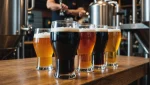
- Flights and smaller formats. Flights move people from one pint to the equivalent of two, and they sell the beers nobody orders by name.
- Staff who sell. A bartender who can describe three beers and recommend one lifts check size more than any menu redesign. That is a training line, not a marketing line.
- Glassware and format pricing that makes sense. If your 16oz and 10oz pours are priced two dollars apart, you have told people to buy the cheap one. Price the step-up so it is an easy yes.
- A to-go ask at the register. “Want a four-pack for the house?” asked consistently is worth real money, and it costs nothing.
- Non-beer options. Cider, seltzer, soda, coffee, or wine where your license allows. The designated driver and the non-drinker are currently spending nothing.
Track average check weekly. It is the number that moves first when any of this starts working.
To-go beer, online orders, and local delivery
Packaged beer sold from your own taproom sits in a useful middle: better margin than wholesale, no distributor, and it captures the customer who already walked in.
Order-ahead extends that. A simple online order page for four-packs, crowlers, and growler fills means people buy outside your busiest hours and without standing in line. The operational trick is keeping the available list honest, which is the same discipline as keeping the tap list current.
Local delivery pays off where your state permits direct-to-consumer beer sales, because it turns your taproom into a small retail operation with a radius instead of a doorway. Two things decide whether it works. The first is the rules, which vary by state and sometimes by license class, so check before you build anything. The second is routing: a delivery promise you cannot keep on a Saturday afternoon costs more goodwill than the orders are worth. Grouped delivery windows, a sensible radius, and a realistic drop count per run keep it profitable instead of chaotic.
The same logistics discipline applies to kegs going out to accounts, and it is where a lot of breweries quietly lose money: a late or warm keg does not just cost that delivery, it costs the handle.
Merchandise: the highest-margin thing in the building after beer
Brewery merchandise carries gross margins reported in the 70-80% range with roughly $8 to $15 of contribution per item (DojoBusiness, 2026). It also walks around town advertising you for free, which no other revenue stream does.
The failure mode is inventory, not demand. Rules that keep it profitable:
- Order narrow and deep on the things that always sell, which is usually a plain logo tee and a logo hat, and order shallow on everything else.
- Watch the size curve, not the total. Dead stock in a brewery is almost always XXL shirts and XS everything.
- Make glassware a souvenir, not a giveaway. A branded glass someone paid for goes home and gets used.
- Tie limited merch to limited beer. A release-day shirt sells out; a generic shirt sits.
- Put it where people queue. Merch behind the bar sells a fraction of merch people can touch while waiting.
Memberships and beer clubs as recurring revenue
Memberships are the only brewery revenue that arrives before the beer is poured, which makes them unusually valuable for cash flow.
Pricing in the market runs from roughly $20 a month to annual memberships between $200 and $325, with tiered programs clustering around $99, $199, and $349 and selling mainly to a brewery’s most frequent customers (Brewlytics, 2026).
The discipline is simple and widely skipped: compare a member’s monthly spend before and after joining. If it did not rise, you sold a discount to someone who was already coming in, and the program is a cost. Perks that raise frequency, like a members-only pour, early release access, or a quiet-night benefit, are what make the math work.
Subscription boxes and beer-of-the-month clubs are the shipped version of the same idea. They carry fulfillment cost and shipping law complications, so treat them as a packaging and logistics project rather than a marketing one.
Events, tours, and private bookings
Events earn money two ways: ticket or booking revenue, and the pints sold around them.
- Paid tours and tastings turn curiosity into revenue at high margin, and they send people home able to explain why your beer is worth buying.
- Ticketed dinners and meet-the-brewer nights carry a high per-head spend and fill a night that was going to be empty anyway.
- Private bookings are the best use of a room during daytime hours when nothing else is happening. Birthdays, work events, team gatherings. One bookable space and a simple inquiry form is the whole setup.
- Recurring weeknight events are revenue you can forecast, which matters more than a single big night.
The math on any event is incremental revenue minus the labor you added. A packed room that required three extra staff and sold the same pints as a normal Friday is a break-even party.
Events also feed the top of the funnel, and promotion is where that happens. What to post, where, and how often is covered in the brewery social media marketing plan.
Wholesale accounts and self-distribution: reach, not margin
Wholesale is the lowest-margin barrel you will sell, and sometimes it is still the right call.
It makes sense when you have capacity you cannot fill on-site, when you need brand presence in a city you want to grow into, or when a specific account puts your beer in front of exactly the drinkers you want. It does not make sense as a revenue fix, because adding wholesale volume at wholesale margin requires a lot of barrels to equal a modest taproom improvement.
If you do push it, push on the things that compound. Accounts that reorder are worth multiples of accounts that bought once, so measure sell-through per account rather than the account count. Run staff tastings, because the bartender recommending your beer is the actual sales channel. And be relentlessly reliable on delivery, since a keg that shows up late or warm is how hard-won handles get reassigned.
Pricing: the fastest lever and the scariest
A 50-cent increase on a $7 pint is a 7% revenue increase on every pint you sell, with no new customers and no new beer. Nothing else on this page is that efficient.
It also feels dangerous, so do it the way that minimizes the risk. Raise prices on new menus and new releases rather than on the flagship everyone has memorized. Keep one familiar beer at a familiar price. Round to numbers that make change easy. And do it in a month you are otherwise doing something good, like a food launch or a refreshed space, so the increase arrives alongside added value.
Watch transaction counts for three weeks afterward. If traffic holds, the increase was overdue.
What to fix first
If revenue is flat and you want the shortest path:
- Measure revenue per visit and visits per week. You cannot improve a mix you have not measured.
- Fix food and the to-go ask. Both raise the average check within weeks and need no capital.
- Audit merch inventory and reorder narrow. Free margin sitting in the wrong sizes.
- Design or repair the membership so it raises frequency. Recurring revenue plus more visits.
- Add one paid tour slot and one bookable private window. High margin, uses hours you already pay for.
- Only then look at more wholesale volume. Reach is a longer game and a thinner barrel.
Frequently asked questions about brewery revenue
How much revenue does a taproom generate compared with distribution?
On-premise taproom sales are commonly estimated at $350-$550 of gross revenue per barrel, several times the per-barrel return from a distributor, because you keep the retail margin instead of splitting it twice (DojoBusiness, 2026).
What percentage of brewery revenue comes from the taproom?
For most independent breweries, between 25% and 50%. Small breweries with little distribution often exceed 50%, while regional breweries with established distributor relationships usually sit below 30%. The share also swings seasonally, since distribution is steadier than foot traffic.
Can a brewery increase revenue without brewing more beer?
Yes, and that is usually the better first move. Shifting volume toward on-premise, raising the average check with food and to-go, and adding high-margin streams like merch, tours, and memberships all increase revenue on the same production.
Is brewery merchandise profitable?
It is one of the highest-margin items in the building, with reported gross margins of 70-80%. The risk is inventory rather than margin, so order narrow on proven items and watch the size curve.
Should a brewery deliver its own beer?
Where state law allows direct-to-consumer sales, local delivery can capture meaningful to-go revenue. Whether it is profitable comes down to routing and reliability: grouped delivery windows, a realistic radius, and drop counts your staff can complete.
Where the next dollar comes from
Increasing brewery revenue is mostly a mix problem. The same beer is worth three or four times as much over your own bar as it is through a distributor, and the fastest gains come from selling more of what you already make at the highest price available to you.
Start with the average check, add the high-margin streams that need no capital, build recurring revenue through memberships, and treat wholesale as a reach decision rather than a revenue fix. Measure revenue per visit every week and the next move will usually be obvious.