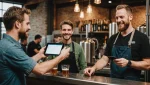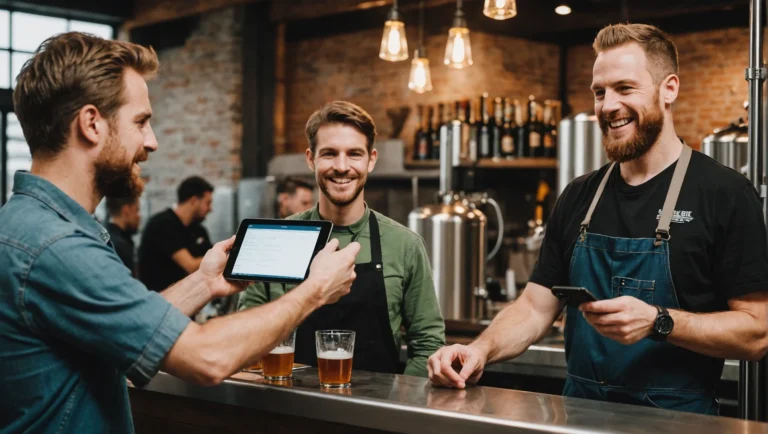

Nobody walks out of a brewery raving about the card reader. But plenty of people walk out early because of one.
A brewery payment system is usually treated as back-office plumbing, something you pick once, during the buildout, based on whichever rep called first. In practice it’s the part of your operation that touches every single customer, every single time, at the exact moment they’re deciding whether this place is easy to be in. A slow tap-to-pay, a tab that can’t be split, a bartender hunting for a receipt printer: each of those is 30 seconds of friction multiplied by every transaction you’ll ever run.
This is about the checkout experience specifically: in the taproom, on the phone, and on the online orders you deliver. For the wider picture of running the place, see how to operate a brewery day to day.
The Bottom Line
- A tap closes a check in under two seconds. A chip insert takes 12–18 seconds, and that gap is your bar queue on a Saturday.
- 89% of breweries now accept contactless payments, and roughly 62% of restaurant transactions are already contactless or tap-to-pay. That’s the default now, not an upgrade.
- Food and beverage online carts are abandoned 81.92% of the time, well above the 70.22% all-industry average, and the top causes are forced account creation and complicated checkouts.
- Effective processing rates at full-service venues run 2.6–3.5%, while the underlying interchange is closer to 1.75–2.05%. The spread is negotiable.
- Tip screen design is money: the US full-service average tip was 19.3% in Q1 2026, and a small or laggy prompt pushes guests to the lowest default.
Save 80% of delivery management time
We handle everything:
- Dedicated operations manager
- Real-time tracking dashboard
- Automated customer notifications
- Urgent issue resolution
What a brewery payment system actually has to do
A brewery takes money in more ways than almost any other small business, and one system has to handle all of them.
Run the list: pints and flights at the bar, four-tops that want a split check, a tab somebody opened at 4pm and closed at 9pm, cans to go, merchandise, a private event deposit, an online order for pickup, an online order you’re delivering, and a keg invoice to a bar across town that pays on net-30. Most restaurant POS systems handle two or three of those well. Brewery-specific platforms exist because the combination is unusual. Arryved markets itself as a single system for taproom POS, production, ecommerce, and payments, while Square, TouchBistro, Lightspeed, and EposNow all run brewery and taproom configurations.
The requirement list that matters:
- Open tab handling that survives a shift change and doesn’t require re-swiping a card
- Split and partial payments without a manager override
- Contactless and digital wallet acceptance on every terminal, including the mobile one
- Tab-side ordering or QR ordering if you have a patio or a long bar
- Online ordering that shares one inventory with the taproom, so you don’t sell the last case twice
- Invoicing for wholesale accounts, which is a different workflow from retail entirely
If a platform can’t do wholesale invoicing, you’ll end up running two systems and reconciling them by hand every month. Ask about it before you sign, not after.
Metrobi is transforming beverage deliveries
Specialized solutions for beverage businesses:
- Beverage-trained drivers
- Proper handling equipment
- Peak day delivery support
- 23% average cost reduction
Why checkout speed decides how much a taproom sells
Payment speed is throughput, and in a taproom throughput is revenue.
A tap closes a check in under two seconds, against 12–18 seconds for a chip insert (SignaPay). On a quiet Tuesday that’s invisible. On a Friday with 40 people waiting, ten seconds per transaction compounds into a queue that visibly deters the person walking in the door. People don’t join a six-deep bar line at a brewery; they go next door.
Adoption has already settled the argument. Roughly 62% of restaurant transactions are now contactless or tap-to-pay, contactless passed 50% of in-person card volume in 2025 and well past 60% by early 2026, and digital wallet use in restaurants grew 45% year over year (Factura.ai restaurant payment statistics). On the brewery side specifically, 89% now accept contactless, and 79% of consumers say they prefer contactless or mobile payment, with 73% preferring a digital wallet such as Apple Pay or Google Wallet (Raspberry Pints, brewery and taproom technology trends).
The practical read: if your terminals still require an insert, or your reader sits at an awkward angle for a phone, you are adding a queue to your own bar for no reason.
Open tabs, pre-auths, and the walked-tab problem
The tab is where most taproom payment friction and most payment loss actually live.
Breweries run long tabs by nature, because people settle in. That creates three operating problems: cards left behind the bar, tabs that walk out unpaid, and a close-out rush at the end of the night when everyone wants to pay at once. The tools that help:
- Pre-authorize rather than hold cards. A pre-auth on open means an unclosed tab can still be charged, and nobody’s card is sitting in a cup.
- Let guests close their own tab from their phone. Mobile ordering and tab management is the current frontier in taproom technology for exactly this reason: it moves the 9pm close-out rush off your bartenders.
- Set an auto-close policy and a gratuity default for walked tabs, and make sure your processor’s rules actually support it.
- Name tabs by card, not by first name. Three Mikes on a Saturday is a real and recurring problem.
The reason this matters beyond convenience: a bartender spending four minutes untangling tabs is a bartender not pouring. That’s labor you’re paying for that produces nothing, and labor is already supposed to run 8–12% of taproom sales. Who’s covering the bar while that happens is a staffing question too: the brewery roles worth hiring and what each one owns is where the taproom manager’s shift-change and cash-handling responsibilities land.
How to design a tip screen that doesn’t cost you tips
Tip prompts are interface design with a direct payroll consequence.
The US average tip at full-service restaurants was 19.3% in Q1 2026, with the overall restaurant average at 18.8% and quick service at 15.8% (Toast Platform Data). A brewery taproom sits between those models, which means your tip screen is doing the work of deciding which average you land near.
What matters mechanically: the digital tip prompt has to be fast, large, and clearly readable, because small or laggy screens push guests toward the lower default. Three rules follow from that:
- Use percentage defaults for table-service style tabs and flat amounts for single-pint counter service. A 20% prompt on a $7 pint reads as pennies; “$1 / $2 / $3” reads as a choice.
- Keep the terminal screen bright and angled toward the guest. A dim screen in a dark taproom gets the fastest tap, not the intended one.
- Don’t stack a tip prompt behind a loading spinner. Latency reads as a malfunction, and people press whatever ends it.
Online and delivery order checkout for breweries
If you sell beer online, your checkout is leaking more orders than your taproom ever will.
Food and beverage carts are abandoned 81.92% of the time as of mid-2026, against a 70.22% average across all industries from Baymard Institute’s meta-analysis of 50 studies (GrowthSuite cart abandonment data). The reasons are not mysterious: being forced to create an account (18%), a long or complicated checkout (17%), and site errors (17%). Mobile abandons at 85.65% against 73.07% on desktop, and each additional checkout step on mobile raises abandonment risk by roughly 5%.
For a brewery selling local pickup and delivery, that translates into a short fix list:
- Allow guest checkout. Nobody wants an account to buy a four-pack.
- Collect age verification once, at the right moment. Not as a modal before anyone has seen the beer, and not as a surprise at step four.
- Show the delivery window and fee before the payment step. Surprise fees at checkout are the single most-cited abandonment reason across every version of this research.
- Support digital wallets on mobile. Apple Pay and Google Pay collapse the whole form into one tap, which is the only real answer to the mobile step penalty.
- Keep one inventory for taproom and online. Overselling a limited release and refunding it costs more goodwill than the sale was worth.
What breweries actually pay in processing fees
The headline rate you were quoted is probably not your effective rate.
The average full-service restaurant runs an effective processing rate between 2.6% and 3.5%, while the actual interchange cost averages around 1.75–2.05% depending on card mix (Katalyst, bundled vs. interchange-plus). Visa card-present restaurant interchange runs 2.10% for basic consumer credit up to 2.60% for premium cards; restaurant debit is 1.19% + $0.10.
| Pricing model | Typical rate | Best fit |
|---|---|---|
| Flat-rate bundled (Square) | 2.6% + $0.15 in person | Low volume, simple setup |
| Flat-rate bundled (Toast Payments) | ~2.49%–2.99% + $0.15 | Venues already on that POS |
| Interchange-plus | Interchange + 0.20–0.40% + $0.08–$0.09 | Higher volume, worth the paperwork |
The decision rule is volume. Under roughly $20,000 a month, flat-rate’s simplicity usually wins. Above that, the spread between 3.0% effective and interchange-plus is real money. On $50,000 a month in card sales, half a point is $3,000 a year. Ask any prospective processor for interchange-plus pricing in writing and compare effective rates on a recent statement, not advertised rates.
Two fee traps specific to breweries: per-terminal monthly charges when you add a mobile reader for events, and a separate rate tier for keyed-in wholesale invoices, which are card-not-present and therefore priced higher.
Loyalty, repeat visits, and what the payment system knows
Your payment system is already collecting the data that tells you who your regulars are.
Payment platforms with loyalty integrations let a brewery track repeat customers and reward them, which matters in a category where the same forty people drive a disproportionate share of weeknight revenue. The mechanism is simple: the card or wallet becomes the identifier, so enrollment doesn’t require a separate app or a punch card nobody keeps.
Worth understanding what you’re buying before you switch it on: Open Loyalty’s breakdown of how a loyalty program can grow a business is a good primer on which program mechanics actually change repeat behavior versus which ones just discount sales you’d have made anyway.
This is the part of the payment stack that pays for itself twice: once in faster checkout, and once in knowing that a guest’s fourth visit is worth encouraging before it happens.
Choosing a brewery payment system: a short checklist
Work through this before you commit to a platform or a processor.
- Does it handle open tabs with pre-auth, split payments, and guest-side close-out?
- Is contactless and digital wallet acceptance standard on every terminal, including mobile?
- Does online ordering share inventory with the taproom?
- Can it invoice wholesale accounts on terms, or will that stay manual?
- What is the effective rate on a real statement, not the advertised rate?
- What does leaving cost? Contract length, hardware ownership, and whether your data exports.
- Does the tip prompt render fast and legibly on the hardware you’re actually buying?
Question five and question six are where breweries get hurt, and they’re the two nobody asks during a demo.
Frequently asked questions
What is the best payment system for a brewery?
There’s no single answer, but the shortlist divides cleanly. Brewery-specific platforms like Arryved bundle taproom POS with production and ecommerce, which suits a brewery doing all three. General restaurant POS systems such as Square, Toast, TouchBistro and Lightspeed are cheaper and simpler, and fit a taproom-first operation without much wholesale. Pick based on whether you need production and wholesale in the same system.
How much does a brewery pay in credit card fees?
Expect an effective rate between 2.6% and 3.5% on a bundled flat-rate plan. Underlying interchange is roughly 1.75–2.05%, so above about $20,000 a month in card volume it’s worth pricing interchange-plus, which typically runs interchange plus 0.20–0.40% and a small per-transaction fee.
Should a taproom go fully cashless?
It speeds service and removes a cash-handling job, but check local law first, because several cities prohibit cashless retail. A middle path works well: card and wallet at the bar, with cash accepted at one register or via an on-site cash-to-card kiosk.
Does a faster checkout really bring people back?
Indirectly, and measurably. Speed shortens the queue, and queue length is one of the few things a first-time visitor notices immediately. Pair it with loyalty tracking through the payment system and you get the actual repeat-visit mechanism: short lines plus a reason to come back.
Where to start
If you’re auditing an existing setup rather than buying new, do these three things this week: pull a recent processing statement and calculate your real effective rate, stand at the bar through one Friday rush and time ten checkouts, and place an online order from your own phone as a first-time customer. Those three exercises will find more lost revenue than any vendor demo.
A brewery payment system isn’t competing to be interesting. It’s competing to be invisible, and invisible at a busy bar means fast.