
You can start a coffee shop in six to twelve months, and most of that time goes into three things: finding a space, getting it through permitting, and getting the build-out finished. The coffee part is the easy part. WebstaurantStore puts the opening process at eight overlapping phases over six to twelve months, and that matches what most first-time owners report (WebstaurantStore).
The demand is there. The National Coffee Association’s Fall 2026 National Coffee Data Trends report found 66% of American adults had coffee in the past day, 48% had specialty coffee in the past day, a record, and 38% drank coffee away from home, the highest level since January 2020 (National Coffee Association, September 15, 2026). So is the competition: IBISWorld counts 94,331 coffee and snack shops operating in the US in 2026, up 3.4% in a year, in a $75.5 billion market (IBISWorld).
What follows is the whole sequence, in the order you’ll actually hit it.
The Bottom Line
- Opening takes six to twelve months. Permitting and build-out, not coffee, are what set the timeline.
- Budget $80,000 to $400,000 depending on format. A kiosk or cart can open for a fraction of a seated café.
- Lock the location before you spend on anything else. Rent is the one cost you cannot renegotiate after signing.
- Decide early whether you buy roasted beans or roast your own. It changes your equipment, your licensing and your margins.
- Off-premise orders are now a third of coffee demand. Plan for them before opening, not after.
Metrobi drivers are rated 4.97/5
Trusted by local businesses for:
- Background-checked professionals
- Specialized in business deliveries
- Same drivers for consistency
- 4.97/5 average delivery rating
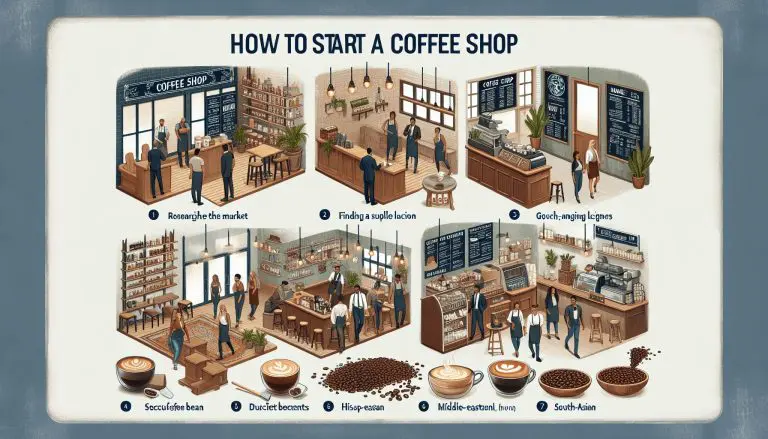
The nine stages of opening a coffee shop
The order matters more than the list. Each stage below gates the one after it, and skipping ahead is the most common way first-time owners lose money.
- Write the concept down in one paragraph. Who comes in, when, what they buy, what they pay.
- Build the numbers. Startup budget, monthly operating costs, and the daily sales figure you need to cover both.
- Find and secure the space. This is the longest stage and the hardest to undo.
- Apply for licenses and permits. Start the health department process the week you sign the lease.
- Design the build-out. Equipment layout drives plumbing and electrical, so the equipment list comes before the floor plan.
- Order equipment and set up suppliers. Lead times on espresso machines run weeks, sometimes months.
- Get found online. Your listing, menu and ordering page should be live before the doors open.
- Hire and train. Two to three weeks of training before you serve a paying customer.
- Soft open, then launch. A quiet week to break your own systems before you invite a crowd.
Stages three and two are where most of this guide’s depth lives, and both have their own full breakdowns: the coffee shop startup cost breakdown covers every line item with current ranges, and the guide to finding the best location for a coffee shop covers how to read a site before you commit to it.
Metrobi is transforming coffee deliveries
Specialized solutions for coffee businesses:
- Coffee-trained drivers
- Proper handling equipment
- Peak day delivery support
- 23% average cost reduction
Choosing a coffee shop concept and business model
Your concept is a set of constraints, not a mood board. Write down the hour of day you expect peak volume, the average ticket you need, and whether people sit down. Those three answers decide your square footage, your equipment and your staffing, which in turn decide most of your budget.
You have four business models to pick from, and they are different businesses, not variations on one:
- Independent from scratch. Full control, full risk, lowest entry cost, longest timeline.
- Buying an existing shop. You inherit a built-out space, a permit history and sometimes a customer base. You also inherit whatever is wrong with it.
- Franchising. The franchisor makes most decisions for you and charges for the privilege. Korona POS puts coffee franchise startup at $250,000 to $600,000 and up (Korona POS, February 2026). If you want to see what a franchisor actually asks of you, Scooter’s Coffee publishes its own guide to starting a coffee franchise alongside the territory and investment detail on its coffee franchising site. It is a concrete example of the commitments involved, whichever brand you end up considering.
- Kiosk, cart or drive-thru only. No dining room, far less build-out, and a model that leans hard on throughput. The NCA found drive-thru accounted for 55% of past-week out-of-home coffee purchases, which is why this format keeps growing. The operational specifics of that format are covered in how to start a drive-thru coffee shop.
A fifth option sits slightly outside the café world: roasting. If what you actually want is to sell your own coffee rather than serve drinks, read how to start a coffee roaster before committing to a retail lease. The economics, licensing and equipment are different enough that it is a separate decision, not a variation on this one.
How much does it cost to open a coffee shop?
Expect $80,000 to $400,000 for a bricks-and-mortar café, and $25,000 to $100,000 for a cart or kiosk. Korona POS’s February 2026 breakdown puts a seating-only shop at $80,000 to $275,000, drive-thru only at $100,000 to $300,000, both together at $200,000 to $400,000 and up, a kiosk at $50,000 to $100,000, and a mobile truck or cart at $25,000 to $85,000.
The three line items that move the total most are build-out ($30,000 to $150,000, or $150 to $300 per square foot), equipment ($15,000 to $40,000), and the first few months of rent, which ranges from $2,000 a month in the Midwest to $12,000 in New York City.
Two numbers people forget. Working capital, because you will pay staff and rent for weeks before revenue steadies. And hiring and training, which Korona puts at $10,000 to $25,000. The full line-by-line version, including how to stress-test the budget before you sign anything, is in the coffee shop startup costs breakdown.
Margins are thin enough that these decisions matter for years. Bellwether Coffee, citing the Specialty Coffee Association’s financial benchmark work, reports retail coffee shops running about a 6.86% profit margin (Bellwether Coffee). A shop that overpays on rent by $1,500 a month has to find roughly $22,000 in extra annual sales to stand still.
Picking a coffee shop location
The site decides more of your outcome than your coffee does. The practical benchmark from the trade press: keep rent under 15% of projected sales. Andy Anderson, writing in fltr magazine, works the example: $25,000 a month in rent needs north of $165,000 in monthly sales to be viable (fltr magazine, October 2025).
Before you sign, do the cheap work:
- Count traffic yourself, across several days, split into morning, midday, afternoon and evening. Volume at the wrong hour is not your volume.
- Check who the traffic is. A university block and a retiree neighbourhood support completely different menus and price points.
- Look at the neighbours. Complementary businesses feed you. A second café forty feet away does not.
- Test visibility and access. If drivers can’t see you a block out or park within reason, foot-traffic counts overstate your reality.
- Negotiate rent-free build-out months. Every week of construction you pay rent on is pure loss.
That is the summary. The full guide to choosing a coffee shop location goes through trade-area analysis, lease terms, infrastructure checks and the mistakes that only show up two years in.
Licenses and permits a coffee shop needs
Start this the week you sign the lease, because the health department’s calendar is not yours. The usual set:
- Business registration and an EIN from the IRS.
- A local business license from your city or county.
- A food service or food handler permit from the county health department, plus food-handler cards for staff.
- A certificate of occupancy confirming the space meets building, zoning and fire code.
- A seller’s permit or sales tax licence for your state.
- A sign permit, which catches people out surprisingly often.
- Liquor or beer and wine licensing only if you plan to serve alcohol, and that process runs on its own, much slower clock.
Korona POS puts the total permit and licence spend at $500 to $5,000. The money is not the problem; the sequencing is. Health department plan review usually has to happen before build-out, not after, and discovering that late can cost you a month.
Coffee shop equipment and build-out basics
Write the equipment list first, then design the floor plan around it. Plumbing, drainage, electrical load and ventilation all follow from the machines, and moving a drain after the slab is poured is expensive.
The core kit and current ranges, per Korona POS:
- Espresso machine: $5,000 to $20,000. A two-group machine handles most independent shops.
- Commercial grinder: $800 to $2,500 each, and you want at least two, one for espresso and one for everything else.
- Drip brewer: $500 to $2,000.
- Water filtration: $300 to $1,500. Cheap insurance, because water chemistry ruins more coffee than beans do.
- Refrigeration and back-of-house kitchen equipment: $5,000 to $15,000.
- POS system: $1,000 to $5,000.
Buy the espresso machine and grinders new or refurbished from a dealer who services them locally. Everything else (refrigeration, prep tables, shelving) is fair game used.
Where your coffee comes from: buying roasted beans or roasting your own
Most new shops buy roasted coffee from a local roaster, and that is the right call for almost everyone opening their first location. You get consistency, training support and no extra licensing, and you can change supplier if it isn’t working.
Roasting in-house is a second business bolted onto the first. Bellwether puts commercial roasters at $20,000 to $150,000, and the gas-roaster learning curve at six months or more before you’re happy with your own output. The upside is there, because roaster-retailers run about 65% gross margins against a retail shop’s thinner numbers, but it is a different operation with its own equipment, ventilation permits and labour.
If you are seriously weighing it, the detail is in how to start a coffee roaster, and the sales side of that business, which catches people out, is in how to get your first coffee roaster customers.
Getting your coffee shop found online before you open
Your listing and your menu should be live weeks before your doors are. People decide where to get coffee on a phone, usually within a few blocks of where they already are, and a shop with no menu online is a shop they can’t choose.
The ordering side has moved fast. The NCA’s Fall 2026 report found 40% of past-week out-of-home coffee buyers ordered on an app, a record high. That is now a mainstream behaviour, not an early-adopter one.
Three things to have ready on opening day: a claimed Google Business Profile with real hours and photos, a menu with prices that a phone can read without pinching, and a way to take an order that isn’t the phone ringing during your morning rush. The build is covered in detail in how to create a coffee business website.
Hiring and training baristas
Hire for temperament, train for skill. You can teach someone to pull a decent shot in a fortnight; you cannot teach someone to stay pleasant during a forty-person morning queue.
Budget two to three weeks of paid training before the first paying customer, and build it around the rush rather than around the coffee. Have your team work a simulated peak, twelve drinks on the board at once, because that is the only drill that reveals whether your bar layout and your sequencing actually function.
Write down your drink specs: dose, yield, time, milk temperature. A written standard is the only way a second barista makes the same latte as you do.
Soft opening and launch day
Open quietly first. Invite friends, neighbouring businesses and the people who were curious during build-out, charge them real money, and run one normal week.
The soft opening exists to break things cheaply. You will find that your pastry case is in the wrong place, that your POS modifiers are wrong, that one step in your closing routine takes twenty minutes longer than you planned. Fix those, then launch properly, with the local press, your Google listing populated and your social accounts live.
Planning for off-premise coffee orders
A third of coffee demand now happens somewhere other than home, and a growing share of it never crosses your counter. With 38% of coffee drinkers drinking away from home and 40% of out-of-home buyers ordering through an app, the question for a new shop is not whether to handle off-premise orders but how.
For most new shops that starts with pickup, which costs you nothing but a clear process and a shelf by the door. Delivery is the next step, and it’s worth planning for before you open: office standing orders, catering drops for a nearby business park, bean subscriptions for regulars. Shipping beans is a separate channel again, with its own economics. Dripshipper’s rundown of how to make money selling coffee online is a reasonable primer on what that model involves before you decide whether it belongs in your plan. That work needs a dependable way to get boxes across town, which for food and beverage businesses usually means either a staff member in their own car or a local delivery platform like Metrobi, built for food, floral, catering and wholesale businesses and designed around deliveries planned and posted ahead, one stop or fifteen, recurring or one-off.
Either way, decide before opening. Retrofitting a delivery program into a shop designed only for a counter queue is harder than designing for both from the start.
Frequently asked questions
How long does it take to open a coffee shop?
Six to twelve months is normal, across eight overlapping phases, according to WebstaurantStore. Permitting and build-out dominate the timeline. If you take over a space that was already a café with current permits, you can compress it considerably.
How much money do I need to start a coffee shop?
Korona POS’s 2026 figures put a seated café at $80,000 to $275,000, a drive-thru at $100,000 to $300,000, and a cart or truck at $25,000 to $85,000. Add working capital on top, enough to cover several months of rent and payroll before sales stabilise.
Is a coffee shop profitable?
Thinly, and only when run well. Bellwether, citing SCA benchmark data, reports about 6.86% profit margins for retail coffee shops, rising to 8.79% for shops that also roast and 11.92% for operations combining retail and wholesale.
Do I need experience to open a coffee shop?
Not formally, but you need it somewhere in the building. If you have never worked a bar during a rush, either spend a few months doing it or hire a lead barista who has. The difference shows up in your labour costs within the first month.
Should I buy a coffee shop instead of starting one?
Buying is faster and the permits usually transfer, so it suits anyone short on time or build-out appetite. It also means inheriting the previous owner’s equipment, lease terms and local reputation, so price the due diligence in.
What to do this week
Opening a coffee shop is a sequencing problem disguised as a coffee problem. The owners who get it right do three things early: they write the concept down in a paragraph they can defend, they build a budget with working capital in it, and they refuse to sign a lease until they’ve counted traffic themselves on more than one day.
Start with the money and the site, because those two are the hardest to change later. Work through the full cost breakdown until your opening budget survives a bad month on paper, then go and stand on the pavement outside the three spaces on your shortlist and count.