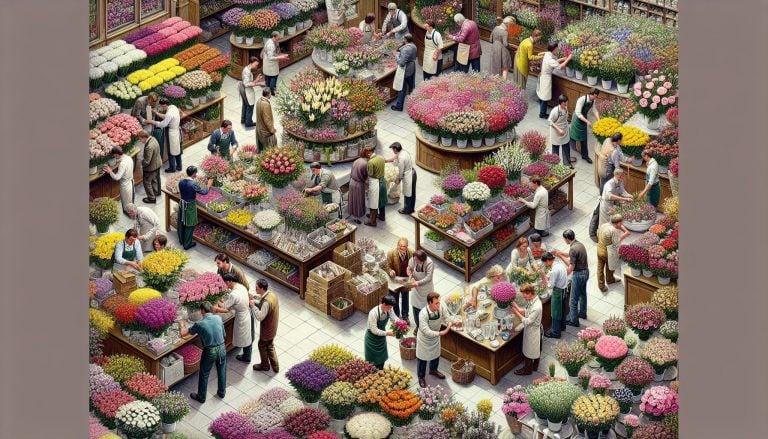

A flower shop does not have a busy season. It has about fourteen brutal days spread across the year, and roughly 250 ordinary ones. That is the whole problem with florist payroll: the team that comfortably runs a Tuesday in October cannot physically process Valentine’s Day, and the team that can process Valentine’s Day would bankrupt you by March.
Temporary florist staffing is how you resolve that without over-hiring. This post covers the peak-season side specifically: how to forecast how many extra people you need, where to find them, what to pay them, how to onboard someone in a single shift, and how to schedule the week so the surge does not collapse into chaos. For the standing team, meaning which roles a shop needs year-round and what they cost, see the main guide to florist staffing.
The Bottom Line
- Valentine’s Day accounts for about 30% of annual flower and plant purchase transactions and 28% of dollar volume, more than Christmas or Mother’s Day (Society of American Florists / IPSOS, 2022).
- Consumers were projected to spend $3.1 billion on flowers for Valentine’s Day 2026, so the demand spike is real money, not just a busy feeling.
- Plan temps around tasks that take minutes to teach (stripping, boxing, phones, driving) and keep design and order-taking with trained staff.
- Hire and onboard before the week starts. A temp who first walks in on 13 February is a cost, not a help.
Boost customer satisfaction with just a few clicks
Most-Loved Features:
- On-demand drivers
- Real-time GPS tracking
- Delivery confirmation photos
- Over 50% of customers report a smoother delivery experience
Which flower shop holidays actually need extra staff
Not every holiday deserves extra payroll. The three that reliably do are Valentine’s Day, Mother’s Day and the local wedding season; the rest are usually absorbed by overtime and a Saturday.
| Peak | Share of annual floral transactions | Shape of the demand | Extra hands usually needed |
|---|---|---|---|
| Valentine’s Day | ~30% of transactions, 28% of dollars | One or two days, enormous delivery volume, mostly roses | Boxing, delivery, phones |
| Christmas / Chanukah | ~26% of transactions, 29% of dollars | Spread over three weeks, higher value per order | Design support, retail floor |
| Mother’s Day | ~26% of transactions, 24% of dollars | One weekend, heavy on arrangements and plants | Design support, delivery |
| Wedding season | Varies by market | Clustered Fridays and Saturdays, long build days | Prep, setup crew, transport |
Shares are from the Society of American Florists’ IPSOS consumer poll (SAF, 2022). The operational difference matters as much as the size: Valentine’s Day is a logistics problem compressed into 48 hours, while Christmas is a six-week endurance problem. Valentine’s needs drivers and packers. Christmas needs someone who can hold the retail floor while you design.
Metrobi is transforming flower deliveries
Specialized solutions for flower businesses:
- Flower-trained drivers
- Proper handling equipment
- Peak day delivery support
- 23% average cost reduction
How many temporary staff a flower shop needs for Valentine’s Day
Work backwards from orders, not from a feeling. Take last year’s Valentine’s order count, split it into walk-in, phone or web, and delivery, and apply rough throughput:
- Design: a trained designer produces roughly 8 to 15 standard dozen-rose arrangements an hour once the roses are processed and the vases are prepped. Prep is the bottleneck, not design.
- Processing and boxing: one person can strip, hydrate and box for about two designers.
- Delivery: a driver in a city completes roughly 10 to 15 stops an hour with tight routes, and far fewer with apartment buildings and office towers.
- Phones and counter: one person per 40 to 60 orders a day, more if you take complex orders.
So a shop doing 400 Valentine’s deliveries against a normal day of 25 is not looking for “an extra pair of hands.” It needs two or three processors, extra delivery capacity, and someone on the phone full-time. Delivery is usually the piece that breaks first, and it is cheaper to buy capacity than to hire for it, and the comparison between payroll drivers and couriers is in the guide to flower delivery drivers.
Build the plan in writing six weeks out, with names against shifts. Vague intentions do not survive 13 February.
Where to find temporary floral designers and helpers
The hiring pool for skilled floral work is tight. The Bureau of Labor Statistics counts about 45,200 floral designer jobs in the US and projects employment to decline 6% from 2025 to 2035 (BLS Occupational Outlook Handbook, May 2025 data). You are not going to find three experienced designers in February. You will find helpers, and that is fine, because most peak work is not design.
Sources that actually produce people:
- Last year’s temps. Keep a list with phone numbers and a note on who was good. This is the single highest-return habit in seasonal staffing.
- Staff family and friends. For two days of boxing, trust and attendance beat experience.
- Students and teachers. February and May line up badly with exams but well with people wanting short, paid, intense work.
- Retired florists in your area. One experienced hand on design for two days is worth four helpers.
- Local floral schools and design courses. Students want the hours and the exposure.
- Temp and event staffing agencies. Fastest option, highest hourly cost, least floral knowledge. Good for packing and runners.
- Your own customers. A regular who adores your shop will often take a holiday shift.
Ask early. Anyone good is already booked by the first week of February.
What to pay temporary florist staff
Pay the market rate for the task, not a “temp discount.” Helper and packer work in most US markets sits in the low-to-mid teens an hour; experienced seasonal designers command well above the $37,360 median annual wage for floral designers (BLS, May 2025) when converted to a holiday hourly rate, because they know you have no alternative.
Three things to budget alongside the wage:
- Overtime for your permanent staff, which is usually the larger number.
- Food. Feeding ten people for two days is trivially cheap next to the productivity of people who did not leave for lunch.
- A completion bonus. A modest bonus paid for finishing the full committed schedule solves the one real risk with temps, which is someone not turning up on day two.
Keep these costs in a separate account line so you can see what each holiday actually earned you. Peak-season labour, overtime and temp agency fees get lost in general payroll otherwise, which is one of the categories the florist bookkeeping guide recommends tracking on its own.
Onboarding seasonal staff in one shift
A temp needs to be productive within 30 minutes. That only happens if you have decided in advance what they will do and prepared the station.
- One station, one task. “You strip and hydrate at this table” is a job someone can do well by 9:30. “Help out wherever” produces an expensive bystander.
- A physical sample. Put a finished, approved example of the arrangement in front of them. Nobody learns a recipe from a verbal description under pressure.
- A one-page sheet per station. Stem length, number of stems, which greens, which vase, where finished work goes.
- Name the person they ask. One named buddy, not “anyone.”
- Safety in two minutes. Knives, buckets, wet floors, the walk-in door, lifting.
- Say what finished looks like. Quality standard, shown rather than described.
Front-load the attention. Across retail, 22% of staff attrition happens inside the first 30 days (Boostpoint analysis of BLS data, retrieved 2026-11-02), and a temp’s whole tenure is shorter than that window. Their first hour is effectively their entire onboarding.
Peak season scheduling for a flower shop
Three scheduling decisions carry most of the week:
Stagger your start times. Processing has to run ahead of design, and design has to run ahead of delivery. If everybody starts at 8am, the designers stand idle while roses are still in boxes, and the drivers stand idle until noon, then work until 10pm. Bring processors in first, designers an hour or two later, drivers later still.
Protect the pre-build day. The day before the holiday is for prepping vases, cutting greens, hydrating roses and building anything that holds. Shops that build nothing in advance are not short of staff, they are short of hours.
Schedule the recovery. The day after a major holiday is for cleaning, counting, and sending people home early. Booking a normal full day after Valentine’s Day is how you lose two good employees in March.
Write the schedule down, post it, and give it to people at least two weeks ahead. Holiday schedules sprung on staff with three days’ notice are the most common avoidable reason a shop loses someone right before its busiest week.
Which jobs to give temps and which to keep in-house
The rule is simple: temps take the tasks where a mistake is cheap and recoverable.
Good temp work: stripping and hydrating stems, boxing and bagging, water-filling, ribbon and card prep, cleaning, running arrangements out to vehicles, delivery, breaking down cardboard, simple repeat recipes once shown.
Keep in-house: order taking and consultative selling, wedding and funeral work, anything bespoke, price changes, substitutions, and resolving an unhappy customer. These depend on judgement that takes months to build, which is the part of the counter role covered in the guide to training flower sales associates.
The one exception worth making is phones. If a temp is articulate and you give them a script with a clear escalation rule, taking straightforward dozen-rose orders off your senior staff is the highest-value thing a temp can do on 13 February.
After the holiday: who to keep
Every peak season is a two-day interview with no interview questions. Before you pay people out, write down the three or four who were good: the ones who showed up early, worked clean, asked sensible questions, and stayed pleasant at hour nine.
Then do two things. Tell them, specifically, that they were good and that you want them back for Mother’s Day. And add them to the list you keep for next year. Rehiring someone who already knows your buckets, your recipes and your walk-in door removes the onboarding cost entirely, which is why experienced shops treat the temp list as an asset rather than a one-off expense. Against a replacement cost of roughly $5,000 for an hourly retail worker once recruiting and training are counted (Boostpoint, retrieved 2026-11-02), a seasonal hire who converts to permanent is the cheapest hire you will make all year.
Frequently asked questions
How far in advance should a flower shop hire temporary staff?
Six weeks before Valentine’s Day and Mother’s Day, four weeks before Christmas. The good candidates, meaning students, returning temps and retired designers, commit early, and anyone still available in the final week is available for a reason.
Can you hire temporary florist staff through an agency?
Yes, and agencies are the fastest option when you are short. Expect to pay a significant premium over a direct hire and expect no floral knowledge, so use agency staff for packing, cleaning, running and delivery rather than for design or order taking.
What is the biggest mistake shops make with seasonal staffing?
Hiring enough hands but not preparing stations for them. Ten people with no prepped vases, no sample arrangement and no assigned task produce less than four people with all three.
Should temporary staff handle flower deliveries?
They can, and on Valentine’s Day they often must. Make sure they are insured to drive whatever they are driving, give them the one-page loading and awkward-case sheet you use for permanent drivers, and keep timed deliveries (funerals, events, hospitals) with someone experienced. The driver-specific detail is in the guide to flower delivery drivers.
How do you keep quality consistent with temporary staff?
A visible approved sample at each station, a per-station recipe card, and one experienced person doing a final check before anything is boxed. Quality control is a station, not an attitude.
Plan the peak, not the panic
Temporary florist staffing works when it is a plan with names on it six weeks out, and fails when it is a scramble on the 12th. Forecast from last year’s order count rather than from memory, buy delivery capacity instead of hiring for it, give temps narrow tasks at prepared stations, stagger the start times so processing stays ahead of design, and write down who you want back. The holiday will still be exhausting. It will not be out of control.