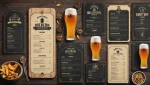
Your online brewery menu is the only menu most of your customers will ever read carefully. They read it on a couch, deciding whether to come. They read it in a car, deciding whether to stop. They read it at 10 p.m. wondering if you still have that hazy IPA in four-packs.
And in a lot of taprooms it’s a photo of a chalkboard taken in March.
That gap is expensive, because the online version is doing a different job than the board behind the bar. The board sells the next pint to someone already standing in your room. The online menu decides whether they get in the car at all, and whether they order anything before they arrive. This guide covers what to put on it, where to host it, how to keep it accurate while your taps rotate, and how to turn it into a to-go channel. What goes on the menu as a matter of content, from descriptions to pricing tiers to section order, is covered in the complete guide to brewery menu ideas.
The Bottom Line
- An online menu is not a replacement for a printed one. US Foods’ 2024 Diner Dispatch survey found 90% of diners prefer print menus over QR codes, up from 74% a year earlier. Run both.
- The online menu’s real jobs are pre-visit research and off-premise orders. Optimise for those, not for the guest already at the bar.
- Accuracy beats design. A beautiful menu listing a beer that blew on Thursday does more damage than a plain one that’s right.
- Vendors quote digital menu board setups around $1,500 to $3,500 with $75 to $150 a month in software. Those are vendor figures, so get your own quotes.
- Separate your draft list from your to-go list. They have different buyers, different pricing and, in many states, different legal limits.
Metrobi drivers are rated 4.97/5
Trusted by local businesses for:
- Background-checked professionals
- Specialized in business deliveries
- Same drivers for consistency
- 4.97/5 average delivery rating
What an online brewery menu is actually for
Start here, because it changes every decision that follows: most of your guests don’t want a phone menu once they’re inside.
US Foods surveyed more than 1,005 US adults in April 2024, weighted to reflect the general American population, and found 90% preferred printed menus over QR codes, up sharply from 74% in 2023. The shift held across generations, with baby boomers at 95% and Gen Z at 90%, the latter up from 69% the year before (US Foods 2024 Diner Dispatch survey).
Read that as a correction, not a verdict against digital. QR menus got deployed in 2020 as a substitute for paper, and as a substitute they’re unpopular. As a channel they’re indispensable, because they serve the moments paper can’t:
- Before the visit: Somebody deciding between your taproom and two others, on their phone, from home.
- Off-premise: Four-packs, crowlers, growler fills, food for pickup. The person ordering can’t see your board.
- The detail paper can’t hold. Full tasting notes, allergen information, what’s new this week, what’s nearly gone.
- Anything that changes faster than you can print. Which is, in a brewery, most of it.
So the design brief isn’t “put the menu online.” It’s “build the version a stranger reads before they’ve chosen you, and the version a regular orders from when they’re not here.”
Metrobi is transforming beverage deliveries
Specialized solutions for beverage businesses:
- Beverage-trained drivers
- Proper handling equipment
- Peak day delivery support
- 23% average cost reduction
What belongs on an online brewery menu
The online version carries more detail than the in-room one, because screen space is cheap and the reader is leaning in rather than standing at a rail.
For each beer:
- Name and style, plainly: Same rule as the printed list. A clever name without a style tells an out-of-towner nothing.
- ABV: Guests planning a visit are planning their evening.
- Pour sizes and prices: Leaving prices off a public menu makes people assume the worst.
- Tasting notes, a short sentence. Online you have room for a real description rather than three adjectives.
- Availability: “On tap now”, “cans only”, “last keg”. This is the single most valuable field and the one most often missing.
For the menu as a whole:
- A clear last-updated date or timestamp. It tells a reader whether to trust the list, and it tells you when you’ve let it slip.
- The food list, if you have one. A guest deciding where to eat needs to know food exists. Whether and how you run food at all is a separate decision, covered in serving food at your brewery.
- The to-go section, as its own block. Different products, different prices, different rules.
- Hours and whether the kitchen or the food truck is in tonight. Half the people reading your menu are really asking “are you open and is there food.”
What to leave out: photos of every beer, long brewing stories, and a PDF. The PDF deserves its own sentence. A PDF menu on a phone requires pinching, zooming and scrolling sideways, and search engines read it poorly. If you only have a designed PDF today, keep it as the printable version and build a plain HTML page as the real menu. Design files are for printing, and the best brewery menu templates and examples cover that side of it.
Where to put your brewery menu: website, QR code, or a screen behind the bar
Most breweries need two or three of these. The thing that matters is that one of them is the source of truth and the others are built from it.
| Channel | Who it serves | Update speed | Watch out for |
|---|---|---|---|
| Page on your own website | Pre-visit research, search traffic | As fast as your CMS | Easy to forget; often the most out-of-date thing you own |
| QR code on tables | Guests wanting detail, off-premise ordering | Instant | Unpopular as a paper replacement; dead with bad signal |
| TV menu board behind the bar | Everyone standing at the rail | Seconds, from one dashboard | Hardware cost; a blank screen if it fails |
| Third-party listing sites | Discovery by people who don’t know you | Depends on the platform | You don’t control it, and stale listings reflect on you |
| Printed sheet or card | The 90% who prefer paper | Reprint | Goes stale the moment a tap blows |
The combination that works for most taprooms: a web page as the master, a screen or chalkboard for the room, a short printed card at the tables, and a QR code that goes to the to-go and order-ahead menu rather than to a copy of the list on the table.
That last point is worth repeating, because it’s the easy win. Pointing a QR code at the same list the guest is already holding adds nothing. Pointing it at “order a four-pack to take home” adds a transaction.
Keeping a rotating tap list accurate
This is the whole game, and it’s an operations problem rather than a design one. A brewery that changes four taps a week has a menu that’s wrong four times a week unless somebody owns updating it.
What works:
- Make it one person’s job, by name, on a shift. Not “the team”. A closing or opening duty with a checklist line.
- Update at the moment the keg changes, not later. The person who taps the keg is the person who should change the list. Anything that waits for a manager waits a day.
- Pick a system someone can update from their phone in under two minutes. If it needs a laptop and a design file, it won’t happen on a Friday.
- Mark beers as gone rather than deleting them silently. “Just blew” is useful information and it’s honest. A beer that vanishes without a note makes guests think they imagined it.
- Audit once a week against the actual taps. Walk the bar with the online menu open. It takes five minutes and it’s always worth it.
Vendors building in this space describe a 30-to-60-second edit cycle from a phone, with POS-integrated setups marking items sold out automatically (Raspberry Pints, January 2026; vendor documentation, not independent research). Automatic sold-out syncing is the feature worth paying for if your POS supports it, because it removes the human step that always fails.
What digital menu boards for breweries cost
Hard numbers in this category come almost entirely from the companies selling the systems, so treat them as a starting range and get quotes.
Evergreen’s 2026 guide for breweries puts initial setup at $1,500 to $3,500 for hardware and software combined, with $75 to $150 a month in software after that, and compares it against $600 to $1,200 a year in reprinting for a menu that changes often. It recommends 55-to-75-inch screens for most taprooms and claims a 12-to-18-month payback (Evergreen, May 2026).
Two caveats, because this is a vendor’s own arithmetic. The payback assumes you were reprinting frequently, which not every brewery does. If your list lives on a chalkboard, your current cost is chalk. And the published sales-lift figures in this category (claims of 18% to 25% increases in beer sales) are vendor case studies with no stated methodology or control, so they aren’t a basis for a budget.
The honest case for a screen isn’t a sales-lift percentage. It’s that one dashboard can update the board, the website and the QR menu at once, which solves the accuracy problem that actually costs you orders.
If you’re not ready for that, a locally hosted web page you edit in a text field and a chalkboard you wipe is a completely legitimate setup. Keeping two things in sync by hand is manageable. Keeping five is not.
Turning your online menu into to-go and delivery orders
An online menu becomes a revenue channel the moment somebody can act on it without driving over. Three steps, in order of how much they return.
First, make the to-go list a real list. Cans, four-packs, crowlers, growler fills, merch, and whatever food travels. State container sizes in terms a non-regular understands, such as “32 oz crowler, about two pints”, and state prices. A to-go section that reads as an afterthought gets treated as one.
Second, put the legal limits on the page. Off-premise rules for breweries vary sharply by state, and some cap volume per customer or restrict which containers you may fill. Montana permits breweries to sell up to 48 ounces to-go per customer per day; Colorado allows growler and crowler fills only into new, unused containers no larger than 64 ounces (Park Street; 5280). Check your own state’s rules, then publish them. It saves an argument at the register and it stops a customer planning an order you can’t legally fill.
Third, add order-ahead before you add delivery. Pickup is the lower-risk version: no vehicle, no temperature liability on the road, no third-party commission. Get the ordering flow working and the pack-and-hold process reliable, then extend it.
Off-premise is where the restaurant industry’s volume has gone. The National Restaurant Association’s 2026 State of the Industry report found that delivery, takeout and curbside now account for more than half of total traffic at the average restaurant (reported by Fast Casual, February 2026). Breweries have structural limits restaurants don’t, since you can’t ship a pint, but the four-pack someone orders on their phone at 4 p.m. is the same behaviour.
Two practical notes on fulfilment. Hold times matter more than you’d think for beer: a crowler filled at noon for a 7 p.m. pickup is a worse product than one filled at 6:45. And if food is going out with the beer, only put travel-tolerant items on the pickup list, because the fried thing that’s perfect at the bar is a complaint twenty minutes later.
Making your online brewery menu findable
A menu nobody can find doesn’t sell anything, and breweries lose this one in predictable ways.
- Put it on its own page with a readable URL. Not inside a slideshow on the homepage, not a PDF download, not an image.
- Use real text, not a picture of text. An image of a menu is invisible to search engines and to screen readers.
- Keep your hours and address on the same page. It’s the second thing every reader wants and it stops them bouncing to find it.
- Claim and update your third-party listings. People search for breweries on maps and listing sites before they search your site. A stale listing elsewhere outranks a current menu at home.
- Don’t hide the to-go list behind the draft list. If somebody arrives looking to buy cans, make that reachable in one tap.
Online menu mistakes that cost you orders
- No date on the menu. Readers can’t tell whether to trust it, so they assume it’s old.
- A beer listed that blew last week. The most common complaint a taproom gets about its website, and the easiest to prevent.
- Prices missing: Reads as evasive, and sends price-sensitive guests elsewhere without asking.
- A QR code that points at a PDF. Two layers of friction to read a list.
- No non-alcoholic option on the page. The designated driver is often the one choosing the venue.
- Food listed that isn’t available tonight. If you run food trucks, the schedule belongs on the menu page, not only on social media.
Frequently asked questions
Do breweries still need QR code menus?
As an ordering and off-premise channel, yes. As a replacement for a paper menu at the table, no. US Foods’ 2024 survey found 90% of diners prefer printed menus over QR codes. Use the QR code to reach something paper can’t do, like a to-go order.
What’s the best way to keep an online brewery menu current?
Make it one named person’s shift duty, updated at the moment the keg changes, using a system editable from a phone in under two minutes. If your POS can mark items sold out automatically, use that.
Should a brewery menu be a PDF or a web page?
A web page. PDFs are hard to read on phones, poorly indexed by search engines, and inaccessible to screen readers. Keep a PDF as the printable version if you need one, but don’t make it the primary menu.
How much does a digital menu board cost for a brewery?
Vendors quote roughly $1,500 to $3,500 to set up and $75 to $150 a month for software, with 55-to-75-inch screens recommended for most taprooms. Those figures come from the companies selling the systems, so collect local quotes before budgeting.
Can breweries sell beer to-go through an online menu?
In most states, within limits, but the limits differ substantially, covering container type, container size and volume per customer per day. Confirm your state’s rules, then publish them on the menu so customers don’t build an order you can’t fill.
Where to start
If your online menu is currently a photo or a PDF, replace it with a plain text page this week. Nothing else on this list matters as much, and it costs an afternoon.
If you already have a text page, the next job is accuracy: assign the update to a named shift duty and audit it against the taps once a week. Then, and only then, build the to-go section out into something someone can order from.