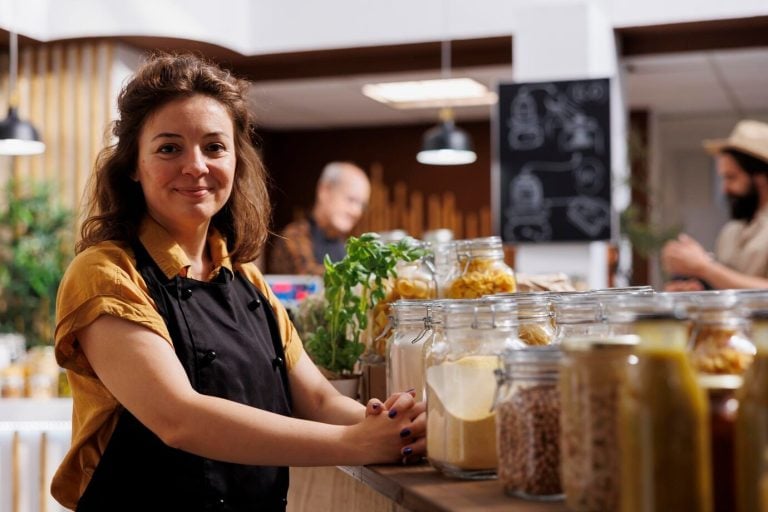

Food entrepreneurship is the work of turning a food idea into a business that survives without you holding it up every day. Most of that work is not cooking. It is demand testing, pricing, cash management, sourcing, hiring and fulfillment: the decisions that determine whether a product people like becomes a company that pays.
That distinction is the whole subject. Plenty of people can make something worth buying. The gap between that and a durable business is a specific, learnable set of operator skills, and this guide is about those skills rather than about which idea to pick. If you have already settled on a model and want the mechanics of capital, suppliers, permits and margins, the step-by-step guide to starting a profitable foodstuff business covers that sequence in detail. This piece is about whether and how you run it.
Save 80% of delivery management time
We handle everything:
- Dedicated operations manager
- Real-time tracking dashboard
- Automated customer notifications
- Urgent issue resolution
Key takeaways
- Food entrepreneurship is a management discipline. Culinary skill is the entry ticket, not the differentiator.
- The “90% of food businesses fail in year one” claim is not true. U.S. Bureau of Labor Statistics research puts first-year restaurant survival at 83.1%, better than the 79.6% average across all small businesses.
- Running out of cash, not a bad product, is the dominant failure mode. Undercapitalization kills businesses during a slow month.
- Validate demand with real money from strangers before you commit to stock, equipment or a lease. Friends buying once is not validation.
- Margins in food are tight, commonly 3–5% net in food service, so one unmeasured cost line can erase your profit entirely.
What does a food entrepreneur do?
A food entrepreneur starts and runs a business in the food sector: a packaged product, a catering operation, a bakery, a meal-prep service, a food truck, a specialty supply business. The job description, though, looks almost nothing like the job people imagine when they start.
On any given week, the work is: deciding what to make and how much, negotiating with suppliers, setting prices that survive a cost increase, tracking what actually sold against what you thought would sell, handling the regulatory paperwork, getting orders to buyers on time, and managing money you have not yet received against bills already due.
Culinary schools are blunt about this. Ecole Ducasse’s guide to food entrepreneurship and the Culinary Institute’s piece on becoming a food entrepreneur both land on the same point. Beyond cooking ability, a food entrepreneur needs business acumen: financial reporting, strategic planning, cost control. The USDA maintains a food entrepreneurship resource hub for the same reason. The technical craft is assumed; the management is where people arrive unprepared.
The practical version: if you want to spend your days cooking, you want a job in a kitchen. If you want to spend your days deciding, you want to be a food entrepreneur. Both are legitimate. Confusing them is what makes the first two years miserable.
The real food business failure rates
The number you have heard is wrong, and it is worth correcting, because it causes people to either avoid the field entirely or treat failure as inevitable and plan accordingly.
Research from the U.S. Bureau of Labor Statistics and UC Berkeley, in the paper Restaurant Mortality in the Western US, found that about 17% of restaurants fail in their first year. Survival is 83.1% at one year, 51.4% at five years, and 34.6% at ten. For comparison, the one-year survival rate across all U.S. small businesses is 79.6%. Food businesses are not unusually fragile. They are slightly more durable than average in year one, and they thin out over the following decade like everything else.
The widely repeated “90% fail in the first year” figure has no study behind it; Owner’s analysis traces it to an unsourced television advertisement.
What the real numbers tell you is more useful than the myth. Most food businesses do not die at launch. They die somewhere in years two through five, which is a cash and operations problem rather than a product problem. The named causes are consistent across operator surveys: undercapitalization (too little cash reserve, so a slow month becomes terminal), no financial tracking, guessing at profit instead of calculating it, and poor product-market fit that persists because nobody measured it. Food service operates on roughly 3–5% net margins, and recent operator data suggests about 42% entered 2026 unprofitable. On those margins, there is no room for an untracked cost.
So the planning implication is not “beat the odds at launch.” It is “survive year three,” and that is a function of reserve cash and measurement.
Skills a food entrepreneur needs beyond the kitchen
Five capabilities, in the order they tend to bite.
- Unit economics. You must be able to state, from memory, what one unit of your product costs you fully loaded: ingredients, packaging, labor, a share of overhead, and the cost of getting it to the buyer. Most founders know the ingredient cost and guess the rest. The guess is where the margin goes.
- Cash-flow literacy. Profit and cash are different things, and food businesses routinely die profitable. You buy stock now and get paid in thirty days. Knowing your cash position four weeks forward is a weekly discipline, not an annual one.
- Sourcing and negotiation. Your suppliers set your cost base, so your ability to hold a price, secure terms, and keep a second source for every critical item is a direct input to your margin.
- Demand reading. Tracking what sold, in what quantity, to whom, and whether they came back. This is the skill that most reliably separates operators who grow from operators who stay the same size for a decade.
- Delegation. The ceiling on a founder-run food business is the founder’s hours. Every hour you spend on something a process or another person could do is an hour not spent on the decisions only you can make.
Notice that none of these are culinary. The craft gets you a product worth selling once. These get you a business.
How to validate a food product before you spend real money
Validation means strangers paying full price, repeatedly, without a personal relationship to you. Everything short of that is encouragement, not evidence.
A sequence that costs very little:
- Sell at small scale first, in person. A farmers’ market stall, a pop-up, a market day, a single wholesale account. You get price feedback, objection feedback and repeat-rate data in weeks rather than quarters.
- Price at your target from day one. Introductory pricing teaches you what people will pay for a discount, which is not information you can use.
- Record every transaction, including the refusals. What someone nearly bought and why they did not is the most valuable data you will collect, and it disappears if you do not write it down that day.
- Watch the second purchase, not the first. First purchases measure curiosity. Second purchases measure the product. A product that sells well once and does not repeat is a problem that gets worse at scale, not better.
- Test the awkward version. Can you make forty of these in a day? Will the packaging survive a drive? Does the margin hold when you deliver it instead of handing it over? Scale exposes problems the prototype hides.
Give yourself a number to beat before you start, and write it down. “I need 30% of first-time buyers to buy again within six weeks” is a decision rule. “I’ll see how it goes” is not, and it tends to resolve in favor of continuing regardless of what the data said.
Which kind of food business is most profitable?
It depends on your capital, your tolerance for fixed costs and the hours you can realistically work. That sounds like a dodge, so here is the structural answer.
Margin per unit is highest in specialty, premium and value-added products such as prepared foods, artisan goods and branded packaged items. Specialty food has been growing at several times the rate of conventional food, and buyers in that segment are less price-sensitive. The catch is slower turnover and a narrower market.
Return on capital is often better in lower-margin, faster-moving businesses. Dry goods supply, staple reselling and high-frequency catering recycle your working capital many times a year, which can beat a high-margin product that sells through slowly.
Lowest-risk is usually a service with little inventory and no lease, such as personal chef work, small-scale catering or meal prep to order, where you buy against orders already placed rather than against a forecast.
The reliable predictor of profitability is not the category. It is order frequency. A business with customers who buy weekly on a standing arrangement will out-earn a higher-margin business with customers who buy twice a year, and it will be far easier to run, because predictable volume is what makes purchasing, staffing and delivery cheap.
What is the easiest food business to start?
Easiest to start usually means lowest capital, lightest regulation and no lease. In practice that points to the same short list:
- Cottage food products — shelf-stable baked goods, jams, granola, spice blends, sauces where permitted. Several states require no license at all for these, within a sales cap.
- Catering and personal chef services — you cook against confirmed orders, so inventory risk is minimal and you can often use a rented commercial kitchen by the hour.
- Meal prep to order — subscription-shaped revenue with predictable volume, which makes purchasing straightforward.
- Reselling and supply — buying food goods in bulk and selling onward requires no production at all, and the permit question is comparatively simple. The foodstuff business guide walks through capital, suppliers and licensing for this route specifically.
Two caveats. Easy to start is not the same as easy to run. A cottage food operation with twenty wholesale accounts is a demanding business. And the thing that most often turns an easy start into a stuck business is fulfillment: once orders exist in more than one place at once, somebody has to drive, and that somebody is usually you. Working out early whether you will run deliveries yourself or hand them to a local delivery service that handles food, with its temperature control, narrow windows and proof of delivery, is a decision that shapes how large the business can get before it breaks. Metrobi exists for exactly that handoff, across bakery, catering, meal prep, food product and wholesale operations.
How to become a food entrepreneur: the first 90 days
A concrete sequence that produces evidence rather than plans.
Weeks 1–3. Pick one product or service. Confirm what your state requires to sell it legally, and what the sales ceiling is. Cost one unit fully loaded and set a real price.
Weeks 4–7. Sell to strangers at that price, in person, at least four separate times. Record every sale, every refusal and every piece of feedback the same day.
Weeks 8–10. Measure the repeat rate against the number you wrote down in week one. Fix pricing or product before considering anything else.
Weeks 11–13. If the repeat rate held, find one business account: a café, a shop, an office, a caterer. One recurring buyer teaches you more about operating this business than fifty individual sales, because it forces you to be consistent on a schedule.
What you should not do in the first 90 days: sign a lease, buy major equipment, build a complex brand, or expand your product range. Each of those converts flexible cash into a fixed commitment before you know what you are committing to.
Knowing when to grow, and when growth will break you
Growth is the stage where competent food businesses most often fail, because the constraint shifts without warning. Demand stops being the problem and capacity becomes the problem: kitchen hours, storage, cash tied up in stock, and the logistics of getting more orders to more places.
Three signals that you are ready:
- Your repeat rate is stable or rising at current volume. Growing on a falling repeat rate multiplies a leak.
- You know your fully loaded cost per unit, including fulfillment, and it holds at the next volume tier rather than being assumed to.
- You have cash reserve covering a slow month at the new cost base, not the old one.
Three signals you are not:
- You are the only person who can produce the product, and you are already at your hours.
- Your delivery cost per order is unmeasured, or you are absorbing it to win accounts.
- Your biggest customer is more than about a third of revenue. Growth that deepens that concentration increases risk rather than reducing it.
The growth decision is mostly a cash decision wearing an ambition costume. When the numbers above are in place, growth is a calculation. When they are not, it is a bet, and the failure data says most food businesses lose that bet in year three rather than year one.
Frequently asked questions
What is food entrepreneurship? Starting and running a business in the food sector, whether product, service, supply or distribution, and holding responsibility for its product decisions, costs, compliance and growth. It is a management role built on top of food knowledge.
Do I need culinary training to be a food entrepreneur? No. Formal programs exist and are useful for technical and food-safety knowledge, but the capabilities that determine survival are financial and operational. Many successful food entrepreneurs hire the culinary skill and keep the management.
How much do food entrepreneurs earn? It varies enormously with model and scale, and early years are usually reinvestment rather than income. A useful planning assumption is that food service runs on roughly 3–5% net margin, so owner earnings track revenue volume closely.
What is the biggest reason food businesses fail? Running out of cash. Undercapitalization and the absence of real financial tracking show up far more often than a bad product does.
How do I know if my food product will sell? Sell it to strangers at full price and count how many buy a second time. Set your pass mark before you start testing, and treat anything short of it as a reason to change the product or the price rather than to push harder.
The two numbers to track from the start
If you take a single thing from this: measure your repeat rate every month, and know your fully loaded cost per unit by heart.
Those two numbers tell you whether the product works and whether the business works, and they are the two that founders most often leave to instinct. Food entrepreneurship rewards the operator who checks. The craft gets you to the first sale; the measurement gets you to year five.