
The fastest way to increase restaurant sales in 30 days is to sell more to the people already walking in or ordering out, not to go hunting for strangers. Raising your average check, moving takeout orders onto a channel you own, and re-opening a catering line you already have the kitchen for all pay off inside a month. Paid advertising, a new concept, or a second location do not.
That ordering matters more than the tactics themselves. Most of what gets written about restaurant sales is a flat list of fifty ideas with no sense of which ones return cash before rent is due again. Below are ten, arranged roughly by how quickly each one shows up in your numbers.
The Bottom Line: Start with check size and your off-premises channels. They cost nothing to change, they move revenue within days, and they compound with everything further down the list.
Save 80% of delivery management time
We handle everything:
- Dedicated operations manager
- Real-time tracking dashboard
- Automated customer notifications
- Urgent issue resolution
What counts as restaurant sales
Restaurant sales is every dollar of revenue the business takes in: dine-in food and beverage, takeout, delivery, catering, retail items, gift cards, merchandise, private events, and packaged goods you sell at the counter. It is the top line, before food cost, labor, rent, or anything else comes out.
Hold onto that distinction, because growing sales and making money are two separate projects. The National Restaurant Association’s 2026 State of the Restaurant Industry report puts industry sales at a record $1.55 trillion, and in the same breath reports that 42% of operators were not profitable in 2025. Record revenue and no profit, at the same time, in the same industry. The gap between what a restaurant grosses and what its owner takes home is wide enough that the two numbers need separating in your head before you start.
So treat this post as the top-line half of the job. The cost-side half (food cost percentage, labor, waste, how fast tables turn) is where the money you grow gets kept, and that is covered in six restaurant tips and tricks that protect your margin. If you grow sales 15% while your prime cost drifts up five points, you have worked harder for the same money.
Where restaurant sales growth is coming from in 2026
Two numbers explain most of what is happening to restaurant revenue right now.
The first: the association projects real, inflation-adjusted sales growth of just 1.3% for 2026, and 60% of operators reported softer customer traffic over the prior year. Nobody is getting a rising tide. Growth is being taken from somewhere.
The second: nearly 75% of all restaurant traffic now happens off-premises, according to the association’s 2025 Off-Premises Restaurant Trends report: takeout, delivery, and drive-thru. Among limited-service operators, 58% say off-premises is a larger share of their sales than it was in 2019; 41% of full-service operators say the same.
Put those together and the answer is unglamorous. The growth is not in getting more people through the door on a Friday. It is in what happens to the orders leaving the building, and in how much each one is worth. The ten moves below weight accordingly.
1. Raise the average check before you chase a single new customer
Average check is the cheapest lever in the building. If your average ticket is $24 and you lift it to $26.50, that is roughly a 10% revenue increase with no new guests, no marketing budget, and no extra covers.
The mechanics are mostly staff and menu, not software:
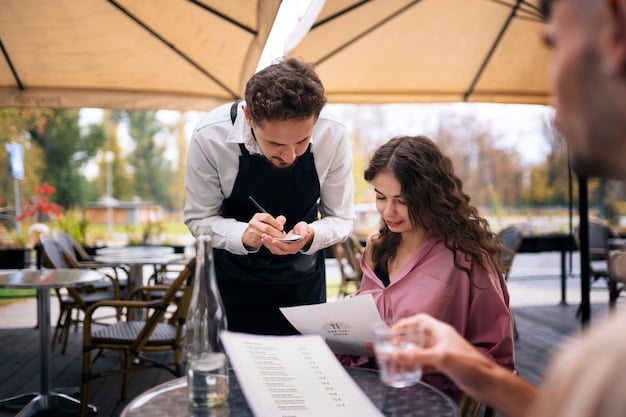
- Train suggestions, not questions. “Would you like a starter?” invites no. “The burrata is what I’d start with tonight — it’s enough for two to share” gives the guest something to picture.
- Name the item, the price, and the reason. Vague upsells fail because the guest is doing arithmetic they can’t complete.
- Put your highest-margin items where eyes land first, not where the category says they belong.
- Give servers three specific things to mention per shift instead of a general instruction to sell more.
The pitch has to sound like hospitality rather than a transaction, which is a skill of its own, and there is a whole technique to upselling without making the guest feel sold to.
2. Get your takeout and delivery operation working properly
If three out of four orders are already off-premises and you are still treating takeout as an inconvenience that happens at the end of the pass, there is revenue sitting on the floor.
Consumers are explicit about what they want from it. The association’s off-premises research found 94% of consumers prioritize speed, more than nine in ten cite customer service as important, and 90% said they would order a wider range of dishes if packaging kept the quality intact. That last one is the overlooked one: menu items get left out of takeout because they travel badly, which caps the check size of every off-premises order you take.
What to fix this month:
- Pick the five dishes that travel worst and either re-package them or re-engineer them. Vented containers, sauces separated, fried items never sealed in plastic.
- Set a separate takeout prep target and actually time it. If your quoted 20 minutes is really 35, you are losing repeat orders you will never see complain.
- Give off-premises orders a dedicated pickup spot and a person responsible for it during peak.
- Add the items you have been hiding from the takeout menu once they survive a transport test.
3. Move delivery orders onto a channel you own
Third-party marketplaces are the most expensive sales you can make. Commissions run roughly 15–30% per order before marketing fees and surcharges, which means a $40 delivery order can contribute less margin than a $25 dine-in check.
Direct ordering costs you payment processing and not much else, typically around 3% all in. And the checks are bigger: Paytronix’s 2024 Online Ordering Report found guests order 35% more items per check on a restaurant’s first-party platform than on a third-party marketplace. Higher revenue per order, and you keep more of it.
The piece most operators get stuck on is the physical delivery, because taking orders directly means the driving is yours to solve. That is a solvable problem rather than a reason to stay on the apps. A local delivery platform like Metrobi gives restaurants route optimization across multi-stop runs, real-time tracking and photo proof of delivery, automated notifications to the customer, and a preferred-driver list so the same drivers keep taking your work and learn your packaging and your pickup routine. It handles same-day and next-hour requests as well as runs scheduled ahead, which covers both the dinner rush and a standing weekly catering drop. Coverage is metro-wide rather than neighbourhood-by-neighbourhood, so a restaurant in a market like Wilmington can reach the whole surrounding area, and the same platform runs across the other major US metros on exactly the same terms.
The move is rarely all-or-nothing. Most restaurants keep the marketplaces for discovery and push repeat customers toward direct ordering with an insert in every bag, a magnet on the box, and a first-order discount that costs less than one marketplace commission.
4. Open or restart a catering line
Catering is the highest-value order a restaurant kitchen can produce with equipment it already owns. One corporate lunch drop is worth thirty covers, arrives as a single ticket, is paid in advance, and gets prepped at a time of day your kitchen is otherwise idle.
Most independents have run catering before and let it lapse because the logistics got messy. Worth restarting with narrow scope:
- Three packages, fixed per-head pricing, one page. Endless customization is why the last attempt died.
- A standing order minimum and a 48-hour lead time, so catering never collides with service.
- A single delivery window per day you can actually staff.
- Email the twenty businesses within a ten-minute radius. Office managers, not marketing lists.
5. Fix your Google Business Profile and local listings
This is the most productive hour of unpaid work available to a restaurant. When someone searches for food near them, your profile is your storefront: hours, photos, menu, the order button, the review count.
Specifics that move orders:
- Correct hours, including holidays. Wrong hours send a hungry customer to a competitor and generate a one-star review for being closed.
- Twenty current photos of actual food, replaced seasonally. Not the 2019 interior shots.
- Your real menu, with prices, loaded as a menu rather than a PDF link.
- An order link that points at your own ordering page, not a marketplace.
- Replies to every review, good and bad, within a week.
Your listing does not work alone. Social accounts are where a diner checks whether the place looks alive before they order, and the restaurant social media statistics compiled by MenuTiger are a reasonable reality check on how much that channel is carrying. Local listings and your wider promotional presence work as a system rather than a checklist, so the branding and promotion strategies that boost sales are the companion piece to the listing work.
6. Launch a loyalty program, or restart the one you abandoned
Repeat guests are where restaurant revenue lives. Olo’s analysis of more than 100 million guest records found 60% of restaurant revenue comes from repeat guests. Roughly 60% of consumers are already enrolled in at least one restaurant loyalty program, so the behaviour is established. The question is whether you are one of the programs they are in.
The association’s off-premises data adds a useful wrinkle: 65% of drive-thru users and more than 60% of takeout and delivery users say membership and loyalty programs affect their ordering decisions. Loyalty is doing more work off-premises than on.
Keep it simple enough to explain in one sentence at the register. A points scheme nobody can describe is a cost with no return, and complexity is the usual reason these programs quietly die.
7. Fill your dead hours with time-boxed offers
Every restaurant has hours where fixed costs run and revenue does not. Rent and salaried labor are being spent at 3pm whether anyone is eating or not, so an incremental sale in that window is almost pure contribution.
The rule is to discount the time, never the food. A happy hour, an early-bird prix fixe, a Tuesday family deal, a late-night menu. All of these move demand into empty capacity. A blanket 20% off teaches your Friday regulars to expect 20% off on Friday, which costs you money forever.
Discounts and daily specials are among the things the association identifies as influencing where consumers spend, so the demand responds. Just keep the fence around the window tight and the end date real.
8. Re-engineer the menu around what already sells
Pull ninety days of item-level sales out of your POS and sort every item by units sold and contribution margin. You will get four groups, and each one has an obvious action.
| Sells a lot | Margin | What to do | Time to see it |
|---|---|---|---|
| High | High | Promote hard — menu placement, server scripts, photos | Days |
| High | Low | Re-cost, re-portion, or raise the price | 1–2 weeks |
| Low | High | Rename, reposition, make servers mention it | 2–4 weeks |
| Low | Low | Cut it and reclaim the prep time and the freezer space | Immediate |
The cuts are where the resistance shows up, and they are usually the right call anyway. Every item you keep for sentiment costs prep labor, inventory space, and a line of menu real estate that something profitable could use.
9. Get more out of the seats and hours you already have
Throughput is a sales lever that most operators file under operations. If your dining room turns 2.5 times on a Saturday and you get it to 3, that is a 20% revenue increase on your best night with no new marketing.
Levers that need no capital: tighter server sections at peak, pre-bussing, handheld ordering so the ticket hits the kitchen at the table, a reservation system that staggers arrivals rather than clustering them at 7:30, and a bar or counter that can seat waiting parties. Each one shaves minutes off a table cycle, and minutes compound across a night.
10. Bring back lapsed regulars directly
Someone who used to come in every other week and has not been in for three months is the warmest possible audience, and reaching them costs almost nothing. They already like your food. They just fell out of the habit.
If you have an email list or a POS with customer records, pull everyone who ordered three or more times and has not ordered in sixty days. Send one personal-sounding message with a specific reason to return: a new dish, a seasonal menu, or a date-limited offer. Mobile ordering is now used by 57% of adults, so for most of these customers the path from your message to a placed order is two taps.
Which restaurant sales tactic to start with
| Tactic | Cost | Time to first result | Lifts check or traffic |
|---|---|---|---|
| Raise average check | None | Days | Check |
| Fix takeout execution | Low | 1–2 weeks | Both |
| Move delivery in-house | Low | 2–4 weeks | Check |
| Catering line | Low | 3–6 weeks | Check |
| Google Business Profile | None | 1–3 weeks | Traffic |
| Loyalty program | Low–medium | 4–8 weeks | Traffic |
| Dead-hour offers | Discount cost | Days | Traffic |
| Menu re-engineering | None | 1–2 weeks | Check |
| Throughput | None–low | Days | Both |
| Lapsed-customer outreach | None | Days | Traffic |
Pick two from the top of that table and finish them before adding a third. The common failure is starting eight of these in one month and completing none, which is indistinguishable from doing nothing.
How to tell whether restaurant sales are improving
Track four numbers weekly, not monthly, and compare them to the same week last year rather than to last week:
- Total sales, split by channel: dine-in, takeout, delivery, catering. A flat total can hide delivery growth offsetting a dine-in decline, which is a different problem than it looks like.
- Average check, also by channel. This is where upselling and menu work show up first.
- Transaction count. Rising sales with falling transactions means you raised prices, not demand. You need to know which one you did.
- Repeat order rate, if your POS can produce it. This is the one that predicts next quarter.
Only 10% of operators consider themselves at the forefront of technology and nearly 30% say they are lagging, so if your POS reporting is a mystery to you, you are in ordinary company. Spending an hour with it is still the highest-return hour on this list, because without it you cannot tell which of the ten things above actually worked.
What rising sales mean for what you take home
Higher sales do not automatically mean a bigger paycheque for the person who owns the place. Owner earnings are a function of revenue, cost structure, and what the business can afford to pay out after reinvestment, which is why two restaurants with identical sales can pay their owners wildly different amounts. The full picture of what restaurant owners really take home, and how to set your own number, is a separate calculation to run before you count a sales increase as a raise.
Frequently asked questions about restaurant sales
What is a good monthly sales increase for a restaurant?
Against an industry backdrop of 1.3% real growth, a 5–10% year-over-year increase is a strong result for an independent restaurant. A 30-day push on check size and off-premises execution can produce more than that in the short term, but treat the first month as a step change rather than a monthly rate you can repeat.
How can I increase restaurant sales without spending money on advertising?
Every one of the first ten minutes of this list qualifies: upselling, takeout execution, Google Business Profile, menu re-engineering, throughput, and lapsed-customer outreach all cost staff time rather than cash. Advertising is the thing you do after these are working, because it sends more people to an operation that now converts them better.
Why are my restaurant sales up but my profit flat?
Usually because the growth arrived through expensive channels. Third-party delivery at 15–30% commission can add revenue while subtracting margin, and so can discounting that pulls in orders you would have gotten anyway. Check your sales growth by channel against your prime cost over the same period.
Is delivery worth it for a small restaurant?
For most, yes, but the channel matters more than the decision. Marketplace delivery is worth it for discovery and for filling capacity; direct delivery is worth it for margin and for owning the customer. The usual answer is both, with deliberate effort spent moving repeat customers from the first to the second.
How long before these restaurant sales strategies show up in my numbers?
Check-size work, dead-hour offers, throughput, and lapsed-customer outreach show up within days. Takeout execution and menu re-engineering take one to two weeks. Catering, loyalty, and a direct delivery channel take a month or more to build but keep paying after that. The sequence in the table above is built around that spread.
Start with two
Restaurant sales growth in 2026 is mostly a redistribution exercise. Traffic is soft, real growth is barely positive, and three quarters of orders now leave the building, so the restaurants gaining share are the ones taking better care of off-premises revenue and getting more out of every ticket.
Choose the two tactics closest to the top of the list that you have not seriously tried, run them for thirty days, and measure by channel. Then pick the next two.