The flower arrangement ideas that land hardest are almost never the ones with the most stems in them. They are the ones with a decided shape. Pick a silhouette first, group the flowers in odd numbers, keep the palette to two or three colours, and a $30 bunch from a wholesaler reads as designed rather than gathered.
This guide is about what to actually build: the classic forms and what each is good for, the grouping rule underneath nearly every professional arrangement, easy designs that punch above their stem count, and the 2026 styles worth borrowing. It stops at the design decision. What the piece costs to produce and quote is covered in wedding flowers cost from stems to setup, and getting a finished arrangement to someone in another state intact is its own craft, covered in shipping flowers without losing quality.
The Bottom Line
- There are five classic arrangement shapes (round, triangular, vertical, horizontal and crescent), and choosing one before you touch a stem is the single decision that separates designed from arranged.
- The 3-5-8 rule groups flowers in odd numbers by role: roughly three focal blooms, five secondary flowers, eight filler or textural stems. It is a repeatable recipe for proportion, not a superstition.
- Two or three colours maximum. More than that and an arrangement reads as a supermarket bunch however good the individual flowers are.
- Negative space is a design element. The 2026 direction is sculptural and architectural, deliberately leaving gaps, rather than the dense airy garden style that dominated 2025 (The Knot).
- Monofloral designs, meaning one species, one colour and maximum restraint, are the cheapest way to look expensive, and they are a defining 2026 trend.
- Table arrangements live or die on sightline: keep centerpieces below roughly 12 inches or above 24, never in the band where they block the person opposite.
Lower your delivery costs by 23%
How we reduce costs:
- No delivery vehicle expenses
- Optimized local routes
- Pay-per-delivery model
- Average 23% delivery cost reduction
The five basic types of flower arrangements
Nearly every arrangement you will ever build is a version of one of five silhouettes. Knowing which one you are making answers most of the questions that follow it.
Round. A dome or sphere, viewable from every side, usually with no strong line material. The most forgiving shape and the one most retail work uses, because it suits a single flower type and a single filler and still looks complete. Best for table centerpieces, gift arrangements and anything that will be walked around.
Triangular. A tall central stem with the design stepping down symmetrically on both sides. Formal, stable and the traditional choice for ceremony and altar work, where it is seen from the front and needs to read from a distance.
Vertical. Height-dominant, narrow, reaching up from a small base. Excellent in a tight footprint (a console, a bar, a narrow mantel), and the most dramatic shape per stem, because the eye reads height as ambition.
Horizontal. Low and wide, width emphasised over height. The classic long dinner-table or buffet piece. It never blocks a sightline, which is why it keeps coming back for seated dinners.
Crescent. An asymmetric curve, like a crescent moon, built with line material that bends. The hardest of the five to build well and the most striking when it works, because the curve creates movement a symmetrical shape cannot.
Round and oval forms are generally built without line materials and are commonly made with just one flower type and one filler (Beverly Hills Flower Gallery). The other three all depend on line material to establish the silhouette, which is the practical reason they look harder.
What is the 3:5:8 rule in flower arrangement?
The 3-5-8 rule says to group flowers in odd numbers, and to assign those numbers by the job each flower is doing in the design.
In practice it builds an arrangement in three layers:
- Three focal blooms. The largest, most expensive, most visually dominant flowers. Roses, peonies, dahlias, open lilies. These are what the eye lands on, so they get placed first and they get the best positions.
- Five secondary flowers. Mid-size supporting blooms in a complementary shape or tone. Ranunculus, lisianthus, spray roses, alstroemeria. They fill the space between focal points and make the arrangement read as full.
- Eight filler and textural stems. The smallest elements and the greenery: wax flower, astilbe, seeded eucalyptus, grasses, berries. They create the edges, the movement and the sense that the piece grew rather than was assembled.
Odd numbers matter because asymmetric groupings read as natural and even ones read as arranged. Three roses placed as a triangle feel organic; four placed as a square feel like a diagram.
The rule is a starting ratio, not a law. Scale it proportionally for larger pieces (6:10:16 for a substantial centerpiece), and break it deliberately for a monofloral design, where the whole point is that there is only one role. What it gives you is a repeatable way to hit good proportion without eyeballing it, and a stem count you can plan a design around before you buy anything.
How to choose an arrangement shape for where it will sit
The most common design mistake is building a beautiful shape for the wrong location. Match the silhouette to the space and the viewing angle:
| Where it sits | Shape that works | Why |
|---|---|---|
| Round dining table, seated | Round, low | Viewed from all sides, must stay below sightline |
| Long banquet table | Horizontal, or repeated low rounds | Width suits the table; nothing blocks conversation |
| Console or entry table | Vertical or crescent | Seen from one side, rewards height and drama |
| Mantel or shelf | Horizontal or crescent | Shallow depth, strong frontal view |
| Altar or ceremony focal point | Triangular | Reads from distance, formal, symmetrical |
| Bar or cocktail table | Vertical, small footprint | Tiny base, needs presence without taking surface |
| Reception welcome moment | Sculptural or oversized round | One piece doing the work of five |
The sightline rule deserves stating plainly because it gets broken constantly: a seated centerpiece belongs either below about 12 inches or above about 24 inches, on a raised stand. Anything in between puts flowers exactly where a face should be, and guests will quietly move it.
Easy flower arrangement ideas that look more expensive than they are
These are the designs with the best impact-to-effort ratio, and all of them work with grocery-store or wholesale-bunch material.
The single-variety mass. One flower type, one colour, packed into a low round bowl at a uniform height. Twenty white tulips in a cylinder. No skill required beyond cutting to length, and it reads as deliberate and expensive because restraint always does.
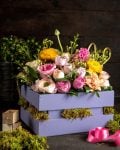
The compote with three focal blooms. A footed bowl, a grid of clear tape across the top to hold stems, three good flowers and a handful of trailing greenery over the rim. The footed vessel and the overhang do almost all the work.
The bud vase cluster. Three to five small vases of varying heights, one or two stems in each, grouped as a unit down the centre of a table. It uses very few stems, is nearly impossible to get wrong, and scales to any table length.
The monochrome textural bunch. One colour, three or four different flower shapes. All white: roses, stock, lisianthus, astilbe. The variation in texture does what colour variation usually does, but looks far more considered.
The branch plus one. A single dramatic flowering or foliage branch (quince, cherry, magnolia, eucalyptus) in a heavy vase, with two or three blooms at the base. The cheapest high-impact arrangement there is.
The low garden bowl. A shallow bowl, chicken wire inside, seasonal stems at slightly varied heights so the top line undulates rather than domes. Deliberately imperfect, which is what makes it look hand-designed.
Two techniques raise all six. Use a mechanic (tape grid, chicken wire, or a frog) so stems stay where you put them instead of collapsing to the vase walls. And cut stems to three different lengths rather than one, so the arrangement has depth instead of a flat ceiling.
Centerpiece arrangement ideas, by height
Centerpieces are where most arrangement decisions actually get made, so they are worth splitting by height rather than by style.
Low centerpieces (6 to 12 inches). Compotes, garden bowls, footed dishes. Intimate, conversation-friendly, and the safest choice for a seated dinner. They need more pieces to fill a long table, but each one is faster to build.
Raised centerpieces (24 inches and up). Elevated stands, candelabra, tall glass cylinders with the design at the top. Dramatic, create a canopy effect over a room, and let guests see under them. They cost more because of the stand and the stem count needed at height.
Mixed heights down one table. Alternating low and raised pieces along a long table is the most visually interesting option and the one professional designers reach for. It also lets you put the expensive stems in the raised pieces where they get seen.
Non-floral runners with floral moments. Candles, fruit, greenery garland and three or four small arrangements rather than twelve full ones. Significant visual payoff with a fraction of the flowers.
For a long table, repetition is your friend: one design repeated eight times reads as intentional, while eight different designs read as leftovers.
Flower arrangement trends worth borrowing in 2026
Trends matter less than shape and proportion, but they are a useful source of ideas, and the 2026 direction is a sharp break from the last few years.
Sculptural and architectural forms. Where 2025 was airy garden style, 2026 is highly structured and intentional, with arrangements designed to echo architecture (TheWed). Think defined edges, strong angles and deliberate asymmetry rather than soft abundance.
Negative space as a feature. Sculptural work with movement and gaps built in, rather than every void filled. This is also the most cost-efficient trend in years, because empty space costs nothing.
Monofloral designs. A single species, a single colour, maximum restraint. This is a defining direction across event design, interiors and gifting. All calla lily, all garden rose, all chrysanthemum.
Warm earth tones. Terracotta, ochre, rust, bronze and soft browns, replacing the pale neutrals and dusty pastels of previous seasons.
Ikebana influence. Softer, Western-inflected takes on ikebana: very few stems, placed with intent, with the line and the space between stems doing the work.
Flower mounds and vessel-free designs. Arrangements that appear to grow from the table or ground without a visible vase, a more technical build but a memorable one.
Borrow the shape ideas freely. Be more careful with the palette ideas, because a colour trend has a shorter shelf life than a silhouette and anything photographed will be looked at for decades.
Which arrangement ideas hold up when the piece has to travel
If the arrangement is going anywhere other than the table it was built on, durability becomes a selection criterion alongside how it looks.
Low, compact, wide-based shapes travel best. A round compote or a garden bowl has a low centre of gravity and nothing protruding to catch. Tall vertical pieces, wide crescents and anything with long unsupported line material are the ones that arrive bent. Flower choice matters as much as shape: thick-petalled roses, chrysanthemums, carnations and lisianthus tolerate handling, while fully open peonies, hydrangea and sweet pea are fragile at the exact moment they look best.
Design in bud rather than at peak when the piece has a journey ahead of it, so it opens on arrival instead of in the van. The packing, cooling and timing side of that journey is a separate discipline with its own rules, set out in how to ship flowers without losing quality.
Frequently asked questions about flower arrangement ideas
What are the five basic types of flower arrangements? Round, triangular, vertical, horizontal and crescent. Oval is sometimes counted as a sixth and behaves like round. Pick the one that matches where the arrangement will sit and how it will be viewed before you choose flowers.
What is the 3:5:8 rule in flower arrangement? Group flowers in odd numbers by role: about three focal blooms, five secondary flowers, and eight filler or textural stems. It produces reliable proportion and gives you a stem count to plan around. Scale it up proportionally for bigger pieces.
What are the latest trends in flower arrangements? For 2026: sculptural and architectural forms, deliberate negative space, monofloral single-species designs, warm earth-tone palettes, ikebana-influenced minimalism, and vessel-free flower mounds (The Knot, TheWed).
What are some easy flower arrangement ideas for beginners? A single-variety mass in a low bowl, a bud vase cluster at varied heights, or one dramatic branch with two blooms at the base. All three use few stems, need no special technique beyond a tape grid, and are very hard to get wrong.
How many flowers do I need for one arrangement? A small bud vase takes one to three stems, a standard low centerpiece roughly 15 to 25 stems including greenery, and a substantial raised centerpiece 35 to 50. The 3-5-8 ratio gives you about 16 placed stems per unit before greenery, which is a good baseline to scale from.
How many colours should an arrangement use? Two or three. One colour in multiple textures reads as the most expensive of all. Four or more almost always reads as unplanned, regardless of how good the flowers are individually.
Should flower arrangements be symmetrical? Only when the setting is formal and frontal, like an altar or a ceremony focal point. Everywhere else, asymmetry reads as more natural and more current, which is why the odd-number grouping rule exists in the first place.
Decide the shape, then choose the flowers
The common thread through every idea here is sequence. Amateur arrangements start with the flowers somebody liked at the market and hope a shape emerges. Professional ones start with a silhouette, a viewing angle and a palette of two or three colours, then go shopping for stems that serve that plan.
Choose one of the five forms, group in odd numbers, keep a mechanic in the vessel so stems hold their position, and leave some space empty. That is most of floral design, and it works identically on a $25 bud vase cluster and a $500 raised centerpiece.