
Most coffee bar equipment lists are written by people selling the equipment. They are thorough, and they are expensive. What they rarely tell you is which items you can skip in year one, which ones quietly decide whether your morning rush runs or stalls, and which ones cost more to install than to buy.
This is the buy list, with prices and reasons. Equipment runs roughly 15–30% of what it costs to open a coffee shop, second only to the build-out itself, and the total bill for opening in the US in 2026 generally lands between $80,000 and $300,000 (Bellwether Coffee, retrieved 2026-10-02). Getting the equipment portion wrong is not a rounding error.
Three pieces of this decision are big enough to have their own guides, and they are linked where they come up: choosing between the different types of espresso machines if you don’t yet know which class of machine you want, building the counter the equipment sits in, and picking the beans worth running through all of it.
Key Takeaways
- Equipment is 15–30% of coffee shop startup costs, typically $20,000–$80,000, and the espresso machine plus grinder alone can account for half of that.
- Buy in this order: espresso machine and grinder, water filtration, refrigeration, batch brewer, then everything else. Filtration before anything else that touches water.
- Installation, plumbing, electrical, and maintenance add 30–50% to the real cost of ownership of an espresso machine, which is the line most first-time budgets miss.
- A record 48% of American adults drank specialty coffee in the past day, so espresso-based drinks are the volume case your equipment has to survive, not a side menu.
Metrobi drivers are rated 4.97/5
Trusted by local businesses for:
- Background-checked professionals
- Specialized in business deliveries
- Same drivers for consistency
- 4.97/5 average delivery rating
What does a coffee bar actually need to open?
Nine categories, in rough order of how badly their absence hurts: espresso machine, grinders, water filtration, refrigeration, batch brewer, milk and barista tools, ice and blending, warewashing, and point of sale. Everything else on a supplier’s checklist is an upgrade on one of those nine.
The reason the order matters is cash. You will spend more than you planned on the build-out, and the equipment budget is what gets squeezed. If you know which nine things are load-bearing, you know what to protect.
There is also a demand case behind the order. In the National Coffee Association’s 2026 data, 48% of American adults said they had a specialty coffee (a latte, cappuccino, mocha, or similar) in the past day, a record and now higher than traditional coffee, and 47% had an espresso-based drink in the past week, up 17.5% since 2022 (NCA, reported by Convenience.org, retrieved 2026-10-02). Your espresso rig is not the prestige item on the bar. It is the production line.
The coffee bar equipment list, with 2026 prices
| Equipment | Typical 2026 cost | Why it earns the spend |
|---|---|---|
| Espresso machine (1–2 group, semi-auto) | $4,000–$9,900 | Produces most of your drink volume and most of your margin |
| Espresso grinder | $949–$6,210 | Sets shot consistency; a cheap one wastes good coffee daily |
| Batch brewer | $1,200–$3,500 | Serves drip in seconds during rush instead of per-cup brewing |
| Bulk / drip grinder | $500–$1,500 | Keeps batch coffee off the espresso grinder |
| Water filtration | $400–$2,500 | Protects every water-fed machine from scale |
| Undercounter refrigeration | $1,500–$4,000 | Milk within arm’s reach of the steam wand |
| Ice machine | $1,500–$4,500 | Cold drinks are 60% of specialty orders |
| Blender (commercial) | $400–$1,200 | Only if you sell blended drinks |
| Three-compartment sink / dishwasher | $800–$6,000 | Usually a health-code requirement, not a choice |
| Barista tools and smallwares | $300–$800 | Tampers, pitchers, knock box, scales, brushes |
Taken together, espresso and kitchen equipment commonly runs $15,000–$45,000 for a first café, inside a total equipment spend of $20,000–$80,000 depending on how much seating and food you take on (Bellwether Coffee, retrieved 2026-10-02).
Two notes on reading that table. The ranges are wide because concept matters more than quality: an espresso-only kiosk can open for $50,000–$100,000 while a full café with seating runs $150,000–$400,000. And the low end of each range is usually a real machine, not a bad one — the premium at the top end buys throughput and temperature stability, which only pay off at volume you may not have yet.
The espresso machine and grinder are one purchase
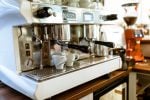
Treat them as a pair with one combined budget, because a strong machine fed by a weak grinder produces weak coffee. For a small shop, a single-group semi-automatic machine typically costs $4,000–$8,000, a quality grinder adds $800–$2,000, and the realistic all-in for espresso service is $6,000–$12,000 (Busy Bean Coffee, retrieved 2026-10-02).
Above that, commercial machines run from about $4,600 for a compact heat-exchanger model to over $32,000 for a multi-boiler platform with pressure profiling, with dual-boiler machines filling the $13,000–$19,448 middle (Pro Coffee Gear, retrieved 2026-10-02).
Where that money goes depends on which class of machine you choose: semi-automatic, volumetric automatic, or a super-automatic bean-to-cup unit that grinds and froths on its own. That choice changes your staffing model as much as your budget, which is why it gets a full treatment in our guide to types of espresso machines and which one belongs behind your bar.
The number most first-time buyers miss: installation, plumbing, electrical work, and ongoing maintenance add 30–50% to the total cost of ownership on top of the sticker price (Busy Bean Coffee, retrieved 2026-10-02). A $7,000 machine is a $9,000–$10,500 decision. Budget it as one.
How many grinders does a coffee bar need?
Two at minimum, three if you run decaf as a serious option. One dialed-in grinder for espresso, one for batch brew, and a third for decaf so nobody has to purge and re-dial the espresso grinder mid-rush.
Shops that try to run espresso and drip off a single grinder discover the cost in waste. Every switch between grind settings throws away coffee and takes a barista out of the line for a minute or two. At twenty switches a day, the second grinder pays for itself inside a season.
Water filtration is the cheapest insurance on the bar
Install filtration before the espresso machine is commissioned, not after the first scale problem. Coffee is about 98% water, and the mineral content of your municipal supply determines both how the coffee tastes and how long the boilers last.
Scale is the failure mode that ends machines early. It builds inside boilers and heat exchangers, degrades temperature stability first and then the machine itself, and it is not covered as a warranty defect because it is classed as maintenance. A $400–$2,500 filtration setup sits between your water supply and every water-fed machine you own.
Ask your supplier for a water test before you spec the filter rather than buying a generic cartridge. Hardness, alkalinity, and chlorine each need a different fix, and the right answer in one city is the wrong answer two states over.
Refrigeration, ice, and the cold side of the menu
Buy undercounter refrigeration sized to a day of milk, plus an ice machine rated above your peak cold-drink hour. Cold is no longer the secondary menu: among past-day specialty coffee drinkers in 2026, 60% had a cold coffee, against 76% for hot (NCA, reported by Convenience.org, retrieved 2026-10-02).
Three things to get right:
- Put the milk fridge under the steam wand. An undercounter unit at the barista’s hip removes a walk from every milk drink. A reach-in across the back wall adds one.
- Oversize the ice machine, not the fridge. Ice production is rated per 24 hours, but demand arrives in a two-hour afternoon spike. A machine that technically makes enough ice per day can still run dry at 2pm.
- Check cold storage before buying a cold brew system. Large-batch cold brew only works if you have somewhere to keep the finished product. Two smaller brewers that fit standard refrigeration are often more practical than one big system that doesn’t.
Batch brewer or pour-over for drip coffee?
A batch brewer, for almost every shop that charges for speed. A commercial brewer with at least 1.5L capacity holds drip coffee ready to pour during the morning rush, while pour-over is a three-to-four minute per-cup process that occupies a barista for the whole of it.
Pour-over still has a place as a menu item: a single-origin option, brewed to order, priced accordingly. It is a product, not infrastructure. The mistake is building your drip service on it and then watching a six-person queue form behind one Hario V60.
If drip is a meaningful share of your sales, add a shuttle or thermal server so coffee comes off the hotplate. Coffee held on a warmer degrades within about twenty minutes, and the version your 9:30 customer gets is the one that decides whether they come back.
Milk tools, smallwares, and the equipment that actually gets handled
Budget $300–$800 for the small items and spend it deliberately, because these are the pieces your staff touch hundreds of times a shift. The list is short and nearly fixed:
- Stainless frothing pitchers in at least two sizes, enough that nobody waits for a clean one.
- A calibrated tamper, sized exactly to your basket, plus a tamping mat.
- A dosing scale with a 0.1g readout. Shot consistency is a weighing problem before it is a skill problem.
- A knock box mounted in the bar, not a bin on the floor.
- A milk thermometer, even if your staff steam by touch, for training new hires.
- Group-head brushes, cleaning tablets, and bar rags, in a quantity that assumes daily use.
The failure here is rarely quality and usually quantity. One pitcher short and your bar develops a queue that no amount of machine capacity fixes.
Warewashing and the health-code equipment you don’t get to choose
Confirm your local requirements before you spec anything, because this category is set by your health inspector rather than your concept. Most jurisdictions require a three-compartment sink for manual washing, a separate handwashing sink, and in many cases a mop sink as well — a combination that can run $800 to $6,000 installed.
This is the category where plan review saves the most money. Sinks need drains, and drains need to be in the slab. Finding out after the concrete is poured that you need a fourth sink is a demolition job, not a purchase.
The practical sequence is to get your equipment list in front of the health department as part of plan review, then order. Day-to-day, warewashing and cleaning sit alongside everything else it takes to operate a coffee shop once the doors open.
What to buy in year two instead of year one
Defer anything that serves a menu item you haven’t proven yet. The common deferrals, in roughly the order shops actually get to them:
- A second grinder for single-origin espresso, once you know customers ask for it.
- A cold brew system, after you’ve sold cold brew from a smaller setup for a season.
- A nitro tap, which is a bet on a specific drink and a specific crowd.
- Automatic milk frothing or a second steam wand, once your tickets per hour justify it.
- A dedicated food line (oven, panini press, prep refrigeration), which is a second business bolted to the first.
The counter-case is anything that would require demolition to add later. Plumbing, electrical capacity, and the equipment footprint inside the bar are cheap to get right during the build and expensive to retrofit, which is the argument for specifying the counter and station layout around the equipment you expect to own in three years, not the equipment you can afford in month one.
New, used, or leased equipment for a coffee bar?
Buy the espresso machine new or factory-refurbished with a warranty, and buy almost everything else used. The espresso machine is the one item where a failure stops service entirely, and where the service history you can’t see is the thing you’re actually buying.
Used works well for stainless steel with no moving parts: sinks, prep tables, shelving, undercounter fridges. Restaurant auctions and closures put these on the market constantly at a fraction of new cost, and there is little to go wrong with a prep table.
Leasing is worth modelling if your opening capital is the binding constraint. It converts a $10,000 equipment purchase into a monthly line item and preserves cash for the working capital you need to survive the first six months — which is itself commonly $25,000–$68,000 and is the single most underfunded item in first-time coffee shop budgets.
Frequently asked questions
How much does coffee bar equipment cost in total?
Plan on $20,000–$80,000 for equipment across the whole shop, with espresso and kitchen equipment accounting for roughly $15,000–$45,000 of that. An espresso-only kiosk can come in well under the low end; a full café with a food program and seating pushes toward the high end.
What is the single most important piece of coffee bar equipment?
The espresso machine and grinder as a pair, because espresso-based drinks carry the volume. A record 47% of American adults had an espresso-based beverage in the past week in the NCA’s 2026 data, and specialty drinks now outsell traditional coffee on a past-day basis.
Can you open a coffee bar without an espresso machine?
Yes, and some brew bars do it deliberately: batch brew, pour-over, cold brew, and a strong bean program instead. It is a narrower business with a lower ceiling on average ticket, and it only works where you can charge specialty prices for the coffee itself.
How long does commercial coffee equipment last?
With filtration and daily cleaning, expect roughly 5–10 years from an espresso machine and 5–15 years from a burr grinder. Without filtration, scale can take years off both, which is why water treatment belongs in the opening budget rather than the maintenance budget.
Where this leaves your budget
The short version: protect the espresso machine, grinder, and filtration line items, size refrigeration and ice to your actual peak rather than your daily average, and let the deferrable items wait until the menu proves them. Equipment is the second-largest thing you will buy, and it is the one where the difference between a good list and a supplier’s list is measured in tens of thousands of dollars.
From here, the three decisions that most change the shape of this list are which class of espresso machine you commit to, how the bar itself is built around it, and what coffee you choose to put through it.