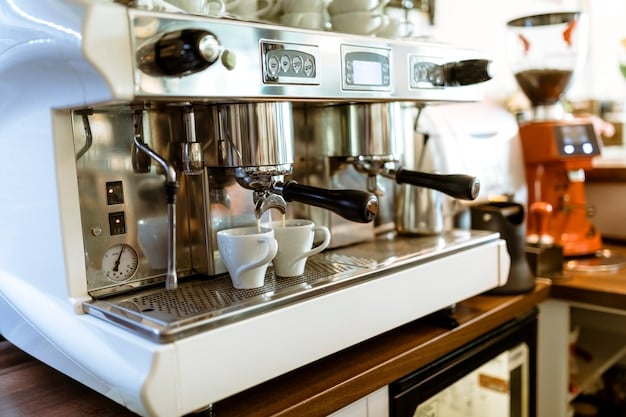

There are four types of espresso machines worth a shop owner’s attention, and they differ less in what they produce than in who they assume is operating them. That is the part the spec sheets bury. A semi-automatic machine assumes a trained barista. A super-automatic assumes a teenager on their third shift. Both can make a decent latte; only one of them will make the same latte at 8:40am on a Monday when your best employee called in sick.
So the real question behind “which type of espresso machine” is a staffing question with a price tag attached. This guide works through the four classes, what each costs in 2026, and which kind of shop each one actually suits.
It sits alongside the wider coffee bar equipment list, which covers the rest of the bar — filtration, refrigeration, brewers, smallwares — and assumes you’ve made this decision already.
Key Takeaways
- The four classes are manual lever, semi-automatic, automatic (volumetric), and super-automatic. They differ in how much of the shot the machine controls versus the barista.
- Semi-automatic is the most common type in specialty coffee shops because it leaves extraction timing with the barista.
- Commercial machines run from about $4,600 for a compact heat exchanger to over $32,000 for a multi-boiler platform; most first shops land between $4,000 and $9,900.
- Group head count, not machine class, is what caps your drinks per hour. Pick the class for your staffing and the group count for your rush.
Metrobi drivers are rated 4.97/5
Trusted by local businesses for:
- Background-checked professionals
- Specialized in business deliveries
- Same drivers for consistency
- 4.97/5 average delivery rating
The four types of espresso machines, compared
| Type | Who controls the shot | Typical commercial price | Best suited to |
|---|---|---|---|
| Manual lever | Barista controls pressure by hand | $2,500–$9,000 | Demonstration bars, tiny specialty shops |
| Semi-automatic | Barista starts and stops the shot | $4,000–$12,000 | Most specialty coffee shops |
| Automatic (volumetric) | Machine stops at a set volume | $7,000–$19,448 | High-volume shops with rotating staff |
| Super-automatic | Machine grinds, doses, brews, froths | $5,000–$25,000 | Offices, hotels, drive-thrus, thin staffing |
Every one of these can be a one-group or multi-group machine, and all of them except the manual lever come in both. Price overlaps heavily between classes, which is why choosing on price alone tends to produce the wrong machine at the right cost.
Manual lever espresso machines
A manual lever machine puts the pressure under the barista’s arm: a spring or a direct lever drives hot water through the puck, and the operator controls the pressure curve by how they pull it. There is no pump deciding anything for you.
The output, in skilled hands, is distinctive: a declining pressure profile that a standard pump machine can only approximate. The cost is that it demands technique, physical consistency, and patience, and that two baristas will produce two different shots from the same coffee.
For a shop, that makes lever machines a second machine rather than a first. They work on a demonstration bar, at a single-origin station, or in a very small specialty shop where the owner is also the only person pulling shots. They do not work as the backbone of a morning rush with seasonal staff.
Semi-automatic espresso machines
A semi-automatic machine runs an electric pump at roughly 9 bars and leaves the start and stop of the shot to the barista. The machine handles temperature stability and pressure; the human handles timing.
This is the most popular type in specialty coffee shops, precisely because of that division of labour. Your barista can shorten a shot that’s running fast, extend one that’s choking, and respond to a bean that behaved differently this morning than last week — none of which a machine on a fixed program will do.
Expect $4,000–$8,000 for a single-group commercial unit, with a quality grinder adding $800–$2,000 and all-in espresso service landing around $6,000–$12,000 (Busy Bean Coffee, retrieved 2026-10-02). Entry-level commercial heat-exchanger models start near $4,600 (Pro Coffee Gear, retrieved 2026-10-02).
The condition attached to this class is training. A semi-automatic machine rewards a trained barista and punishes an untrained one, and it will happily produce bad coffee all day if nobody is watching the clock. If your staffing model is high-turnover part-time, read the super-automatic section before you commit.
Automatic (volumetric) espresso machines
A volumetric machine measures the water passing through the group and stops the shot itself at a programmed volume. The barista grinds, doses, tamps, and presses a button; the machine decides when the shot is over.
What you buy here is repeatability across people. Three baristas on three shifts produce the same volume in the cup, which matters more than it sounds when your drink costs are built on a fixed yield. Volumetric models with advanced thermal control run up to about $9,900 at the entry tier, and dual-boiler machines with independent brew and steam temperature control sit in the $13,000–$19,448 range (Pro Coffee Gear, retrieved 2026-10-02).
The trade-off is that volume is not the same as extraction. If the grind drifts, the machine still delivers 36 grams of liquid. It just takes 18 seconds instead of 28 to get there, and the shot is sour. Volumetric machines reduce the skill needed to be consistent; they do not remove the need to taste and dial in every morning.
This class is the common answer for established shops with real rush volume and a staff rota that changes week to week.
Super-automatic and bean-to-cup machines
A super-automatic grinds, doses, tamps, brews, and in most cases froths the milk, from a single button. These are the bean-to-cup machines, and the whole class exists to remove the barista from the process.
For some operations that is exactly right. Offices, hotel breakfast service, convenience retail, and drive-thrus where speed beats craft all run well on super-automatics. Where a shop has one person covering the till, the bar, and the pastry case at once, a machine that makes a cappuccino unattended is not a compromise — it’s the only way the ticket gets out.
The reasons shops regret them are consistent: ceiling on quality, cost of repair, and the milk system. A super-automatic’s automatic frother will not produce the microfoam a latte art program needs, the internal mechanisms are more expensive to service than a pump and a group head, and the milk lines need rigorous daily cleaning or they become a health problem rather than a quality one.
A middle path exists and is underused: a semi-automatic or volumetric machine paired with an automatic milk steamer. The barista keeps control of the espresso, the machine takes over the slowest manual step, and you avoid the quality ceiling of a full bean-to-cup unit.
How many group heads does your shop need?
One group per roughly 50–75 drinks in your busiest hour, which for most independent shops means two. Group count, not machine class, is the real throughput constraint — a one-group super-automatic will bottleneck faster than a two-group semi-automatic no matter how much of the process it automates.
The practical guide:
- One group suits a shop under about 100 drinks a day, a kiosk, or a bar where coffee is secondary to food.
- Two groups covers the large majority of independent cafés, and gives you a working machine when one group needs servicing.
- Three groups is a volume decision, not a prestige one. It only pays when you have two baristas on the bar simultaneously during rush.
Add steam wands to the same calculation. A two-group machine with one usable steam wand will choke on a milk-heavy menu regardless of how many groups it has, because milk steaming is the slowest step in a latte.
Count the orders you don’t see when you work out that peak hour. Mobile and courier tickets land in the same fifteen minutes as the walk-in queue, so a shop that has started running coffee shop delivery to expand its reach often needs a group head more than its footfall alone would suggest.
Pump, steam, and lever: the mechanism underneath
The four classes above describe who controls the shot. Underneath that, machines differ in how they generate pressure, and the distinction matters when you’re reading listings:
- Pump-driven machines are the standard commercial mechanism, using an electric pump to deliver around 9 bars of pressure. Semi-automatic, volumetric, and super-automatic machines are all pump-driven.
- Steam-driven machines use steam pressure to push water through the coffee, reaching only about 1–3 bars. They are household appliances; the result is strong coffee rather than espresso, and they have no commercial application.
- Lever-driven machines use a spring or direct human force, as described above.
If a commercially listed machine is steam-driven, it is a consumer unit being sold into the wrong market. That is a common trap at the bottom of the price range.
Boilers: heat exchanger, dual boiler, or multi-boiler?
The boiler configuration decides whether you can brew and steam at the same time without either suffering, which is the difference between a machine that keeps up and one that falls behind at 8:30am.
- Heat exchanger machines use one steam boiler and pass brew water through a heat exchanger. They brew and steam simultaneously, cost the least, and give up some brew-temperature precision. Entry commercial units start around $4,600.
- Dual boiler machines run separate brew and steam boilers, so brew temperature holds steady no matter how hard you’re steaming. The $13,000–$19,448 band.
- Multi-boiler machines give each group its own brew boiler, allowing different temperatures per group, which is useful if you run two espressos with different roast profiles. Premium platforms with saturated groups and pressure profiling start near $17,499 and can pass $32,999 (Pro Coffee Gear, retrieved 2026-10-02).
Most independent shops are well served by a good heat exchanger or an entry dual boiler. Multi-boiler machines solve a problem that most shops do not have: simultaneous multi-temperature espresso programs.
What the machine costs after you buy it
Add 30–50% to the purchase price for installation, plumbing, electrical work, and ongoing maintenance (Busy Bean Coffee, retrieved 2026-10-02). A commercial grinder is a separate $949–$6,210 line, and water filtration is non-negotiable if you want the boiler to survive. If you are still assembling the wider order, our checklist for coffee shop equipment covers the rest of the room — refrigeration, warewashing, food line — that competes with the machine for the same budget.
Three ownership costs that routinely get left out of the comparison:
- Electrical capacity. A two-group machine commonly needs a dedicated 20–30 amp circuit, and in many cases 220V. Running that circuit after the walls are closed is an electrician’s invoice plus a patching job.
- Plumbing and drainage. Direct-plumbed machines need a water line and a drain within reach of the machine’s position, which is a decision made when the bar itself is built, not when the machine arrives.
- Scheduled service. Gaskets, screens, and seals are consumables. A service contract or a local technician you can actually reach is part of the cost of the machine, not an optional extra.
The machine class you choose also changes what the coffee has to be. Volumetric and super-automatic machines on fixed programs are least forgiving of a bean that behaves inconsistently batch to batch, which raises the stakes on which coffee you source and how reliably your roaster can repeat it.
Frequently asked questions
What is the difference between automatic and super-automatic espresso machines?
An automatic machine stops the shot at a preset volume but still requires the barista to grind, dose, tamp, and steam the milk. A super-automatic does all of those steps itself from whole beans. Automatic keeps the human in the process; super-automatic removes them.
Which type of espresso machine do most coffee shops use?
Semi-automatic, because it gives baristas full control over extraction timing while the machine manages pressure and temperature. Volumetric automatics are the common upgrade for higher-volume shops with rotating staff.
Are super-automatic espresso machines worth it for a coffee shop?
They are worth it where labour is the binding constraint: thin staffing, high turnover, drive-thru speed, or coffee as a secondary offer. They are not worth it where coffee quality is your differentiator, because the automatic milk system caps what the drinks can be.
How much should a first commercial espresso machine cost?
Most first shops land between $4,000 and $9,900 for the machine, plus $800–$2,000 for the grinder, plus 30–50% of the machine price in installation and first-year service. Budget the whole figure rather than the sticker.
Choosing between them
Pick the class that matches how you will actually be staffed in month six, not how you imagine the bar on opening day. Semi-automatic if you will have trained baristas and coffee is the product. Volumetric if you will have volume and a changing rota. Super-automatic if one person has to do everything at once. Lever if it is a second machine with a story attached.
Then size the group heads to your peak hour, confirm the electrical and plumbing before the build closes up, and put the filtration in first.