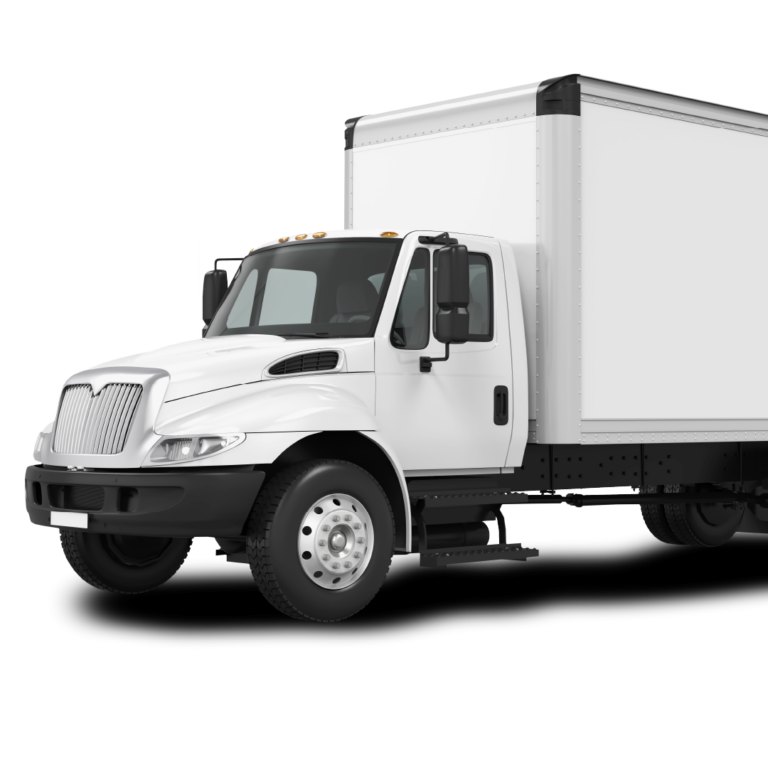

There’s a moment in a growing wholesale or food business where the delivery problem changes character. It stops being “who can drive this” and becomes “this doesn’t fit.” A standing order has turned into pallets. A café account has become six café accounts and one of them wants a full week’s stock at once.
That’s the point where a box truck delivery service stops being over-specification and starts being the cheapest way to move the load. One truck run replaces three van runs, and the arithmetic is not close.
This post covers when you’ve crossed that line, what to ask a provider, and what changes about the delivery once a truck is involved. For the broader provider decision, how to choose a courier service for your business covers the full set of criteria.
The Bottom Line
- A 26-foot box truck carries roughly four times the weight and three to four times the volume of a full-size cargo van, and handles around twelve pallets where a van handles none to two.
- If you’re splitting one order across multiple van runs, you’re already paying truck prices without the truck.
- Liftgate access, not capacity, is what most businesses actually discover they need.
- Truck deliveries need to be planned ahead. Urban access, dock time and parking all shrink the window.
Save 80% of delivery management time
We handle everything:
- Dedicated operations manager
- Real-time tracking dashboard
- Automated customer notifications
- Urgent issue resolution
What a box truck delivery service actually gives you
A box truck is a medium-duty vehicle with an enclosed cargo box on a chassis, typically between 10 and 26 feet long. In delivery terms it sits between a cargo van and freight.
The capacity gap is larger than people expect. A 26-foot box truck carries roughly four times the weight and three to four times the volume of a full-size cargo van, and can take around twelve pallets where a van manages none to two (OTrucking box truck versus cargo van guide).
Beyond raw space, three features change what’s possible:
- A liftgate, which lets one person move heavy pallets or equipment without a dock at either end.
- Standing height, so goods can be loaded on pallets and moved with a pallet jack rather than carried by hand.
- Structured stacking, which means a full load arrives in the condition it left in rather than packed around a van’s wheel arches.
Signs your deliveries have outgrown a van
Five signals, and any two together usually settle it:
- You routinely split a single customer’s order across two or more runs.
- Your goods arrive on pallets from suppliers and get broken down purely because the delivery vehicle can’t take a pallet.
- Drivers are hand-carrying heavy cases because there’s no liftgate at one end.
- A single wholesale account now takes more than half a van.
- You’re paying for multiple van trips to the same address in one week.
That last one is the clearest. Splitting a load is the most expensive way to move it: you pay the fixed cost of a run (the driver, the travel, the parking) two or three times to move goods one vehicle could have carried once.
The cost side of this deserves care. Last-mile delivery now represents roughly 53% of total shipping cost industry-wide (SmartRoutes last-mile statistics), which means vehicle choice is a margin decision rather than a logistics detail.
What changes when a truck is doing the delivery
A truck is not a van with more room. Three practical differences reshape the day.
Access becomes the constraint. Narrow streets, low bridges, tight loading bays and residential parking restrictions all rule out vehicle sizes that would otherwise be ideal. A 16-foot truck that can actually reach the dock beats a 26-footer that can’t.
Dock time lengthens. Pallet handling, a liftgate cycle and paperwork take longer than a hand-carried box. Service time per stop goes up, and a route planned on van timings will run late, which is exactly the failure mode described in efficient delivery planning.
Planning ahead becomes mandatory. Truck capacity is scarcer than van capacity, and receiving sites often have fixed dock hours. These are not jobs to post at short notice.
What to ask a box truck delivery provider
Seven questions, and the specificity of the answers tells you most of what you need to know:
- What truck sizes can I request, and can I specify one for a particular job?
- Is a liftgate available, and is it charged separately?
- Will the driver handle pallets, and is a pallet jack on board?
- Is loading and unloading included, or is that my responsibility at both ends?
- What’s the weight limit per job, and where do oversize charges start?
- What’s the insurance limit per shipment?
- How much notice do you need to guarantee a truck?
That last one matters more than any other. A provider who can give you a truck tomorrow with a phone call is worth more than one with a slightly better rate and a three-day lead time.
On insurance, check the number rather than the assurance. Default per-shipment limits are frequently lower than the value of a full pallet load of product.
How box truck delivery is priced
Expect pricing built from the vehicle class, the distance or zone, the number of stops, the loading time, and any accessorial charges: liftgate, waiting time, oversize, after-hours access.
Two things to compare properly:
Cost per delivered unit, not cost per run. A truck run costs more than a van run and is almost always cheaper per case or per pallet. Divide by what actually moved.
Multi-stop versus single-job pricing. If you can put several drops on one truck route, the per-stop cost falls sharply, which is the same economics that makes scheduled routes cheaper than on-demand jobs generally.
For the question of whether to hire this capacity at all or buy a vehicle, the comparison is in outsourcing delivery services. Buying a truck is a larger commitment than buying a van: a heavier fixed cost against demand that for most food, floral and wholesale businesses is seasonal. The full set of ownership costs people forget is in the hidden costs of in-house delivery.
Reliability matters more at truck scale
A failed van delivery is an inconvenience. A failed truck delivery is a week of a customer’s stock sitting in your building.
So the quality bar rises with the load size. Ask for an on-time percentage and how it’s defined, ask what happens when a truck doesn’t show, and ask whether you can work with drivers who’ve done the route before, because a driver who knows which gate the truck fits through saves everyone an afternoon on a tight urban dock. The full checklist is in what makes a good courier service.
For reference on what a strong baseline looks like: across Metrobi’s driver network, 93% of couriers arrive within 15 minutes of the delivery request and 99.3% of courier requests are fulfilled, with 24/7 support averaging a 76-second response. Deliveries are posted ahead with the requirements attached, so specify the vehicle and any liftgate need when you post the job rather than at pickup.
Local operators are generally better placed for this work than national freight networks, for the same reasons set out in the benefits of a local courier service: one direct leg, no hub handling, and pricing built for short routes.
Frequently asked questions
What size box truck do I need?
Match the truck to the access as much as to the load. A 16-foot truck handles most multi-pallet local deliveries and reaches sites a 26-footer can’t. Go to 26 feet when you’re moving close to a full load and the destination has proper dock access.
Do I need a liftgate?
If either end lacks a loading dock and the goods are heavy or palletised, yes. It’s the single most commonly underestimated requirement in truck delivery, and retrofitting it to a booked job usually isn’t possible.
Is a box truck cheaper than multiple van runs?
Usually, once you’re splitting a load. Compare cost per delivered pallet or case rather than per run. Splitting a load makes you pay the fixed cost of a trip several times over.
How far in advance should I book a box truck delivery?
More notice than a van job. Truck capacity is scarcer and receiving docks often have fixed hours, so plan these around the dock’s schedule rather than yours.
The test to run
Look at last month’s deliveries and find every case where one customer’s order moved in more than one trip. Add up what those trips cost. Then price the same volume as a single truck run.
If the truck wins, the next step is finding a provider who can supply one reliably with reasonable notice, because a truck you can’t book when you need it is worse than a van you can.