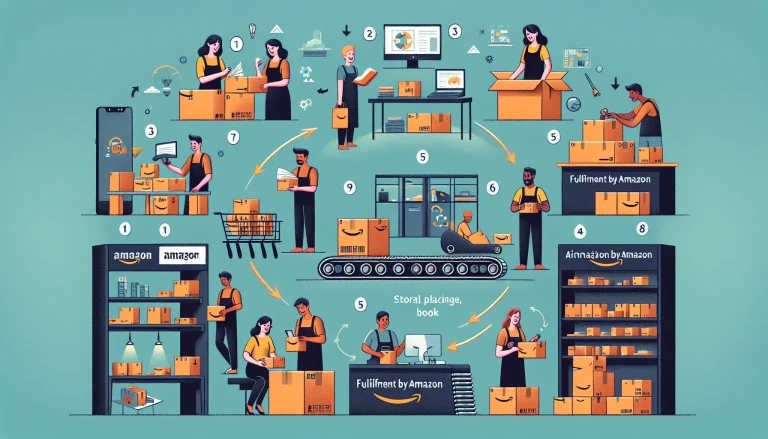

Fulfillment by Amazon is the arrangement where you send your inventory into Amazon’s warehouses and Amazon does the rest: storage, picking, packing, shipping, returns and customer service on those orders. You keep ownership of the stock and the listing. Amazon takes the operational work and charges per unit for it.
The reason sellers use it is not convenience, it is Prime. FBA listings get Prime eligibility and the fast, free delivery badge that comes with it, and on a marketplace where delivery speed drives placement, that is hard to replicate yourself. Matching that promise on your own site means working out who absorbs the shipping cost before you advertise it. The reason sellers complain about FBA is the fee schedule, which Amazon revises on its own timetable, twice in 2026 alone. Understanding both sides of that trade is the point of this guide.
The Bottom Line
- FBA means Amazon stores, picks, packs, ships and handles returns and customer service for your Amazon orders, for a per-unit fee.
- Adoption is near-universal among serious sellers: industry estimates put FBA use at around 82% of active sellers, and marketplace data shows third-party sellers accounted for 61% of paid units in Q3 2026.
- Fees moved twice in 2026. Non-peak fulfillment fees rose on 15 January, and a 3.5% fuel and logistics surcharge, roughly $0.17 per unit, was added on 17 April.
- Monthly storage held at $0.78 per cubic foot from January to September and $2.40 from October to December.
- FBA is a model, not the model. The decision is the same one behind any fulfillment setup: cost per order against control.
Metrobi drivers are rated 4.97/5
Trusted by local businesses for:
- Background-checked professionals
- Specialized in business deliveries
- Same drivers for consistency
- 4.97/5 average delivery rating
How FBA works, step by step
The flow is straightforward once you have seen it.
You prep and label first. Each unit needs to meet Amazon’s packaging and labelling requirements before it ships in: poly-bagging, suffocation warnings, barcode labels, bundle labelling. These are rules rather than suggestions, and getting them wrong triggers inbound defect fees of up to $5.72 per unit.
Then you ship inventory in. Amazon tells you which fulfillment centers to send stock to, which is the point of the inbound placement fee structure, and you create the shipment plan in Seller Central and arrange freight or parcel delivery to those destinations.
Amazon receives and stocks it. Units are checked in and distributed across the network, and from this point they count as available inventory against your listings.
When an order comes in, Amazon picks, packs and ships it under the Prime promise where applicable. You do not see the order until it is already on its way. Returns and customer support for FBA orders go to Amazon too, and returned units go back into Amazon’s network, where they are assessed as sellable or unsellable.
You pay per unit, monthly: fulfillment fees per unit shipped, storage per cubic foot per month, plus whatever surcharges apply to your inventory profile.
The part that surprises new sellers is how little visibility this gives you. You cannot inspect a unit, change the packaging on a specific order, or include an insert that violates policy. In exchange, you are not picking anything at 9pm.
FBA fees in 2026: what you actually pay
Fees are per-unit and banded by size tier, weight and, since the 2023 restructuring, the item’s price. Two increases landed during 2026.
The January increase came first. Non-peak fulfillment fees rose on 15 January 2026, and across standard-size products the increase averaged $0.08 per unit in the $10 to $50 price band, $0.05 for items under $10 and $0.31 for items above $50. Reported by price band, the increases came out at roughly $0.12 per unit under $10, about $0.25 in the $10 to $50 band and about $0.51 above $50.
Where that leaves the rate card: in the $10 to $50 price band, small standard-size products run roughly $3.32 to $3.96 per unit depending on weight. Large standard products start around $3.73 for a 4 oz item and rise to about $6.97 for a 3 lb item, with $0.08 added per 4 oz interval beyond that.
Then came the April surcharge. A 3.5% fuel and logistics surcharge was applied to US FBA fulfillment fees on 17 April 2026, working out at around $0.17 per unit on average.
Storage was unchanged: $0.78 per cubic foot January through September, rising to $2.40 per cubic foot October through December. That Q4 multiple is why inventory planning for the holidays is a profitability exercise and not just a stock exercise.
2026 also introduced newer penalties: an Overmax surcharge of $17 to $25 per unit on oversize dimensional outliers, a packaging fee of around $2.07 for bulky items not enrolled in Ships in Product Packaging, and inbound defect fees up to $5.72 per unit. Those three matter more than their size suggests, because they are avoidable. They are charges for sending Amazon something awkward, and awkwardness is often a packaging decision you can change.
FBA versus fulfilling it yourself
FBA is one of four models, and it competes directly with handling orders in-house and with using an independent provider.
| FBA | Merchant fulfilled (FBM) | Independent 3PL | |
|---|---|---|---|
| Prime eligibility | Yes | Only via Seller Fulfilled Prime | No |
| Fee structure | Per unit, revised by Amazon | Your own costs | Negotiated, quote-driven |
| Control of packaging | Minimal | Total | Limited by SLA |
| Works off Amazon | Via multi-channel fulfillment | Yes | Yes |
| Best for | Amazon-primary sellers | Low volume, custom, local, oversized | Multi-channel brands |
The honest version of the comparison: if Amazon is where your revenue comes from, FBA’s fees buy you placement you cannot otherwise get. If Amazon is one channel among several, compare it line by line against an independent fulfillment provider, because an independent 3PL will serve your own store and your wholesale orders on the same terms.
Some sellers run both: FBA for fast-moving SKUs that need Prime, merchant-fulfilled for oversized, fragile or low-margin items where the per-unit fee swallows the profit. Splitting by SKU rather than committing wholesale is usually the cheaper answer.
When FBA is the wrong choice
Four situations where sellers routinely lose money inside FBA.
Oversized, heavy or awkward products are the first. The fee bands scale with size and weight, and the 2026 Overmax and packaging surcharges punish dimensional outliers specifically, so a provider that specialises in bulky goods will often be cheaper per order.
Slow-moving inventory is the second. Storage is charged by the cubic foot, every month, and more than doubles in Q4. Stock that sits is paying rent.
Perishable, fragile or hand-finished goods are the third. Amazon’s network is optimised for throughput, not for careful handling, so anything that needs temperature control or a specific handling routine is a poor fit. The way a high-volume fulfillment operation runs explains why.
Local order books are the fourth. If your customers are concentrated near you, shipping stock to Amazon’s network so it can be shipped back out to your own city is pure wasted distance. Your own route is faster and cheaper.
Amazon’s own delivery economics work very differently from yours, which is worth understanding. Amazon runs a vast network of contracted and gig-based drivers to make its delivery promise affordable at scale. That cost base is not something a single seller can replicate, which is precisely why the per-unit fee exists, and why a local delivery route is the one place a small operator can be cheaper than Amazon.
FBA for multi-channel sellers
Amazon sells fulfillment for orders that do not come from Amazon. Multi-channel fulfillment lets you route orders from your own store through the same inventory pool, and in 2026 Amazon extended its freight, distribution, fulfillment and parcel infrastructure to businesses that do not sell on the marketplace at all.
Two cautions. Orders fulfilled this way arrive in Amazon-branded or plain packaging, which matters if your brand presentation is part of the product. And you are now dependent on one provider’s fee schedule across every channel you sell on, a schedule that changed twice in 2026.
Running both channels off one inventory pool is also a systems problem before it is a logistics one. You need a single source of truth for stock, which in practice means order fulfillment software sitting between the channels rather than a spreadsheet reconciled nightly.
If your own store is the bigger half of your business, configure that store’s fulfillment on its own terms first. For a Shopify store, that means getting locations, apps and fulfillment services set up properly, and treating Amazon as one channel plugging into it rather than the hub everything runs through.
Keeping an eye on FBA performance
Amazon handling the work does not mean the numbers take care of themselves.
Watch your Inventory Performance Index, because it governs how much space you are allowed. Watch sell-through against storage cost per SKU, monthly, and cull anything paying rent without earning it. Watch reimbursements for lost and damaged units, which you have to claim rather than receive automatically.
And watch your return rate and the reason codes behind it. Amazon’s returns process is fast and customer-friendly by design, which means a product with a fit or description problem generates returns quickly. That is a product signal, not a fulfillment one, and distinguishing the two depends on reading the data the same way you would for order accuracy in your own operation. Treating every return as a cost of doing business is how a correctable listing problem turns into a permanent margin problem.
The scale of the marketplace is the reason this discipline pays. Amazon’s third-party seller base has grown into the millions, and seller-side benchmarks show how concentrated success is: fewer than 8,000 sellers account for roughly half of US third-party sales. The sellers in that group are not the ones guessing at their fee exposure.
Frequently asked questions
How much does FBA cost per unit? It depends on size tier, weight and price band. In the $10 to $50 band, small standard items run about $3.32 to $3.96 and large standard items from about $3.73 up to $6.97 at 3 lb, plus the 3.5% fuel and logistics surcharge added in April 2026 and monthly storage.
What is the difference between FBA and FBM? FBA means Amazon stores and ships your inventory. FBM, fulfilled by merchant, means you do, whether yourself or through your own provider. FBA gets Prime eligibility by default; FBM only through Seller Fulfilled Prime.
Do FBA fees include shipping to the customer? Yes. The per-unit fulfillment fee covers picking, packing and delivery to the buyer. It does not cover getting your inventory into Amazon’s network, which you arrange and pay for.
Can I use FBA for orders from my own website? Yes, through multi-channel fulfillment. Expect Amazon-branded or plain packaging rather than your own, and check the per-unit economics against an independent provider before routing your whole store through it.