
Most catering equipment lists are written as if the food never leaves the building. They cover prep tables, convection ovens and chafing dishes, then stop at the kitchen door. For a caterer, the kitchen door is the halfway point. Everything after it is where jobs are actually won or lost: the carriers, the racks, the ramps, the thermometers you use in a parking lot. It is also the part that gets bought in a panic the week of the first big event.
So this list runs the whole route: what you need to prep food, cook it, move it, hold it, serve it, and clean up afterwards. Where a piece of gear raises a decision rather than just a purchase, the decision gets its own page. Working out whether to own an item at all is covered in our guide to renting versus buying catering equipment, and the specs, certifications and supplier questions that separate a good purchase from an expensive one are in how to buy catering supplies and equipment.
The Bottom Line: A working catering equipment list has six stages: prep, cooking, transport, holding, service, and cleanup. The two that get under-budgeted are transport and holding: insulated carriers, sheet pan racks, hot boxes and calibrated thermometers. They only matter once the food is off-site. US food code sets the standard those stages have to meet: hot food at 135°F or above and cold food at 41°F or below, including on arrival. Expect to spend most of your startup equipment budget on cooking and refrigeration, and most of your ongoing budget on disposables.
Boost customer satisfaction with just a few clicks
Most-Loved Features:
- On-demand drivers
- Real-time GPS tracking
- Delivery confirmation photos
- Over 50% of customers report a smoother delivery experience
The six stages of a catering equipment list
Read the list as a route the food takes, not a catalogue. Each stage hands off to the next, and a gap anywhere shows up as cold food, a late setup, or a pan on the floor of a van.
- Prep. Turns raw ingredients into components in your own kitchen. Tables, sinks, refrigeration, cutting and mixing.
- Cooking. Finishes the food, either at your kitchen or at the venue. Ovens and ranges at base, portable burners and induction on the road.
- Transport. Moves finished food to the venue at a safe temperature, intact. Insulated carriers, racks, carts and ramps.
- Holding. Keeps it at temperature from arrival until the last plate goes out. Hot boxes, chafers, induction warmers, cold wells.
- Service. Puts it in front of guests. Buffet hardware, serving utensils, tableware or disposables, beverage service.
- Cleanup. Gets everything back, washed and ready for the next job. Bus tubs, bins, sanitizer, a labelled place for every item.
Caterers reliably budget stages one, two and five. Stages three, four and six are the ones that cost money quietly.
Metrobi is transforming catering deliveries
Specialized solutions for catering businesses:
- Catering-trained drivers
- Proper handling equipment
- Peak day delivery support
- 23% average cost reduction
Food prep equipment for a catering kitchen
This is the base-kitchen half of the list, and it is mostly fixed in place.
- Stainless steel work tables. NSF-rated tops, sized to your space. You will want more surface than you think, because catering prep happens in parallel batches rather than to order.
- Three-compartment sink and a separate hand sink. Wash, rinse, sanitize, plus a dedicated hand sink. Health departments treat both as non-negotiable in a commercial kitchen.
- Reach-in and walk-in refrigeration. Catering volume is lumpy. The constraint is not average storage, it is the 48 hours before a large event when everything is prepped at once.
- Freezer capacity. Separate from refrigeration, and easy to undersize.
- Food processor and commercial mixer. The two pieces that replace labour hours most directly.
- Slicer, scales and measuring gear. Portion control is where catering margin lives, and it needs accurate scales rather than eyeballing.
- Cutting boards, knives and sheet pans. Colour-coded boards for allergen and raw-protein separation. Full-size and half-size sheet pans in quantity, because pans are the unit of currency in a catering kitchen.
- Food storage containers and labels. Date-and-label discipline is both a food safety requirement and the only way to know what you actually have.
Buy pans, containers and smallware in sets rather than singly. Sets cost less per piece, and matched sizes are what let you stack a van efficiently later.
Cooking and heating equipment caterers travel with
Catering splits cooking across two places, and the equipment list reflects that.
At your base kitchen, the heavy pieces are a commercial range, a convection or combi oven, a griddle or flat top, and ventilation to match. These are the largest single line items on a startup budget and the ones most worth looking at used.
On the road, the list changes character entirely. Venues are unpredictable: some have a working kitchen, many have a loading dock and a power strip. Portable cooking gear is what makes a venue workable.
- Induction burners. Fast, no open flame, and accepted in venues with fire-code restrictions on butane. They need reliable power, so ask about circuits before the event, not during it.
- Butane or propane burners. The fallback when power is short. Check the venue’s rules first; many museums, historic sites and office buildings prohibit open flame outright.
- Portable convection oven or cook-and-hold cabinet. Lets you finish on-site instead of transporting food already fully cooked and hoping it holds.
- Carving station with a heat lamp. Both functional and the visual centrepiece of a lot of buffets.
- Extension cords, power strips and adapters. Unglamorous, and the single most common reason a setup stalls.
A practical rule: assume every venue has less power, less water and less flat space than you were told, and pack so that the menu still works if all three turn out to be true.
Catering transport equipment: moving food at temperature
This is the stage general equipment lists skip, and the stage that defines whether you can take a job 40 minutes away.
The standard your transport gear has to meet is a temperature one. The FDA Food Code requires hot time/temperature-control-for-safety food to be held at 135°F or above and cold food at 41°F or below, and food is expected to arrive inside those limits rather than just leave inside them (FDA Food Code 2022, section 3-501.16, as summarized by ConnectedFresh). Between 41°F and 135°F is the range where bacteria multiply fastest. A 35-minute drive in traffic is long enough to matter.
What that requires in practice:
- Insulated food pan carriers. Front-loading or top-loading, sized to full-size and half-size pans. The workhorse of off-site catering. Rigid carriers hold temperature for hours without power and stack in a van.
- Insulated delivery bags. For drop-off catering, boxed lunches and small jobs. Cheap, light, and far easier to carry up a flight of stairs than a rigid cabinet.
- Heated holding and proofing cabinets. Powered cabinets for large events where you need to stage food on arrival and serve on your own schedule. These need a circuit at the venue.
- Cold transport: coolers, ice packs and cold plates. Cold chain gets less attention than hot and causes just as many problems. Salads, dairy, cut fruit and raw proteins all need to arrive at 41°F or below.
- Sheet pan racks and rack covers. End-loading racks roll straight from the kitchen into a van and back out at the venue. They turn 40 individual trips into two.
- Beverage carriers and insulated urns. Coffee that is still hot on arrival is a reputation item.
- Rolling carts and ramps. A flat cart that handles a curb and a loading dock saves more labour than any other item at this price.
- Load bars, straps and non-slip matting. Pans slide. Stacks tip on the first hard corner. A $40 strap prevents a $400 remake.
- Calibrated digital thermometers, plus a log. Thermometers are the only way to prove the chain held, and the only way to know. Keep spares; they get left behind.
Two decisions follow from this stage. The first is vehicle capacity, which sets the largest event you can physically take. The second is how often you own this gear versus hire it for the one job a year that needs twice as much, which is exactly the rent-or-buy calculation to run per item rather than for the whole list.
Holding and warming equipment for on-site service
Transport gets food there. Holding keeps it servable for the two or three hours that follow.
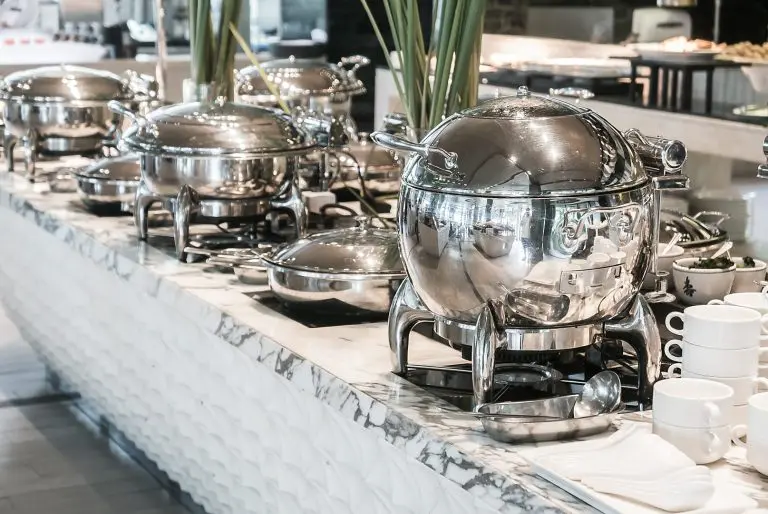
- Chafing dishes with fuel or water pans. The default buffet holder. Roll-top and full-size pan configurations cover most menus.
- Chafer fuel. Gel or wick fuel, and more of it than the job needs. Running out mid-service is a specific kind of bad day.
- Induction warmers. Cleaner and more controllable than fuel, and allowed where open flame is not. Power-dependent again.
- Electric food warmers and steam tables. For staffed buffets and longer service windows.
- Heat lamps. Carving and plating stations.
- Cold wells, ice beds and display trays. The cold side of the buffet, which is where temperature abuse usually happens because nobody is watching it.
- Full-size and fractional buffet pans, with lids. Pan inventory is what lets you run two events in a weekend.
Holding equipment is the stage where fire code and electrical limits bite hardest. Carrying both fuel-based and induction options means a venue restriction changes your setup rather than cancelling your service style.
Catering serving and buffet supplies
The service stage is where the client sees the equipment, so it does double duty as kit and as presentation.
- Buffet tables, risers and skirting. Height variation is most of what makes a buffet look designed rather than assembled.
- Linens and table coverings, owned or hired. Laundry is the hidden cost.
- Serving utensils: tongs, ladles, slotted spoons, cake servers, pie servers, in quantity, because they walk off.
- Platters, bowls, trays and stands, in mixed materials and heights.
- Tableware, meaning plates, glassware and flatware. Full rental sets for seated service, or disposables for drop-off and casual events.
- Guest-facing extras: napkins, menu cards, allergen signage, table numbers.
- Trash and recycling bins with liners. Guests need somewhere to put a plate. If you do not supply it, the venue’s floor becomes it.
Disposable catering supplies and packaging
Disposables are the line that moves from a startup cost to a monthly operating cost, and for a caterer doing drop-off or delivered work, they are a large one.
- Aluminium and polypropylene pans with lids, half and full size, shallow and deep. The backbone of drop-off catering.
- Catering trays and dome lids, for platter presentation that survives a van.
- Deli containers, clamshells and boxed-lunch boxes. Portioned and individually packed service is now a standard request rather than a special one.
- Cups, lids, cutlery kits, napkins and plates. Order by case; this is where buying in volume pays off fastest.
- Foil, film, pan liners and sheet pan paper, consumed constantly and never on the list.
- Labels, tamper seals and allergen stickers. For delivered catering these are close to mandatory: the person handing the food over is often not the person who cooked it.
Compostable and recyclable lines cost more per unit and are increasingly specified by corporate clients outright, so it is worth pricing both versions of your core items before a contract rather than after.
Cleanup and sanitation gear
The stage that determines how long your team is still working after the guests leave.
- Bus tubs and dish dollies. Dirty gear has to travel home too, and it has to travel without contaminating anything.
- Sanitizer, test strips and wiping cloths, plus a bucket system that keeps clean and dirty separate.
- Trash bags, floor mats and a basic spill kit. Venues expect the space handed back as found.
- A hand-washing station or portable sink, required at many outdoor and temporary sites.
- Labelled bins and a packing inventory. The cheapest equipment loss prevention there is. Gear disappears at the end of events, not the start.
What to buy first, and what each stage costs
Equipment spending is not evenly useful. Some items unlock jobs you cannot otherwise take; others are refinements. A rough ordering:
| Stage | Typical first purchases | Budget weight | Buy first? |
|---|---|---|---|
| Prep | Work tables, three-compartment sink, reach-in refrigeration, sheet pans | High (fixed) | Yes — a commercial kitchen is a licensing precondition |
| Cooking | Range, convection oven, ventilation; induction burners for the road | Highest | Base kitchen yes; portable gear as menus demand |
| Transport | Insulated pan carriers, delivery bags, sheet pan rack, cart, thermometers | Low to moderate | Yes — this is what makes off-site work possible |
| Holding | Chafers and fuel, induction warmers, buffet pans | Moderate | Yes, in the quantity one average event needs |
| Service | Buffet tables, linens, serving utensils, tableware | Moderate, often hired | Own utensils and pans; hire tableware early on |
| Disposables | Pans, lids, containers, cutlery kits, labels | Recurring | Buy by the case, not the pack |
| Cleanup | Bus tubs, sanitizer, bins, labelled storage | Low | Yes — it is cheap and it prevents losses |
Two levers matter more than the individual prices. Buying used is the first: dealers and auction houses commonly put used commercial kitchen equipment at 30% to 70% below new retail, with the steepest discounts at auction (The Horeca Store, Restaurant Equipment Bid). The second is timing the purchase against tax treatment: for equipment placed in service during 2026, the Section 179 expensing limit is $2,560,000 with a $4,090,000 phase-out threshold, well above anything a catering startup will spend, which in practice means a qualifying purchase can be expensed in the year you buy it (Ameris Bank Equipment Finance). Confirm the detail with your accountant before letting it drive a purchase date.
Both levers are purchase-side decisions rather than list decisions, and they are covered properly in the catering equipment buying guide.
The sourcing channels are largely shared across food businesses, too. If you run baking alongside catering, which is a common combination with a near-identical dealer-versus-auction trade-off, the same channels are mapped out in our guide to where to find bakery supplies and equipment.
Scaling the list to the work you actually book
The list above is the full version. Nobody buys all of it at once, and the right subset depends on the kind of catering you sell.
Drop-off and delivered catering. Transport and disposables dominate. Insulated bags and carriers, aluminium pans, boxed-lunch packaging, labels, and thermometers. You need almost no buffet hardware and no tableware.
Full-service on-site catering. Everything, with holding and service weighted heaviest. Chafers, buffet tables, linens, tableware, serving utensils, plus the portable cooking gear to finish food at the venue.
Corporate and recurring meal programs. Repeatable, portioned, label-heavy, and volume-sensitive. Here the purchasing question is per-unit disposable cost and how many deliveries one vehicle run can cover.
Weddings and large one-offs. The jobs that justify hiring rather than owning. A 250-guest wedding may need three times your normal chafer and pan count for one weekend a year.
Off-premise work is a meaningful share of catering activity and depends directly on this half of the list: transport, temperature-controlled holding and delivery scheduling rather than kitchen hardware (Coherent Market Insights). Which is another way of saying the stages most lists leave out are the stages most of the money comes through.
Frequently asked questions
What equipment do I need for catering?
At minimum: a commercial prep kitchen with work tables, a three-compartment sink and refrigeration; cooking equipment at base plus portable burners for venues; insulated food carriers and a cart to move food at safe temperature; chafers or warmers to hold it at the venue; serving utensils and buffet pans; and cleanup gear. Tableware and large-volume buffet hardware can be hired until bookings justify owning them.
What should a catering equipment checklist include that most lists miss?
The transport and holding stages. Insulated pan carriers, sheet pan racks, load straps, ramps, a rolling cart, calibrated thermometers and a temperature log. These rarely appear on restaurant-derived equipment lists because a restaurant never moves finished food, and they are the items that determine how far from your kitchen you can take a job.
How much does catering equipment cost to start?
It varies far too widely to quote a single figure. The honest answer is that cooking equipment and refrigeration will dominate your startup number, and disposables will dominate your monthly one. The useful move is to price your own list in two columns, new and used, since used commercial equipment commonly runs 30% to 70% below new retail, and then decide which items are worth owning at all.
Do I need NSF-certified equipment for catering?
For anything that contacts food or is installed in a commercial kitchen, yes in practice. NSF certification means the item was independently tested against public health and sanitation standards: materials, and whether it can actually be cleaned. Health inspectors look for it, and an uncertified food-contact surface is a straightforward way to fail an inspection. Electrical safety is a separate mark (UL or ETL).
Can I use disposable catering supplies for a full-service event?
For some service styles, yes, and increasingly clients ask for it. Individually packed and portioned service became normal rather than exceptional. Heavier-weight disposables and compostable lines exist specifically for this. For seated plated dinners, hired china still reads better and usually costs less than buying a set you use twice a year.
Where to start
If you are building this list for the first time, work backwards from the job you want to book rather than forwards from a supplier catalogue. Pick the largest event you intend to take in your first year, count the pans it needs, count how many of those pans have to travel hot, and buy to that number. Everything else can wait for the booking that requires it.
Then make two decisions deliberately instead of by default: which items you own versus hire, and which you buy new versus used. Those two choices will move your equipment spend more than any individual product comparison, and each has a page of its own: rent versus buy, item by item, and how to spec, certify and buy the gear you have decided to own.