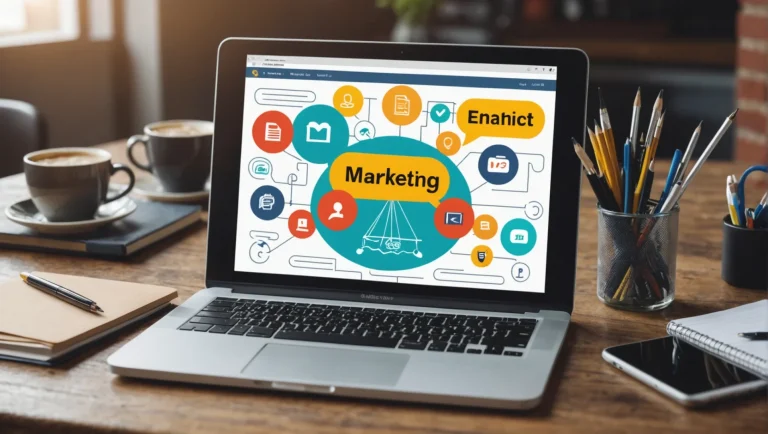

ChatGPT is good at the marketing work you keep putting off and bad at the marketing work that decides whether your business grows. That split is the whole answer. Hand it the social captions, the email drafts, the product descriptions and the ad variations. Keep the pricing, the positioning and the decision about which neighborhoods you deliver to.
If you run a bakery, a flower shop, a catering kitchen or a wholesale line, you have a second marketing problem most small businesses don’t: your delivery promise is part of the product. The cutoff time, the radius and the same-day window sell as hard as the thing in the box. Most generic advice about ChatGPT for small business marketing ignores all of that, which is why the copy it produces reads like it was written for a business with no vans.
This post covers the marketing side end to end. For the admin side of the same tool, see ChatGPT for small business owners, which goes deep on inbox, quoting and paperwork. If you haven’t opened yet, the ChatGPT prompts for starting a small business cover the idea-and-plan stage instead.
Metrobi drivers are rated 4.97/5
Trusted by local businesses for:
- Background-checked professionals
- Specialized in business deliveries
- Same drivers for consistency
- 4.97/5 average delivery rating
The Bottom Line
- ChatGPT earns its keep on first drafts and variations, not on strategy. Marketing professionals report some of the highest adoption of any profession, at roughly 65%, according to compiled ChatGPT usage data.
- The nine jobs worth handing over: social captions, email campaigns, product and menu descriptions, local ad copy, Google Business Profile posts, review replies, order and delivery notifications, repurposing one piece into five, and subject line testing.
- Every prompt needs three things to produce usable copy: who you sell to, what makes your delivery different, and a real example of your own voice.
- The free tier handles nearly all of this. Paid plans buy speed, memory and connections to your own files, not better marketing ideas.
- Keep human: pricing, your delivery radius and cutoff promises, anything claiming a specific outcome, and the final read before publish.
What ChatGPT is actually good at in small business marketing
Strip away the hype and ChatGPT is a fast, well-read writer with no idea what your business is like. That makes it excellent at four things.
Volume. Ten caption options in the time it takes to write one badly. Five subject lines instead of the one you’d have settled for.
Format conversion. One blog post becomes a newsletter, three social posts, an SMS blast and a script. This is the highest-return use on the list, and almost nobody does it.
Getting past a blank page. A mediocre first draft you can fix in four minutes beats a perfect draft you never start.
Rewriting to a constraint. “Same message, 140 characters.” “Same message, no exclamation points.” “Same message, for a restaurant buyer instead of a walk-in customer.”
What it is not good at: knowing your margins, knowing which customers reorder, knowing that Tuesday runs to the west side always go long, or telling you the truth when it doesn’t know something. It will invent a statistic with total confidence. The US Chamber’s guidance on using ChatGPT at your small business lands in the same place: a drafting tool with a human editor on top.
Tool choice matters less at this stage than most people expect. If you do want to connect it to your own calendar, files or invoices, the best ChatGPT plugins for small businesses covers which connectors pull their weight. But everything in this post works on a free account and a copy-paste habit.
Which marketing tasks to hand over and which to keep
| Marketing task | Hand to ChatGPT? | Why |
|---|---|---|
| Social captions and hashtags | Yes, fully | Low risk, high volume, easy to check |
| Email campaign drafts | Yes, with edits | Structure is formulaic; the offer is yours |
| Product and menu descriptions | Yes, with facts supplied | Needs your ingredients, sizes, lead times |
| Local ad copy variations | Yes, fully | Variation testing is exactly its strength |
| Review replies | Yes, with a final read | Tone matters; never send unread |
| Order and delivery notifications | Yes, as templates | Write once, reuse forever |
| Pricing and discount levels | No | It has no idea what you make per order |
| Delivery radius and cutoff promises | No | An invented cutoff becomes a broken promise |
| Positioning against a local competitor | No | It doesn’t know your market |
| Anything with a number in it | Check every time | Fabricated stats are the top failure mode |
Social media captions that sell your delivery window
Most small business social copy forgets the one thing customers want to know: can I get this today, and do you come to me? Put that in the prompt as a hard requirement.
A working prompt looks like this:
You write social captions for a neighborhood flower shop in Somerville, MA. We deliver same-day within 6 miles if the order is in by 1pm. Customers are mostly people sending apology or celebration bouquets, plus a few offices on standing orders. Write 8 Instagram captions for this week’s seasonal bunch (dahlias, eucalyptus, $48). Each under 150 characters, mention the 1pm cutoff in at least half, no hashtag spam, no exclamation points.
The constraints are doing the work. “Under 150 characters” stops the waffle. “At least half mention the cutoff” forces the operational detail into the marketing. “No exclamation points” strips out the default cheerfulness that makes AI copy read like a press release.
Then do the thing most people skip: paste in three captions you wrote yourself and say “match this voice.” Voice matching from examples beats any adjective you can supply. “Casual but not cutesy” means nothing to a model. Three real captions mean everything.
Email marketing for a local delivery list
Email is where a delivery business has an unfair advantage. You know what each customer ordered and roughly when they’ll need it again. That’s a reorder calendar most retailers would pay for.
Four email jobs worth drafting with ChatGPT:
- The reorder nudge. “It’s been about four weeks since your last order.” Supply the gap in weeks and the typical product, and let it write the copy.
- The cutoff reminder. Sent the morning of your busiest delivery day, aimed at the people who always order late. Short, one link, no preamble.
- The radius announcement. When you add a zip code, the customers just outside the old line are the warmest audience you will ever email.
- The slow-day offer. If Tuesdays are dead, a Tuesday-only delivery deal is a real campaign. Decide the discount yourself, then let ChatGPT write the five versions of it.
For subject lines, ask for ten and name the angles: two curiosity, two direct offer, two deadline, two question, two plain. You’ll pick one, but you’ll pick a better one than the first thing you’d have typed.
One caution on send timing. ChatGPT will happily suggest “best times to send” and quote them as fact. Those numbers are averages across industries that have nothing to do with yours. Your own open rates from two campaigns beat any benchmark it offers.
Product descriptions and menu copy for delivery orders
This is the highest-volume writing job in most food, floral and wholesale businesses, and it’s almost entirely mechanical once you’ve supplied the facts.
Give it a template and feed it rows:
Write a 40-word product description for an online store. Facts: [product name], [ingredients or materials], [size or serving count], [price], [lead time], [how it travels]. Tone: plain, warm, no adjectives like “artisanal” or “curated.” Always end with the lead time.
That last instruction is the delivery-specific part. “Order by noon for same-day” or “needs 48 hours’ notice” belongs in the description, not buried in a shipping policy page. Customers abandon carts over exactly this uncertainty.
For wholesale sheets the angle flips. Your buyer is a chef or a store manager who cares about case counts, minimums, delivery days and shelf life, not romance. Say that in the prompt, or you’ll get consumer copy aimed at a trade audience every single time.
Local ad copy and Google Business Profile posts
Paid local advertising rewards variation, and variation is close to free here. Ask for fifteen headline options across three angles (speed, selection, and local-ness) and you have a month of testing.
Two specifics for delivery-led businesses:
- Lead with the window, not the product. “Flowers delivered by 5pm today” tends to beat “beautiful seasonal arrangements” in local markets. It answers a question the buyer already has.
- Name the neighborhoods. Copy that lists the four areas you cover reads as more credible than copy claiming the whole metro, and it filters out clicks you can’t fulfill.
Google Business Profile posts are the most underused free channel in local marketing. They’re short, they expire, and nobody has time to write them, which makes them a perfect fit. Generate a month in one sitting, each tied to a product, a delivery day or a seasonal moment, and schedule the lot.
How to write a marketing prompt that gets usable copy
Nearly every complaint about generic AI output traces back to a thin prompt. A good marketing prompt has five parts.
- Role. “You write copy for a local catering company.” Sets the register.
- Audience. Who buys, and why. “Office managers booking lunch for 20, who mostly care about on-time arrival.”
- Operational facts. Radius, cutoff, minimums, lead times, price. The details that make the copy yours and not anyone’s.
- Format and constraints. Length, count, banned words, required elements. Be specific and slightly strict.
- Voice sample. Two or three things you actually wrote.
Then iterate instead of restarting. “Too formal, try again” gets you somewhere. Deleting the chat and rewriting the prompt from scratch gets you the same mediocre output a second time.
One habit worth building: keep your five best prompts in a note, with the operational facts already filled in. Reusing a prompt you’ve already tuned is the difference between this being a tool and being a novelty.
Where ChatGPT marketing output goes wrong
Four failure modes, in order of how much damage they do.
Invented facts. It will produce statistics, award names, press mentions and customer counts that do not exist. Anything numeric or checkable gets verified before it goes out. This isn’t an occasional glitch, it’s how the tool works.
Promises you can’t keep. Ask for urgent copy and you’ll get “delivered in under an hour” whether or not you can do that. An invented cutoff time is a customer service problem with a two-week fuse.
The same four words everyone else has. Elevate, unlock, seamless, game-changer. Delve, leverage, nestled. Readers have learned the pattern, and so have the detection tools. It’s worth understanding how AI detectors work before you publish at volume, less because you’ll be penalized and more because the signals that trip a detector are the same ones that make copy read as generic to a person.
Flattening your voice. This is the quiet one. Run everything through ChatGPT for six months without editing and you end up sounding like every other business that did the same. The fix is the voice sample and the final read, every time.
What to keep human
Short list, non-negotiable.
- Pricing and discounts. It doesn’t know your food cost, your driver cost or your margin.
- Your delivery promise. Radius, cutoff, minimums, guarantees. These are operational commitments, not copy.
- Anything about a named competitor. It will get details wrong, and you’ll be the one who published it.
- Replies to an angry customer. Draft it, absolutely. Send it unread, never.
- The decision about what to say. ChatGPT says things well and has no opinion worth having about what’s worth saying.
A weekly marketing routine that actually gets done
The reason small business marketing fails usually isn’t bad copy, it’s no copy. Here’s a 45-minute weekly block that holds up.
- Minutes 0 to 10. Pull up your saved caption prompt, generate ten, edit three, schedule them.
- Minutes 10 to 25. One email. Pick from the four jobs above, draft it, choose a subject line from ten options, send or schedule.
- Minutes 25 to 35. Review replies and one Google Business Profile post. Both drafted, both read, both posted.
- Minutes 35 to 45. Repurpose. Turn the email you just wrote into two social posts and one SMS.
That’s one email, ten captions, a profile post and your reviews handled every week from a standing start. It compounds in a way that a brilliant campaign every four months does not.
Marketing a delivery-led business gets easier when the deliveries themselves are predictable. Metrobi is a local delivery platform built for food, floral, catering and wholesale businesses, with multi-stop route optimization, the option to work with the same drivers over time, and a dedicated support rep on every delivery. That predictability is what lets you put a same-day cutoff in your ad copy without flinching.
Frequently asked questions
Can ChatGPT write my whole marketing plan?
It can write a document that looks like a marketing plan. The structure will be fine and the substance will be generic, because it doesn’t know your market, your margins or your capacity. Use it to pressure-test a plan you wrote, not to write one.
Is the free version enough for marketing work?
For everything in this post, yes. Paid plans — Plus at around $20 a month, Business seats at roughly $25 per user monthly — buy faster responses, a larger working memory and connections to your own files. They don’t buy better marketing judgment.
Will Google penalize AI-written content?
Google’s stated position is that it rewards helpful content regardless of how it was produced and acts against low-value content made to manipulate rankings. In practice the risk isn’t the tool, it’s publishing thin, unedited volume. Edited, fact-checked, useful posts are fine.
How do I stop it sounding like AI?
Supply a voice sample, ban the obvious words in the prompt, cut the first and last sentence of whatever it hands back, and read the result out loud. That last step catches more than any instruction you can write.
What’s the single best use of ChatGPT in small business marketing?
Repurposing. You already have content: emails, posts, a FAQ, answers you’ve typed to customers a hundred times. Turning one of those into five formats takes two minutes, and it’s the only use here that reliably produces more reach without producing more work.