


A bakery business plan is a written case that your bakery will make money, laid out in the sections a lender, a landlord, or an investor expects to find, in the order they expect to find them. It is not a creative document, and it is not a formality. It is the thing that gets read before anyone hands you a lease or a loan.
Most first-time bakery owners get stuck in the same place: they can describe the bakery vividly and cannot describe the arithmetic at all. This guide walks through every section of the plan, what belongs in each one, and how much detail is enough. If you would rather start from a structured document than a blank page, the free bakery business plan templates collection compares the free ones and says what each includes.
Key Takeaways
- A bakery business plan has nine standard sections. Lenders read the executive summary and the financials closely and skim the rest.
- The U.S. Small Business Administration requires a business plan when the loan is for startup financing, an acquisition, or expansion into a new market.
- Ten to twenty pages is the working range. Under ten usually means the financials are missing; over thirty usually means nobody will read it.
- Bakery format drives everything downstream. A home bakery, a retail storefront, and a bakery café have different capital needs, different margins, and different plans.
- Write the executive summary last, even though it goes first.
Boost customer satisfaction with just a few clicks
Most-Loved Features:
- On-demand drivers
- Real-time GPS tracking
- Delivery confirmation photos
- Over 50% of customers report a smoother delivery experience
What Is a Bakery Business Plan, and Who Actually Reads It?
A bakery business plan is a 10-to-20-page document covering your concept, market, products, operations, team, and financial forecast. Its job is to answer one question for a specific reader: will this bakery generate enough cash to pay them back?
That reader matters more than most guides admit, because it changes what you emphasize:
- A bank or SBA lender cares about repayment. In 2026 the SBA dropped the mandatory FICO SBSS screen for many smaller 7(a) loans, giving lenders more room to judge the whole business rather than one score, which means the strength of your written plan and your cash flow forecast carry more weight, not less (U.S. Small Business Administration, retrieved 2026-09-08). Lenders generally want a plan when the money is for startup costs, buying an existing bakery, or opening a second location.
- A landlord cares whether you will still be paying rent in year three. They will skim to the financial section.
- An investor cares about growth, which for a bakery usually means wholesale accounts, a second location, or a product line that ships.
- You care about the parts nobody else reads: production schedule, staffing, waste. This is the only section written purely for your own use, and it is the one that decides whether the business works.
Whoever the reader is, the financial section is where the plan is won or lost. That section is deep enough to deserve its own treatment. How to build bakery financial projections walks through the revenue build, cost lines, cash flow, and break-even calculation line by line.
Metrobi is transforming bakery deliveries
Specialized solutions for bakery businesses:
- Bakery-trained drivers
- Proper handling equipment
- Peak day delivery support
- 23% average cost reduction
The Nine Sections Every Bakery Business Plan Needs
Every standard plan format (SBA, SCORE, LivePlan, the bank’s own worksheet) is a rearrangement of the same nine sections. Learn them once and you can fill in any template.
| # | Section | What it answers | Typical length |
|---|---|---|---|
| 1 | Executive summary | What is this bakery and why will it work? | 1–2 pages |
| 2 | Company description | Who owns it, what legal structure, where | 1 page |
| 3 | Market analysis | Who buys, how many, from whom now | 2–3 pages |
| 4 | Products and menu | What you sell and at what price | 1–2 pages |
| 5 | Marketing and sales | How customers find you | 1–2 pages |
| 6 | Operations plan | How the product gets made and sold daily | 2–3 pages |
| 7 | Management and staffing | Who runs it and who works there | 1 page |
| 8 | Financial plan | The numbers, three years out | 3–5 pages |
| 9 | Appendix | Recipes, licenses, lease, resumes, quotes | As needed |
Sections 1 and 8 get read carefully. Sections 3 and 6 get read when the reader is unsure. The rest get skimmed. Budget your effort accordingly.
How to Write the Executive Summary
Write it last. It is a condensed version of the finished plan, and you cannot condense a plan you have not written.
One to two pages, covering: the concept in a sentence, the location and format, the target customer, what you sell, the funding you are asking for and what it buys, and the headline financial forecast: first-year revenue, the month you reach break-even, and net margin by year three.
A useful test: hand the executive summary alone to someone who knows nothing about your bakery. If they can tell you what the business is, who buys from it, and whether it makes money, it works. If they ask “so what would you actually sell?”, it does not.
Avoid the two failure modes. The first is atmosphere. Three paragraphs about the smell of fresh sourdough and no numbers. The second is a table of contents in prose: “This plan will discuss our market analysis, our operations, and our financials.” Say the conclusions, not the topics.
How to Write the Company Description
Short and factual. Legal name, trading name, entity type (LLC, S-corp, sole proprietorship), ownership split, location and why that location, and the bakery format.
The format choice deserves a real sentence of justification, because it drives every number that follows:
- Home or cottage bakery: lowest capital, capped by one kitchen and one person’s hours. Legal under cottage food laws in most states, with limits on what you can sell and where.
- Retail storefront: a counter, a case, walk-in traffic. Full rent and full staffing.
- Bakery café: seating, coffee, longer hours. Highest capital requirement and the most complex operation, but beverage sales carry a strong margin.
- Wholesale: you bake, someone else sells. Thin per-unit pricing, high volume, and delivery becomes part of the operation.
- Custom or celebration cakes: made to order, high price per unit, almost no waste.
These formats do not just cost different amounts to open. They earn different amounts. Bakery profit margins by format shows the spread, and it is wide enough that picking the format is effectively picking your ceiling.
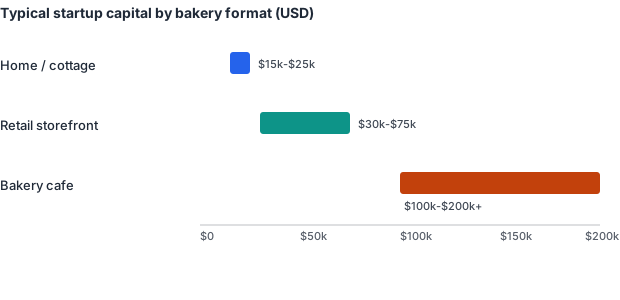
Ranges compiled from published bakery startup cost estimates, including Toast and ZenBusiness, retrieved 2026-09-08. Vendor-published estimates; treat as directional and build your own quotes.
How to Write the Market Analysis
This is the section most first-time owners fake, and lenders can tell. It has three parts.
Industry context. Two or three sentences with real figures. The U.S. bakery café industry is a $17.8 billion market across 9,112 businesses, while patisseries and cake shops account for $5.4 billion across 3,180 businesses (IBISWorld, 2026 figures, retrieved 2026-09-08). Use the segment that matches your format. Quoting the $58.8 billion commercial bread manufacturing figure in a plan for a 900-square-foot neighborhood bakery tells the reader you did not read your own source.
Your local market. This is what actually matters and it cannot be researched from a keyboard alone. Population within a fifteen-minute walk or drive. Median household income. Foot traffic at the hours you would be open. What else is on the street: a coffee shop that would send people to you, or a supermarket bakery that would not.
Your competitors, named. List the three to five bakeries your customers would otherwise use. For each: what they sell, roughly what they charge, when they are busy, and what they do badly. “There is no competition in our area” is read as “we did not look.”
Close the section with a positioning sentence that follows from the evidence: who specifically buys from you instead of them, and why.
How to Write the Products and Menu Section
List what you sell, in categories, with prices. Then do the part most plans skip: show the cost behind at least a few of those prices.
For a representative item, give the ingredient cost, the packaging cost, and the resulting gross margin. Ingredients typically run about a quarter of a baked product’s cost, with overhead adding another 15–20% (The Business Plan Shop, retrieved 2026-09-08). A reader who sees you cost a croissant properly will believe the rest of your numbers.
Keep the opening menu smaller than you want it to be. A tight list is cheaper to buy for, faster to produce, and generates less waste, and waste is where new bakeries lose their margin without ever seeing it on a report. You can add items once you know what sells.
How to Write the Marketing and Sales Plan
Answer one question: how does a stranger become a regular?
For most bakeries the honest answer is location and word of mouth, and a plan that says so is more credible than one promising a viral social campaign. Cover the channels you will actually run: signage and the window, a Google Business Profile, local press or neighborhood groups, one social platform done consistently, and a wholesale or catering channel if you plan one.
Attach a budget and a number to each. “Social media marketing” is not a plan. “$200/month on local Instagram ads targeting a three-mile radius, aiming for 40 new weekly customers by month six” is.
If wholesale is part of the model, treat it as a separate sales channel with its own section: how many accounts, average order size, delivery frequency, and payment terms. Wholesale revenue behaves nothing like retail revenue, and lenders know it.
How to Write the Operations Plan
This is the section you write for yourself. It describes a day.
Cover the production schedule (what time does baking start, what is made when, in what order), the equipment list with capacity, the space and layout, suppliers and lead times, storage and food safety, and the licenses and permits you need, which means health department approval, food handler certification, a business license, and a cottage food registration if you are baking from home. Permit and license costs typically land between $500 and $4,500 depending on size and jurisdiction (Toast, retrieved 2026-09-08).
Write the schedule as an actual timeline with clock times. Doing so surfaces the problems that spreadsheets hide: the oven that cannot hold everything for the 7 a.m. case, the proof time that means someone starts at 3 a.m., the delivery run that collides with the lunch rush.
If you plan to deliver, whether that is wholesale accounts, online orders or catering drops, say who drives, in what, on what schedule, and what it costs per stop. Delivery is a line item, not an afterthought.
How to Write the Management and Staffing Section
One page. Who owns and runs the bakery, what relevant experience they bring, and who else is on the payroll.
For a single-owner bakery, this section is mostly your own background: baking experience, any business or management experience, and an honest note on the gap. If you are a superb baker who has never run payroll, saying so and naming the bookkeeper you have hired reads as competence. Pretending otherwise reads as risk.
Then the staffing plan: roles, headcount, hours, and wage rates, matched to the production schedule from the operations section. Labor is commonly the largest single cost in a staffed bakery, so this section and the financial section have to agree with each other.
How to Write the Financial Plan
The financial plan is three years of forecast plus the assumptions behind it. At minimum, include:
- Startup costs: equipment, build-out, initial inventory, permits, deposits, and working capital to cover the first several months of losses. Equipment and opening inventory alone commonly run $6,500 to $42,000 (Toast, retrieved 2026-09-08).
- Revenue forecast: built from transactions and average ticket, not from a target you would like to hit.
- Profit and loss: monthly for year one, annual for years two and three.
- Cash flow statement: the one that shows whether you can make payroll in March.
- Break-even analysis: the sales volume at which you stop losing money.
- Funding request: how much, what for, and on what terms.
Break-even is the number lenders check first, and it is short arithmetic: fixed costs divided by the contribution each unit makes. A bakery with $3,500 in monthly fixed costs selling $5 loaves that cost $1 in ingredients needs 875 loaves a month to cover itself. Every loaf after that is contribution toward profit.
Build these numbers from your own quotes and your own menu prices rather than from industry averages. Averages tell you whether your answer is plausible; they cannot produce the answer. The full method is covered in the bakery financial projections guide.
How Long Should a Bakery Business Plan Be?
Ten to twenty pages for a plan going to a lender, plus appendices. A home bakery plan written for your own use can be five to ten.
Length is a symptom, not a goal. Under ten pages almost always means the financial section is thin. Over thirty means someone padded the market analysis with national statistics that have nothing to do with a bakery on one street. Lenders read a great many of these, and a tight plan is read more carefully than a long one.
Common Mistakes That Get Bakery Plans Rejected
Revenue forecasts built backwards. Deciding you need $30,000 a month and dividing to find the customer count is transparent to anyone who lends for a living. Build from customers and average ticket forward.
No working capital. Plans routinely fund the build-out and the equipment and nothing else, then run out of cash in month four. Around one in five U.S. businesses closes within its first year and roughly half are gone by year five, across all sectors (U.S. Bureau of Labor Statistics, Business Employment Dynamics, retrieved 2026-09-08). Undercapitalization is the usual mechanism.
Ignoring waste. Unsold product is a real, recurring cost line. A plan that assumes everything baked gets sold is not a forecast.
Copying a template without changing the numbers. Lenders recognize the sample figures from the popular templates. Use the structure; replace every number.
No named competitors. A market analysis without a competitor list is the fastest way to signal that no local research happened.
A menu of forty items on day one. It reads as indecision, and it costs money in inventory and waste before it earns any.
Frequently Asked Questions
Do I need a business plan to open a bakery?
Not legally. Practically, yes if you need outside money. The SBA and most banks require a business plan for startup financing, acquisitions, and expansion, and most commercial landlords will ask for one before signing a lease with a first-time operator. If you are self-funding a home bakery, a shorter plan written for yourself will still tell you things through the financial section that you would otherwise learn expensively.
How long does it take to write a bakery business plan?
Two to four weeks of part-time work for a first-timer, and most of that is not writing. The market research and the financial modeling take the time; the prose takes a few days. Working from a template shortens the structural work but not the research.
What is the hardest section of a bakery business plan?
The financial projections, consistently. Every other section describes something you already know. The financials require forecasting revenue for a business that does not exist yet, which means making assumptions and defending them.
Should I write the plan myself or hire someone?
Write it yourself, then have someone review it. A consultant can produce a more polished document, but the value of the plan is largely in what you learn building it, and a lender who asks a question you cannot answer about your own forecast will notice immediately.
How often should I update the bakery business plan?
Review it quarterly for the first two years, then annually. Compare the forecast against what actually happened and correct the assumptions rather than the targets. The plan stops being a fundraising document after opening and becomes a management one.
Can I use a generic business plan template for a bakery?
Yes, for the structure. The nine sections are the same for any small food or retail business. A flower shop business plan is built on the same skeleton. What is bakery-specific is the content: production schedules built around proof and bake times, ingredient costing at the recipe level, shelf life and waste, and a revenue model that depends heavily on time of day. A generic template will not prompt you for any of that.