


A typical bakery runs a gross margin of 60–80% and a net margin of 5–10%. Both numbers are real, they measure different things, and confusing them is the most expensive mistake in bakery pricing, because an owner who believes 70% is the take-home figure will price as though there is far more room than there is.
The gap between those two numbers is rent, wages, utilities, and everything thrown away at close. That gap is where a bakery is won or lost, and it is almost entirely within your control. Here is what the published ranges actually say, how to calculate your own, and the four things that reliably move the number.
Key Takeaways
- Gross margin runs 60–80% in a bakery. Net margin, after rent and payroll, typically lands at 5–10%, reaching about 15% in well-run operations.
- Cost of goods sold generally runs 25–35% of revenue. Everything left has to cover fixed costs before it becomes profit.
- Format predicts margin better than skill does. Home and custom-cake bakeries report far higher net margins than retail storefronts, mostly because they carry no commercial rent.
- Most circulating bakery margin figures come from vendor platforms rather than government data. Use them to sanity-check your arithmetic, never to replace it.
- The controllable number is contribution per item. Track it per product, not as a blended average.
Lower your delivery costs by 23%
How we reduce costs:
- No delivery vehicle expenses
- Optimized local routes
- Pay-per-delivery model
- Average 23% delivery cost reduction
What Is a Good Profit Margin for a Bakery?
Two figures, and every comparison you make should specify which one.
Gross margin is revenue minus ingredients and packaging. Bakery cost of goods sold generally runs 25–35% of revenue, producing a gross margin around 65–75%, with reported ranges stretching from 55% to 80% (BakeProfit, retrieved 2026-09-08). This is the number quoted in isolation, and it looks fantastic.
Net margin is what survives rent, labor, utilities, insurance, equipment, and waste. That is generally 5–10%, with strong operators reaching 10–15% (BusinessDojo, retrieved 2026-09-08).
The distance between a 70% gross margin and a 7% net margin is not a rounding error. It is the entire cost of running a shop. Any margin claim that does not say “gross” or “net” is close to meaningless, and a great deal of published bakery advice does not say.
If you are building these figures into a forecast rather than measuring an existing bakery, the arithmetic runs in the other direction. How to build bakery financial projections covers forecasting revenue and costs from scratch, and the margin ranges here are what those forecasts get checked against. Several of the free bakery business plan templates include financial exhibits already laid out this way.
Metrobi is transforming bakery deliveries
Specialized solutions for bakery businesses:
- Bakery-trained drivers
- Proper handling equipment
- Peak day delivery support
- 23% average cost reduction
Why Published Bakery Margin Numbers Contradict Each Other
Search for this figure and you will find 5% and 80% presented with equal confidence. Two reasons.
They measure different lines. An article citing 60–80% is quoting gross. One citing 5% is quoting net. Both can be accurate; they are not comparable.
Much of the data is self-reported by vendors. Several of the most widely shared bakery margin breakdowns come from software companies analyzing their own customer base, without naming an underlying dataset. That does not make them wrong, but it is not government or peer-reviewed data, and it likely skews toward businesses organized enough to be paying for software.
For independently published context on the market itself: the U.S. bakery café industry is worth $17.8 billion across 9,112 businesses, and patisseries and cake shops account for a further $5.4 billion across 3,180 businesses (IBISWorld, 2026 figures, retrieved 2026-09-08). A large, fragmented, slow-growing market, which is to say one where margin comes from operating well rather than from riding a wave.
Treat every precise-sounding margin figure, including the ones on this page, as a range to check your own arithmetic against.
Bakery Profit Margin by Format
Format changes the answer more than anything else, because rent and payroll either exist or they do not.
| Bakery format | Reported net margin | Why |
|---|---|---|
| Custom / celebration cakes | 30–50% | High price per unit, made to order, almost no waste |
| Artisan and specialty | 20–35% | Premium pricing on similar ingredient costs |
| Home / cottage bakery | 15–25% | No commercial rent, no payroll |
| Commercial / volume | 10–20% | Scale efficiency against thin per-unit pricing |
| Bakery café | 10–15% | Beverage margins help; seating and staff cost more |
| Retail storefront | 4–9% | Full rent and staffing against walk-in volume |
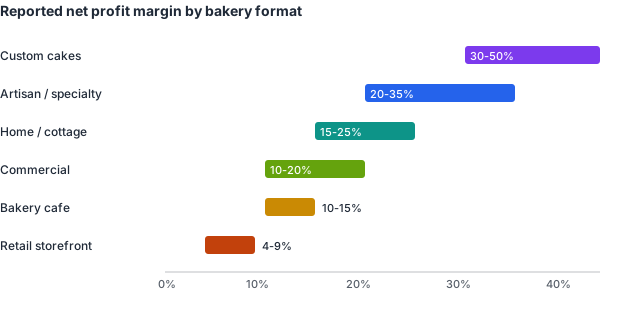
Ranges as published by industry sources including BakeProfit and BusinessDojo, retrieved 2026-09-08. Largely self-reported platform data; directional rather than precise.
Two formats at the top of that table behave differently enough to plan for separately. Custom cakes lead on made-to-order volume with almost no waste, and starting a cake business step by step covers how that model works in practice. Adjacent made-to-order food businesses behave the same way. Building a profitable charcuterie business runs on the same premium-pricing, low-waste logic.
The pattern is consistent: margin tracks fixed costs, not baking skill. A talented baker in an expensive storefront can easily earn less than an average one working from a home kitchen. Which is why format is a business-plan decision rather than an operational one. The bakery business plan guide treats it as the choice that sets every number downstream.
How to Calculate Your Own Margins
Industry ranges tell you whether you are roughly normal. Your own arithmetic tells you what to change. Both calculations are short.
Gross margin, per product:
Gross margin % = (Price − Ingredient cost − Packaging cost) ÷ Price × 100

Sourdough loaf:
  Price                 $7.00
  Ingredients           $1.10
  Packaging             $0.15
  Gross margin = (7.00 − 1.25) ÷ 7.00 = 82%
Net margin, whole business, monthly:
Net margin % = (Revenue − COGS − Operating costs) ÷ Revenue × 100

Example month:
  Revenue                        $24,000
  COGS (30%)                      $7,200
  Labor                           $7,400
  Rent                            $3,800
  Utilities, insurance, other     $2,900
  Net profit                      $2,700  =  11.3%
Run the per-product calculation for everything you sell, including labor time. Bakeries almost always carry two or three items that lose money once decorating hours are counted honestly. Heavily decorated goods and anything with a long proof time are the usual suspects.
The Four Levers That Move a Bakery’s Margin
Four things explain most of the difference between a 4% bakery and a 12% one.
Waste. Unsold product is pure loss and comes straight off the bottom line. Cutting sell-through waste from 20% to 10% often moves net margin further than a price increase would, and it asks nothing of customers. Production quotas set per day of the week, rather than one standing batch size, are the usual fix.
Labor scheduling. Labor commonly approaches 30% of revenue in a staffed bakery. Overlapping shifts during slow hours is the most frequent quiet drain, and it rarely shows up in the P&L as anything more specific than “labor is high.”
Product mix. Some items carry the business and some fill the case. Selling more high-contribution products beats selling more products in general, which is why the per-item calculation above matters more than the blended average.
Pricing discipline. Ingredient costs move. Menu prices often do not, sometimes for years. Ingredients account for roughly a quarter of a baked product’s cost and overhead a further 15–20% (The Business Plan Shop, retrieved 2026-09-08), so a flour price rise absorbed silently is margin given away. Re-costing your top ten items twice a year is unglamorous and reliably worth more than most marketing.
Why a Busy Bakery Can Still Lose Money
A full case and a queue at the counter say nothing about profit. Three mechanisms explain most busy-but-unprofitable bakeries.
The first is mix: high volume concentrated in low-contribution items. Coffee and a plain roll move quickly and contribute little; the cake that pays for the month sells twice a week.
The second is waste hidden inside COGS. If unsold product is never counted separately, the cost of overproduction shows up as a mysteriously high ingredient percentage rather than as a fixable operational problem.
The third is uncosted labor on made-to-order work. Decorated cakes and custom orders often look like the highest-margin products on the menu until the hours are attributed, at which point some of them are the worst.
All three are diagnosable in an afternoon with a per-item contribution calculation and a week of waste logging. Neither of those requires new software.
Frequently Asked Questions
What is a good profit margin for a bakery?
For net profit, 5–10% is typical and 10–15% indicates a well-run operation. For gross profit, 60–80% is the normal band, commonly cited around 70%. Always confirm which of the two a source means before comparing yourself to it.
Are home bakeries more profitable than storefronts?
By margin percentage, usually yes: reported net margins of 15–25% against 4–9% for retail storefronts, because there is no commercial rent and no payroll. By total dollars, usually no, since output is capped by one oven and one person’s hours. Percentage and profit are different goals.
What percentage of revenue should ingredients cost?
Cost of goods sold generally runs 25–35% of revenue, with many operators targeting under 30%. Consistently above 35% points to underpricing, portion drift, supplier costs that have risen without a price response, or waste being absorbed into COGS rather than tracked.
How long before a new bakery is profitable?
It varies too much for a single useful answer, and it depends primarily on fixed costs and the volume needed to cover them. The more useful question is your break-even point in units per month, a figure to calculate before opening rather than discover afterward.
Does adding coffee improve a bakery’s margin?
Usually yes on gross margin, since beverage cost of goods is low, which is part of why bakery cafés report better net margins than plain retail storefronts. It also adds equipment, training, and staffing, so the net effect depends on whether the added traffic covers the added fixed cost.
Should I raise prices or cut costs to improve margin?
Cut waste first, because it costs nothing and annoys no one. Then re-cost and reprice the items whose ingredient costs have moved. Broad price increases are the last lever, not the first, and they work better applied selectively to high-demand items than across the whole menu.