
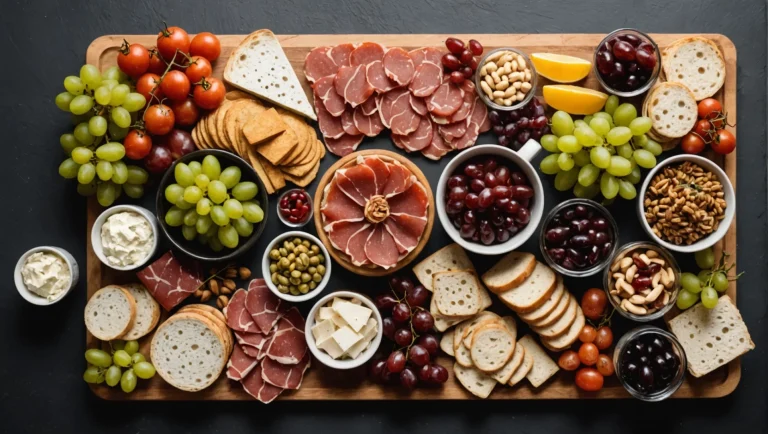

Most charcuterie marketing advice stops at “post pretty pictures on Instagram.” That’s not wrong, exactly. It’s just the part everyone already does, which is why so many board businesses have 4,000 followers and a quiet Thursday.
The boards that sell are rarely the prettiest ones. They’re the ones a specific person could find, price, and order without a three-day text thread. Marketing a charcuterie business is mostly about closing that gap between “that looks amazing” and “here’s my card.”
This guide covers the channels that produce orders for a small board business, what to put on each one, and how to turn a single graduation board into a standing corporate account.
The Bottom Line
Charcuterie demand is rising: Google searches for “charcuterie ideas” rose 30% between February 2024 and February 2026, and the term grew 161% on restaurant menus over four years (Tastewise).
Discovery has moved. 87% of consumers use Google to find local businesses, and use of AI tools like ChatGPT for local recommendations jumped from 6% in 2025 to 45% in 2026 (Local SEO statistics roundup, Shno).
Reviews decide the close. 41% of consumers always read reviews before picking a local business, and 31% only use businesses rated 4.5 stars or higher (WiserNotify).
Your highest-margin marketing isn’t an ad. It’s the referral partner, the repeat corporate client, and the order form that doesn’t make people wait for a quote.
Save 80% of delivery management time
We handle everything:
- Dedicated operations manager
- Real-time tracking dashboard
- Automated customer notifications
- Urgent issue resolution
Where charcuterie customers actually come from
Board orders come from four places, and they don’t deserve equal effort. Ranked by how much revenue they produce per hour you spend on them, the order usually goes: repeat and referral, local event and corporate work, local search, then social media.
That ordering surprises people, because social media is where charcuterie looks like it lives. Social is good at one job, proving you can build a beautiful board, and mediocre at everything else. It rarely tells someone what a board costs, whether you deliver to their zip code, or how far ahead they need to order.
Before you push hard on any channel, settle your prices. Nothing kills a warm lead faster than “message me for a quote,” and nothing makes you resent a busy December more than discovering your large boards were underpriced all along. Our guide to charcuterie board pricing walks through the cost-per-person math, packaging, delivery and margin, so the rest of this playbook has a real number behind it.
| Channel | Best for | Time cost | Typical payoff |
|---|---|---|---|
| Repeat and referrals | Steady baseline revenue | Low | Highest per hour |
| Events and corporate | Large orders, recurring accounts | Medium | High order value |
| Local search and Google | People ready to buy today | Medium upfront, low upkeep | Consistent inbound |
| Social media | Proof, discovery, top of funnel | High | Slow, indirect |
| Paid ads | Filling a specific gap | Low time, real money | Situational |
Most small board businesses should be spending roughly half their marketing time on the top two rows and treating social as the portfolio that supports them.
Metrobi is transforming charcuterie board deliveries
Specialized solutions for charcuterie board businesses:
- Charcuterie board-trained drivers
- Proper handling equipment
- Peak day delivery support
- 23% average cost reduction
The charcuterie marketing channels worth your time
Local search is where the ready-to-buy customers are
Someone typing “charcuterie board delivery near me” is not browsing. They have an event on Saturday. 98% of consumers search online for nearby businesses and 80% do it weekly (Salesgenie), which makes a complete Google Business Profile the most valuable half-hour on this list.
A profile that converts has all of the following, and most board businesses are missing at least three:
- Your actual service area, listed by city or neighborhood rather than a vague radius
- Price ranges or a starting price, so people self-qualify before they message you
- Twenty or more photos, refreshed seasonally, including boards in the format you most want to sell
- Your minimum lead time stated plainly, because “can you do tomorrow?” is the most common message you’ll get
- Products or services listed individually: small board, large board, grazing table, corporate drop
- A booking or order link that goes somewhere that takes orders
Then answer the questions people ask in the Q&A section yourself. Those answers show up in search results and in AI-generated summaries, which increasingly sit between your customer and your website.
Reviews do the selling you can’t do yourself
Reviews are the part of charcuterie marketing that compounds. 97% of consumers read online reviews before choosing a local business, and the bar is rising fast: 31% will only use businesses with 4.5 stars or better, nearly double the 17% who said so a year earlier (WiserNotify).
The mechanics matter more than the ask. Request the review within about 24 hours of the event, while the photos are still on their phone. Ask for something specific, along the lines of “if you have a second, would you mention the grazing table for the Anderson wedding?” Specific reviews read as first-hand, and they carry the keywords your future customers type.
Reply to them, too. Businesses that respond to at least a quarter of their reviews average 35% more revenue than those that don’t (WiserNotify). A reply is also a second chance to mention what you do: “Thanks Marcy, glad the vegetarian board worked for your team lunch.”
Charcuterie social media that does more than look good
76% of consumers who have tried charcuterie boards say they like or love them (Tastewise). You are not selling the concept. You’re selling you, at a price, in a radius, on a date.
So make your social feed do work a portfolio can’t:
- Post the build, not just the finish. Time-lapse assembly outperforms the hero shot because it shows labor, which is what justifies your price.
- Caption with the useful facts. Size, servings, price band, city. A caption reading “Large board, serves 10-12, $145, delivered in Somerville” converts strangers.
- Name the occasion. “Teacher appreciation week,” “closing gift,” “baby shower grazing table.” People search by occasion, not by product.
- Show the box, the cooler bag, the car. Proof that the board survives the trip answers the objection that stops most orders headed across town.
- Keep one pinned highlight that answers pricing, lead time, and delivery area. It will save you hundreds of DMs.
Instagram and Pinterest carry the most weight here because the product is visual, but treat a local Facebook group as an equal. Neighborhood groups are where “does anyone know someone who makes charcuterie boards?” gets asked every single week.
Email and SMS for the occasions that repeat
Charcuterie demand is seasonal and occasion-driven, which makes a list unusually valuable. Collect an email or phone number at every order, then tag it with the occasion. A list segmented by “corporate,” “holiday hosting,” and “personal celebration” lets you send three short, relevant messages instead of one generic blast.
The calendar writes itself: Thanksgiving, December holiday parties, Valentine’s Day, Mother’s Day, graduation, back-to-school teacher gifts, and summer wedding season. Send the reminder two to three weeks before each, with a cutoff date and a link that takes orders. The cutoff is what creates urgency; the link is what captures it before they wander off.
How to win corporate and event charcuterie orders
Corporate work is the quiet answer to seasonal income. One office that orders a board for monthly team lunches is worth more than a hundred likes, and it’s largely uncontested because most board businesses never pitch for it.
Go after four groups:
- Real estate agents. Closing gifts and open houses. They buy repeatedly and they refer, because a good closing gift makes them look thoughtful.
- Wineries, breweries, and tasting rooms. They need food they don’t have to cook, and a board is the natural pairing. Offer a standing weekend arrangement rather than a one-off.
- Office managers and HR coordinators. Team lunches, onboarding days, client visits. Ask to be added to the approved vendor list; that phrase alone gets you past the first gatekeeper.
- Event planners and venue coordinators. They control grazing table budgets for weddings and corporate events, where the total order value is several times a single board.
The pitch is not a menu. It’s a one-page sheet with three fixed packages, per-person pricing, your lead time, your delivery radius, and photos of exactly those three packages. Fixed packages win corporate work because the buyer isn’t spending their own money and doesn’t want to make decisions.
A referral commission of 10-15% to partners who send you business is standard, and it costs nothing until it works. Put it in writing, pay it promptly, and it becomes a sales team you don’t manage.
Make delivery part of the offer, not an afterthought
Charcuterie is a product people order for a moment that has a start time. The board that shows up at 4:45 for a 4:30 party is a bad board, whatever it looks like.
That makes delivery a marketing asset rather than a cost center. Saying “delivered within a two-hour window with a photo confirmation” on your order page answers the objection that stops most event orders, and it separates you from the home operator who says “pickup only.”
It also changes what you can sell. Once delivery is reliable, corporate drops, multi-stop holiday gift runs, and grazing table setups across town stop being favors you dread and start being the highest-value orders on your books. Metrobi runs local deliveries for charcuterie board businesses with route optimization for multi-stop runs, real-time tracking, and proof-of-delivery photos, so a December morning with eleven corporate drops is a planned route rather than a personal driving marathon.
Whatever you use, price the delivery into the board rather than bolting it on at checkout. Surprise fees at the final screen are one of the most reliable ways to lose an order you’d already won.
The charcuterie marketing mistakes that cost the most orders
A few patterns show up again and again in board businesses that have plenty of attention and not enough revenue:
- No published price. “DM for pricing” filters out serious buyers, not tire-kickers. Corporate buyers in particular will simply choose a vendor who published a number.
- No stated lead time. If people don’t know you need 72 hours, they’ll ask for tomorrow, you’ll say no, and they won’t come back.
- Marketing to everyone. A board business that serves weddings, offices, teacher gifts, and date nights equally well is invisible in all four. Pick the two you want and speak directly to them.
- Discounting instead of bundling. A 20% discount takes the cut straight out of your margin. A wine pairing, a matching dessert box, or free delivery over a threshold raises the order value instead.
- Letting a customer go quiet. The person who ordered for a baby shower has a birthday, a holiday party, and an office. One tagged email three weeks before the next occasion outperforms any ad you could buy.
- Chasing follower count. A thousand local followers who can order from you beat ten thousand scattered across the country.
Building a charcuterie marketing plan you’ll actually run
Pick three things and do them consistently, because a plan with nine channels is a plan you’ll abandon in March.
A workable starting set for most board businesses:
- Fix the foundation this week. Google Business Profile completed, prices published, lead time stated, order form live.
- Run one referral push a month. Five conversations with realtors, tasting rooms or office managers, in person or by phone rather than email.
- Send two seasonal emails a quarter. One reminder three weeks before the occasion, one last-call four days before the cutoff.
Post to social as the by-product of the work you’re already doing, not as a separate job. You’re building boards anyway; film one every time.
Then watch two numbers: average order value and the share of orders coming from repeat customers. If both are rising, the marketing is working even in a month when follower count didn’t move. If order volume is up but average order value is flat, your prices are the constraint, not your promotion, and that’s a different problem with a different fix.
Charcuterie is a strong category to be in right now. The term has grown 161% on restaurant menus in four years and is projected for 25% menu growth by 2026 (Tastewise). The businesses that capture that growth aren’t the ones with the best photos. They’re the ones a customer can find, price, and order from in under five minutes.