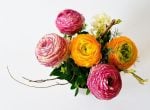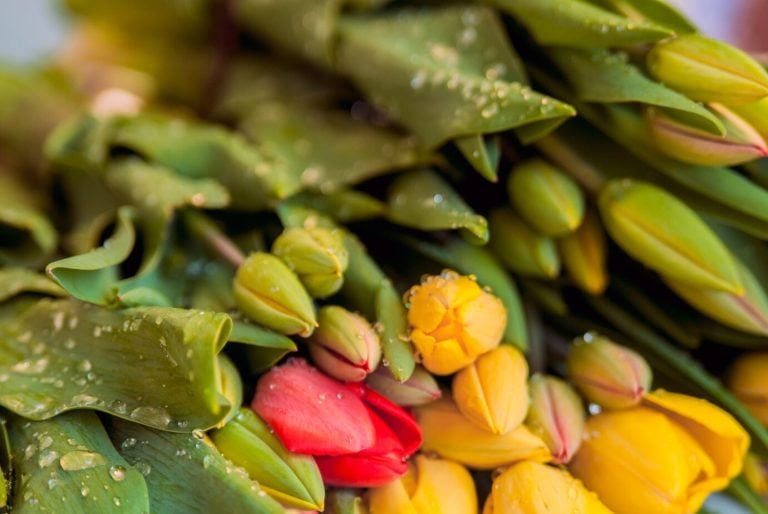

Among the stems a shop sells every week, the popular flowers that last the longest are carnations, chrysanthemums and alstroemeria, commonly cited at 14 to 21 days, 10 to 21 days and 10 to 14 days respectively. Roses and lilies sit in the middle at roughly 7 to 14 days. Tulips are the shortest of the common blooms, at about 5 to 10 days.
That ranking decides something more practical than it first appears. A bouquet that dies on day four generates a phone call; one that holds for two weeks generates a repeat order. For a shop that delivers, vase life is the part of quality the customer judges after the driver has gone, with no chance to explain anything.
This is the longevity view of the everyday stems: what the measured numbers actually are, how much of the range is under your control, and how the difference shows up in remakes and complaints.
The Bottom Line
- Carnations, chrysanthemums and alstroemeria are the longevity leaders among common stems, typically quoted at 14–21, 10–21 and 10–14 days (BloomsyBox).
- Trial data runs lower than trade ranges. NC State measured Dianthus ‘Bouquet Rose’ at about 11 days and ‘Fandango Crimson’ at 9–10 days, against the 14–21 days usually quoted for carnations (NC State Extension).
- Holding solution is the cheapest day you can buy. Snapdragons ran 7.5 days with a holding preservative versus 4 to 5 days without, a gain of more than 50% (NC State Extension).
- Cultivar beats species. Lisianthus cultivars in the same trial ranged from 9 days to 16.8 days (NC State Extension).
- Anthurium is the outlier of the popular specialty stems, with reported vase life as long as about six weeks (Thursd).
Metrobi drivers are rated 4.97/5
Trusted by local businesses for:
- Background-checked professionals
- Specialized in business deliveries
- Same drivers for consistency
- 4.97/5 average delivery rating
What vase life actually measures
Vase life is the number of days from arrival in water until a flower is no longer presentable: petal drop, browning edges, a bent neck, or a head that will not hold up. It is not shelf life, and it is not how long the flower survives in transit.
Three things make the published numbers slippery:
- The starting point differs. A grower measures from harvest. A trial measures from the moment stems enter the test solution. A customer measures from the day the box arrived, which may be several days later.
- The end point is a judgment call. Research protocols define termination criteria explicitly. Consumer guides rarely do, which is why the same flower appears at 14 days in one source and 28 in another.
- Treatment is usually unstated. A number quoted without saying whether a holding solution was used can be off by half.
For a shop, the number worth tracking is days from the customer’s doorstep, because that is the figure a complaint gets measured against.
Popular flowers ranked by vase life
Typical ranges for the stems that make up most everyday volume:
| Flower | Typical vase life | Notes for a delivering shop |
|---|---|---|
| Carnation | 14–21 days | Longest of the cheap stems; needs clean water to avoid bacterial blockage |
| Chrysanthemum | 10–21 days | Long life and high transit durability — the best combination on this list |
| Alstroemeria | 10–14 days, up to ~25 with care | Multi-headed, so it looks fresh as individual buds open |
| Rose | 7–14 days | Highly dependent on hydration at every handover |
| Lily | 7–14 days | Remove stamens to prevent petal staining |
| Gerbera | 7–14 days | Stem bends in deep water; use shallow water or support |
| Tulip | 5–10 days | Keeps growing in the vase and leans toward light |
| Hydrangea | ~11 days measured | Collapses fast if it dries out at any point |
| Sunflower | 8–11 days | Trial-verified range across 17 cultivars |
| Dahlia, peony, sweet pea | Short | Sell in person or on short routes |
Sources: BloomsyBox and NC State Extension postharvest trials.
Transit durability and vase life are different properties and the overlap is only partial. Statice survives any journey and is not a centerpiece; hydrangea looks magnificent and fails on both counts. For which stems hold up in a vehicle rather than in water, see types of flowers that travel well on a delivery route.
Carnation and chrysanthemum vase life: the long-life workhorses
These two deserve separating out, because they are cheap, available year-round, and they outlast almost everything a customer is more impressed by.
Carnation vase life is commonly quoted at 14 to 21 days. Measured trial figures are more conservative: NC State recorded Dianthus ‘Bouquet Rose’ at roughly 11 days and ‘Fandango Crimson’ at 9 to 10 days across treatments (NC State Extension). Even the conservative number beats most premium stems. The main failure mode is bacterial. Carnations block easily in dirty water, so the water the customer gets told about matters.
Chrysanthemum vase life runs 10 to 21 days, and some reporting puts certain varieties considerably higher. Combined with how well mums handle a delivery vehicle, that makes them the highest-value stem per dollar of risk in the cooler.
Both share a commercial problem: they read as inexpensive. The answer is composition rather than substitution: build the structure and the longevity out of carnations and mums, then spend the premium budget on two or three focal stems. The bouquet holds for two weeks and still photographs like a designed piece.
One caution worth knowing. Carnations are strongly ethylene-sensitive, along with delphinium, snapdragons, sweet peas and Asiatic lilies. Keeping them away from ripening fruit, spent blooms and damaged foliage protects a large share of the vase life you just paid for.
How long roses, lilies and gerberas last in a vase
The mid-range stems carry most of the revenue, so their variance costs the most.
Roses are quoted at 7 to 14 days, and the spread is almost entirely about water. A rose that was dry for an hour at any point, whether on the bench, in the van or on a porch, has already spent some of its vase life. Air entering the stem is what causes the bent neck that shows up on day three.
Lilies also run 7 to 14 days, and they have the advantage of staged buds: the display renews itself as later buds open. Removing stamens before delivery prevents pollen staining, which generates complaints that have nothing to do with longevity but get reported as “they went bad”.
Gerberas are quoted at 7 to 14 days but are the most technique-dependent flower on the list. The hollow stem rots in deep water and bends permanently once it softens. Shallow water, clean containers and stem support are the difference between the top and bottom of that range.
Short-vase-life flowers and how to price them
Tulips, dahlias, peonies and sweet peas are not mistakes to remove from the cooler. They are the blooms customers specifically ask for, and they are worth selling with the right expectations.
Tulips run 5 to 10 days and have two quirks worth telling the customer about: they keep growing after cutting, so an arrangement changes shape, and they bend toward light. Neither is a defect, but both get reported as one.
Three ways to sell the short group without absorbing the cost:
- Sell them seasonally and say so. “Peony season, three weeks only” sets an expectation of brevity rather than failure.
- Pair them with long-life structure. A tulip bouquet with alstroemeria and foliage still looks intentional on day eight after the tulips go over.
- Favor short routes. Time in the vehicle comes out of the same budget as time on the table.
Why cultivar matters more than species
The most useful finding in the trial data is that the species name tells you less than the cultivar does.
In the same NC State trial series, lisianthus cultivars under identical treatment ranged from 9 days (‘ABC 1-3 White’, ‘ABC Lavender’) to 15.5–16.8 days (‘Fioretti Green’) (NC State Extension). That is a near-doubling inside one species. Sunflowers show the same pattern: across 17 cultivars tested over five years, most landed at 8 to 11 days with preservative, with only three exceeding 14 days (NC State Extension).
The practical move is to ask wholesalers for cultivar names and keep your own record of which ones come back without complaints. That record is worth more than any published range, because it is measured on your routes, your cooler and your customers.
What conditioning and holding solutions add
Treatment is the one lever that costs almost nothing and reliably buys days.
The NC State figures are unusually clean on this point:
- Snapdragon ‘Chantilly Deep Orange’: 7.5 days with a holding preservative, 4–5 days without.
- Sunflower ‘Orange Glory’: 12.5 days with holding solution, 9.5–10.5 days without.
- Sunflower ‘Tosca’: 11–11.5 days with holding solution, 9.5–10 days without.
- Zinnia: 13–14 days with commercial preservative, about 8 days in plain water.
Temperature is the other lever. Most cut flowers hold best at 33–35°F, with tropicals needing 50–55°F instead, and cooler-industry guidance holds that flowers kept at 33–35°F last roughly twice as long as those stored above 35°F (Sensitech; Water Chillers). Flowers that sit on a warm bench for an hour before loading have already spent part of what the holding solution bought.
Interestingly, the trials also show treatment is not universally positive. Ornamental pepper reached 18.4 days with a holding preservative alone but dropped to about 14 days when a hydrating solution was added first, and one lisianthus cultivar did better without holding preservative than with it. Testing beats assuming.
How vase life shows up in complaints and remakes
Longevity is a cost line, not just a quality attribute. The arithmetic is worth doing once.
Suppose a shop delivers 60 bouquets a week at an average $75, and 4% generate a complaint that ends in a remake or refund. That is roughly 2.4 bouquets a week, or about $180 of revenue plus the labor and stems to rebuild them: call it $9,000 a year once product cost is included. Shifting the standing recipe toward long-life stems and adding holding solution typically costs cents per stem.
Two patterns are worth separating when complaints come in:
- Day one and two failures are almost always transit or hydration problems: a dry van, a hot porch, a long route. They are a delivery issue.
- Day four and five failures are a stem-selection or conditioning issue. The flower was never going to last, or it was never properly conditioned.
Logging which bucket each complaint falls into turns a vague “our flowers don’t last” worry into one of two fixable problems. The first is solved by shortening time in the vehicle, which is what multi-stop route planning on a platform like Metrobi is for. The second is solved in the cooler, before anything is loaded.
Building a long-lasting bouquet from what you already stock
A workable default recipe for delivered volume, built from the longevity data rather than from taste:
- Structure and volume from the long-life group. Carnations, chrysanthemums, alstroemeria and durable foliage. These hold the shape for two weeks.
- One or two focal stems from the mid-range group. Roses or lilies, placed where the eye lands first.
- Short-life stems only by request or in season. Priced accordingly, routed short.
- Holding solution on everything, and a care card that says what to do: fresh water, recut every two to three days, away from heat and fruit.
The care card matters more than it looks. A customer who follows it gets the top of each range rather than the bottom, and attributes the result to your shop.
Frequently asked questions
Which flowers last the longest in a vase? Among common stems, carnations and chrysanthemums lead, typically 14–21 and 10–21 days, with alstroemeria close behind. Among specialty blooms, anthurium is reported as the longest-lasting of all.
How long do roses last in a vase? Roughly 7 to 14 days. Where a given rose lands in that range depends almost entirely on whether it stayed hydrated from the cooler to the customer’s table.
Why do my flowers last longer in the shop than at the customer’s house? A shop has a cooler, clean water, flower food and someone recutting stems. A customer usually has none of those. The gap between shop conditions and home conditions is most of the difference.
Does flower food really work? Yes, measurably. Trials show gains of several days: snapdragons at 7.5 days with a holding preservative against 4 to 5 days without, and zinnias at 13 to 14 days against about 8 in plain water.
Which flowers should I avoid for delivered bouquets? Not avoid, but route carefully: peony, dahlia, sweet pea and hydrangea all have short vase life or poor transit tolerance and suit in-person sale or short local runs.
Buy the days, not the look
Two weeks of vase life is a product feature a customer can see and a competitor can’t easily copy. It costs almost nothing: a shift in the standing recipe toward carnations, mums and alstroemeria, holding solution in every bucket, and a cooler kept honest at 34°F.
The flowers people call beautiful and the flowers that last are not the same set, and the gap between them is where the remake rate lives. Build the structure from the long-life group, spend the premium on the focal stems, and let the bouquet still be worth looking at on day twelve.