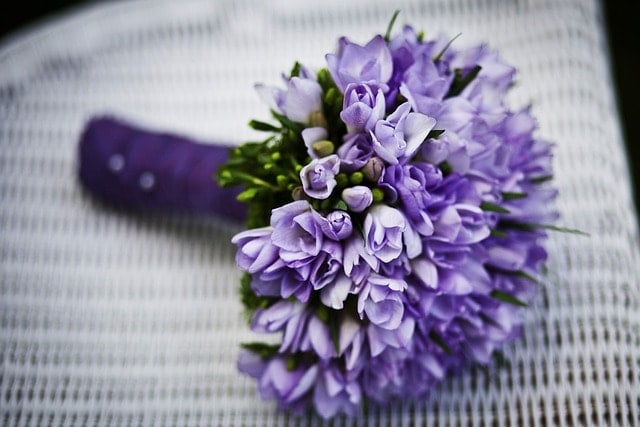

Learning how to make a flower bouquet takes an afternoon. Learning to make one that holds its shape in a van, survives four days in a customer’s kitchen, and still returns a margin takes a recipe you can cost. This covers both: the spiral hand-tie that produces a professional bouquet every time, and the stem-by-stem pricing that decides whether it was worth building.
The technique part is learnable in a week. The part most shops get wrong is the arithmetic. A bouquet with $18 of stems in it should be retailing at roughly $60 to $80, and shops that estimate from memory instead of pricing the recipe consistently land under that. The flowers you choose also have a price of their own: what is at peak on the day changes the cost base entirely, which is why picking the season’s flowers comes before the bench work. And if you are building bouquets at volume for weddings and parties, the surrounding business of booking event clients is a separate skill worth as much as the design.
The Bottom Line
- Every bouquet is three ingredients: focal flowers, secondary and filler stems, and greenery. Get the proportions right and almost any flower combination works.
- The spiral is the whole technique. Add each stem at the same angle, turn the bouquet a quarter turn with every stem, and never turn your hand (Lacy Bird hand-tied guide).
- A workable balance is roughly 20–30% focal, 30–40% secondary, 20–30% filler and 15–20% greenery.
- Price the recipe, not the impression. Mark up flowers and sundries 3x to 3.5x for retail bouquets, then add labor. A $60–80 retail price on $18 of stems is the normal shape (Floral pricing formulas).
- Strip everything below the tie point, leave 4 to 5 inches of clean stem, and cut flat so the bouquet can stand in water.
Metrobi drivers are rated 4.97/5
Trusted by local businesses for:
- Background-checked professionals
- Specialized in business deliveries
- Same drivers for consistency
- 4.97/5 average delivery rating
The three ingredients in every flower bouquet
Stop thinking in flower names and start thinking in roles. Every hand-tied bouquet, from a $35 market bunch to a $400 bridal piece, is built from the same three categories.
Focal flowers are what the customer sees from across the room: roses, peonies, dahlias, sunflowers, lilies, large chrysanthemums. They carry the price and set the style. You want few enough that each one reads individually.
Secondary and filler stems do the structural work: lisianthus, alstroemeria, spray roses, carnations, stock, wax flower, gypsophila, solidago. They fill the gaps between focals, create depth, and make the bouquet look full without the cost of more focal heads. This is where the margin lives.
Greenery gives shape, movement and the frame that stops the whole thing reading as a lump. Eucalyptus, ruscus, pittosporum, italian ruscus, salal, or seasonal foliage.
Once you see a bouquet as three jobs rather than eight flowers, substitution becomes easy. If the dahlias did not come in, you need another focal, not another dahlia.
What to have on the bench before you start
Lay all of this out first. Stopping halfway through a spiral to find scissors is how bouquets get dropped.
- Flowers, already conditioned and in water (see below)
- Sharp floral snips, not kitchen scissors, which crush the stem and block water uptake
- Stem stripper or a knife for clearing foliage
- Binding: floral tape, bind wire, or natural twine
- Ribbon for the finish, plus pins if the handle is wrapped
- A clean bucket with fresh water and flower food, standing ready
- A mirror, if you have wall space. Checking the bouquet in a mirror catches lopsidedness your hand cannot feel.
Clean is not an aesthetic preference. Bacteria in a bucket blocks the stem and costs days of vase life, which the customer experiences as a bad bouquet.
How to make a flower bouquet with the spiral technique
The spiral is why professional bouquets have a slim handle and an even dome, and why a bunch gathered in a fist has neither. Every stem enters at the same angle, so they stack around a single point instead of crossing randomly.
1. Strip the stems. Clear all foliage from the bottom two-thirds of every stem. Anything below the tie point has to go. Leaves under the waterline rot, and leaves in the binding make the handle bulky and slippery.
2. Build a base. Hold three or four sturdy greenery stems and cross them near the top, just below where you intend to tie. Place your first focal flower into the middle. This gives you a collar to build against.
3. Hold at the tie point. Grip loosely between thumb and forefinger at the spot where the binding will go, a few inches below the heads. A loose grip is essential: a tight fist stops stems from sliding into place and bruises them.
4. Add each stem at the same angle. Lay every new stem diagonally across the ones already in your hand, at roughly 45 degrees, always from the same side. Never push a stem down into the middle.
5. Turn the bouquet, not your hand. After each stem, rotate the bouquet a quarter turn in the same direction. This is the discipline the whole technique rests on: it is a wrist movement, and if you turn your hand instead, the spiral collapses. Rotate consistently and the stems arrange themselves into a fan at the bottom.
6. Alternate the roles. Go focal, secondary, filler, greenery, then repeat. Resist the urge to add all your roses first. They will cluster on one side, and no amount of later filler fixes it.
7. Check the dome as you go. Hold the bouquet at arm’s length every few stems. Focal heads should sit at slightly different heights, not on one flat plane, which is what makes a bouquet look designed rather than sliced.
8. Finish the outside with greenery. A final pass of foliage around the perimeter gives the bouquet a clean edge and hides the mechanics.
If it starts to look flat, add greenery around the outside. If it starts to feel heavy and crowded, pull one or two filler stems out and check the shape again. The bouquet should feel light in the hand; weight usually means too many stems, not too much flower.
Stem ratios that make a bouquet look full without adding cost
Fullness is a proportion problem, not a quantity problem. These are reliable starting points:
| Bouquet size | Focal flowers | Secondary / filler | Greenery | Typical total stems |
|---|---|---|---|---|
| Market / everyday | 3–5 | 10–15 | 5–7 | 18–27 |
| Standard retail | 5–8 | 12–18 | 6–9 | 23–35 |
| Bridal / statement | 10–15 | 12–20 | 7–10 | 29–45 |
Expressed as a balance rather than a count: roughly 20–30% focal, 30–40% secondary, 20–30% filler, and 15–20% greenery.
The commercial point hiding in that table is the ratio of the first column to the second. Focal stems are the expensive ones (standard roses wholesale around $3 to $5.50 a stem, garden roses $5.50 to $9), while filler and greenery cost a fraction of that. A bouquet that reads as generous because of its filler-to-focal ratio costs materially less than one that reads as generous because it has four more roses in it, and most customers cannot tell the difference from the doorway.
Which is not an argument for skimping. It is an argument for spending the focal budget on three stems a customer will actually notice rather than eight that blur together.
How to condition flowers before you build
Conditioning is the step that decides whether your bouquet lasts four days or nine, and it happens before any of the above.
Cut every stem at a sharp angle with clean snips, which exposes more surface for water uptake and prevents the cut end sealing flat against the bucket bottom. Do it under water if you can, or at least immediately before the stem goes into water, so no air gets drawn into the stem.
Strip foliage below the waterline. Use flower food at the correct dilution rather than by eye. Let stems drink for several hours, ideally overnight, in a cool place before you build anything.
Know which flowers need special handling. Tulips keep growing and reorienting after cutting. Hydrangea drinks through its head as well as its stem and will wilt within hours if it dries out. Daffodils leak a sap that shortens the life of everything sharing their water, so condition them separately for at least a few hours first. Peonies bought in tight bud will give you close to ten days; the same flower bought fully open may give you three or four.
Vase life varies more than customers expect: chrysanthemum and alstroemeria run 14 to 21 days, carnations 10 to 21, standard roses 7 to 14, tulips and peonies 5 to 10, ranunculus around 7 (Lacy Bird vase life guide). Building a bouquet that mixes a 21-day flower with a 4-day flower means the customer judges the whole thing by the one that died first.
Tying, cutting and wrapping the finished bouquet
Tie at the grip point. Without loosening your hand, bind tightly with floral tape, bind wire or twine right where you have been holding, starting about an inch below the lowest flower heads. Wrap several times and pull firm. The binding is structural, not decorative. If the bouquet can rotate inside the tie, it is too loose.
Cut the stems flat and level. Trim the whole handle in one pass so every stem reaches the water. Leave four to five inches of clean stem below the binding. A bouquet with stems cut at different lengths has flowers that will not drink.
Wrap the handle. Ribbon over the binding, secured with pins pushed up into the stems at an angle, or tied off neatly if you prefer no hardware. For a bridal bouquet, wrap so no mechanics are visible from any angle, including from below, because that is the angle every photograph is taken from.
Water it immediately. Straight into a clean bucket with flower food. A finished bouquet left out on a bench while you make the next one is losing vase life you already paid for.
Sleeve for the customer. Protects the heads and makes the bouquet easier to carry without crushing. Include a care card with the flower food. Customers who get nine days out of a bouquet come back sooner than customers who get four.
How to price a flower bouquet so it actually makes money
Here is the discipline that separates a profitable bench from a busy one: list every stem, every piece of foliage, every sundry, apply your wholesale cost, apply the markup, and add labor. Never price from the last similar bouquet you made, because that estimate is always low.
The standard retail structure:
Retail price = (wholesale flowers + sundries) × 3 to 3.5, plus labor
Worked through on a standard retail bouquet:
| Line | Detail | Cost |
|---|---|---|
| Focal | 6 standard roses @ $4.00 | $24.00 |
| Secondary | 8 lisianthus @ $1.80 | $14.40 |
| Filler | 6 wax flower @ $0.90 | $5.40 |
| Greenery | 7 eucalyptus @ $1.10 | $7.70 |
| Sundries | Tape, wire, ribbon, sleeve, care card | $3.00 |
| Subtotal | $54.50 | |
| Markup | × 3.0 | $163.50 |
| Retail | Rounded | $165.00 |
Scale that formula down and the arithmetic still holds: about $18 of stems in a simple market bouquet lands at $60 to $80 retail. Scale it up and a bridal bouquet with $30 to $80 of wholesale flowers across 25 to 50 stems, plus $5 to $15 of mechanics, at a 3x to 3.5x markup, is exactly where bridal pricing actually sits.
Three rules keep it honest:
- Do not round stems down. Half a bunch of eucalyptus is half a bunch of eucalyptus, not “a bit of greenery”.
- Charge for labor separately on event work. Markup covers the product and the shop overhead. It does not cover the hour of processing and building.
- Reprice when wholesale moves. Seasonal swings of 20% to 40% and holiday spikes both erode a markup. A recipe costed in September is wrong in February.
Shops that sell through wire services should also price with the service’s commission and fees already deducted. How flower wire services take their cut changes what an order is worth to you before you decide how much flower to put in it.
The bouquet mistakes that cost you margin
Gripping too tightly. Stems will not seat, the spiral fails, and soft petals bruise under your fingers.
Adding all the focals first. They cluster. Alternate roles from the start.
Turning your hand instead of the bouquet. The most common beginner error and the one that produces a tangle rather than a spiral.
Building everything at one height. A flat plane of flower heads reads as a supermarket bunch regardless of what the stems cost.
Leaving foliage below the tie. Rots the water, bulks the handle, shortens vase life.
Over-filling. More stems is not more beautiful, and it is definitely less profitable. If the bouquet feels heavy, take something out.
Estimating the price. The single most expensive habit on this list.
Building bouquets that have to survive a delivery
A bouquet handed across a counter and a bouquet driven across town are not the same product, and the second one needs decisions made at the bench.
Choose focals that tolerate contact. Chrysanthemums, carnations, alstroemeria, lisianthus, standard roses and gladiolus travel well. Dahlias, peonies, garden roses and anything fully open bruise on the lightest contact and should be boxed so nothing touches them.
Bind tighter than you would for a walk-in. A bouquet that can shift inside its tie will arrive as a different shape than the one you built.
Travel in water wherever the design allows, and keep the van cool: most non-tropical cut flowers want to sit at 32 to 35°F, and a warm hour in July costs more vase life than a warm hour in January. Hydrangea in particular needs a water source for any journey beyond a few minutes.
Build fragile elements last so they spend the least time out of the cooler, and sleeve everything before it leaves the bench. The delivery is part of the product, and a customer who receives a bruised bouquet does not blame the van.
Frequently asked questions about making flower bouquets
How many stems do you need for a flower bouquet? A simple hand-tied bouquet runs about 18 to 27 stems: 3 to 5 focal flowers, 10 to 15 secondary and filler, and 5 to 7 greenery. Bridal bouquets commonly use 25 to 50 stems depending on the size and the flower.
What is the spiral technique? Laying every stem across the bouquet at the same angle while rotating the bouquet a quarter turn with each addition. It produces an even dome, a narrow handle, and stems that fan out at the base so the bouquet can stand on its own.
How do you make a bouquet look fuller without spending more? Shift the ratio toward secondary and filler stems rather than adding focal heads, vary the heights so the heads do not sit on one plane, and finish the outside with a pass of greenery. Filler and foliage cost a fraction of what focal flowers cost.
How much should I charge for a flower bouquet? Multiply the wholesale cost of flowers and sundries by 3 to 3.5 for retail work, then add labor for anything event-related. That puts roughly $18 of stems at $60 to $80 retail, and a $54 recipe at around $165.
How long should a hand-tied bouquet last? Four to ten days for most mixed bouquets, driven by the shortest-lived flower in it and by conditioning. Longer-lasting mixes built on chrysanthemum, alstroemeria and carnation can hold two weeks or more.
Is making bouquets a profitable part of a flower shop? It is the core of retail floristry, though margins are thinner than on event work. Where it pays best is recipe discipline and volume. Shop economics vary widely, and what florists actually earn puts the bench work in context.
Getting the bouquet and the number right
The spiral technique stops being conscious after about thirty bouquets. You will hold loosely, turn without thinking, and feel when a stem has gone in wrong. That is the easy half, and it arrives on its own with practice.
The half that does not arrive on its own is the recipe sheet. Cost one bouquet properly, every stem and every sundry, markup and labor, and you will find out whether the thing you have been selling at $55 was ever worth building. Do that for your six most-sold designs and the bench starts paying for itself.