
Most brewery equipment lists stop at the packaging line. That’s fine if a distributor picks the beer up at your dock. If you deliver your own, the list has two more stages on the end, and they’re the ones that get skipped in the budget and then bought in a panic three weeks after opening.
Here’s the whole thing in five stages: the hot side, the cellar, packaging, cold storage, and everything that moves finished beer out the door. Roughly $100,000 to $180,000 covers a new 7-barrel brewhouse on its own, and that’s before fermenters, glycol, cold storage or a van. The equipment is the single largest number in a brewery business plan, so it’s worth walking the list properly.
Equipment is only half the spend. The consumables and packaging that run through it, from malt and hops to cans, kegs and chemicals, are covered separately in our guide to brewery supplies for self-distribution.
The Bottom Line: A commercial brewery equipment list runs in five stages. Hot side (mill, HLT, mash tun, kettle, pumps). Cellar (fermenters, brite tanks, glycol chiller, CIP). Packaging (canning line or keg filler, keg washer). Cold storage (walk-in cooler held around 35–42°F). And delivery (pallet jack, keg hand truck, load bars, a vehicle that keeps beer cold). New 7 to 15 bbl systems land between $120,000 and $350,000 all-in; used brewhouses sell for 40–60% of new.
Lower your delivery costs by 23%
How we reduce costs:
- No delivery vehicle expenses
- Optimized local routes
- Pay-per-delivery model
- Average 23% delivery cost reduction
The five stages of a brewery equipment list
Think of the list as a path the beer takes, not a catalogue. Each stage hands off to the next, and a bottleneck anywhere sets the ceiling for the whole operation.
- Hot side. Turns grain and water into wort. Sized in barrels, and this number defines your brewery.
- Cellar. Turns wort into beer and holds it. Fermenter count, not brewhouse size, is what actually limits annual volume.
- Packaging. Puts beer into kegs or cans. The most variable line on the budget by an order of magnitude.
- Cold storage. Keeps finished beer at temperature until it leaves.
- Delivery. Moves it to accounts without warming it or dropping it.
Breweries routinely budget the first three, under-budget the fourth, and forget the fifth entirely.
Metrobi is transforming beverage deliveries
Specialized solutions for beverage businesses:
- Beverage-trained drivers
- Proper handling equipment
- Peak day delivery support
- 23% average cost reduction
Brewhouse equipment: the hot side
This is the equipment people picture when they picture a brewery.
- Mill. Cracks the malt. Some breweries buy pre-milled grain at first and add a mill later, which is a legitimate way to defer capital.
- Hot liquor tank. Stores and heats your brewing water.
- Mash tun. Holds grain and water at temperature and separates wort from the spent grain bed.
- Brew kettle. Boils the wort. On smaller systems the kettle and whirlpool are often the same vessel.
- Whirlpool. Separates hop matter and trub after the boil.
- Heat exchanger. Drops wort from boiling to pitching temperature on the way to the fermenter.
- Pumps and hoses. Unglamorous, constantly in use, and worth buying one more of than you think you need.
- Control panel. Steam, direct fire or electric, plus the automation that runs it.
Almost all of it is stainless steel. A used 7-barrel brewhouse in good condition sells for roughly 40% to 60% of new, which is the single biggest lever a startup brewery has on this part of the list.
Cellar equipment: fermentation and conditioning
The cellar is where breweries run out of room first.
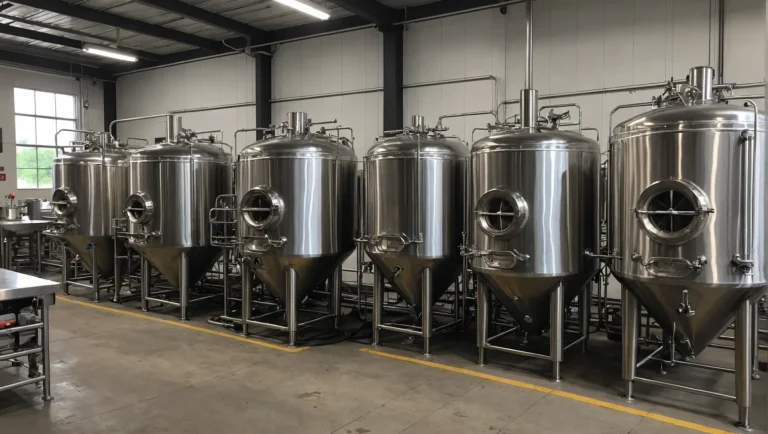
Fermenters. Unitanks in the 5 to 10 barrel range commonly run $3,500 to $10,000 each, with larger and more automated vessels climbing well past that. Buy in multiples: a 7-barrel brewhouse with two fermenters is a very different business than the same brewhouse with six, because fermentation time, not brew time, is the constraint.
Brite tanks. Carbonation and clarity before packaging. Skipping brites to save money means carbonating in the fermenter and tying up your fermentation capacity, which usually costs more than the tank would have.
Glycol chiller and lines. The cooling system for every jacketed tank in the building. A complete system with tanks, lines and installation typically adds $5,000 to $15,000, though quoted chiller prices alone span a very wide range depending on tonnage.
CIP cart or system. Clean-in-place hardware for tanks and lines. Caustic, acid and sanitizer cycles run through it every day.
Hoses, clamps, gaskets and fittings. The cellar consumes these constantly.
Size the glycol before you finalise tank count. Chillers undersized for a full cellar are one of the most common and most expensive brewery retrofits.
Brewery packaging equipment: kegs, cans and bottles
This is the widest cost range on the whole brewery equipment list, and the choice is strategic rather than technical.
Keg-only operations can get started with something like $8,000 to $25,000 of equipment: a keg filler, a washer, couplers and racking. If you self-distribute locally, keg-first is the cheapest credible way to get beer into accounts.
Canning lines range from basic setups around $15,000 to full automated lines north of $200,000, with modern micro-canners typically starting around $80,000. Canning opens retail shelves and takeaway sales, but it also brings a supply chain of cans, ends, carriers and labels with it.
Keg washers are the quiet necessity. Automated units commonly cost $10,000 to $14,000, with larger integrated wash-and-fill systems running much higher. If you deliver your own beer you will wash more kegs than a taproom-only brewery of the same size, because every keg comes home.
Bottling sits between the two: lower minimums on packaging materials, heavier and more fragile on a delivery route.
One more consideration that rarely makes an equipment list: plan 15% to 30% of your equipment cost for rigging, utilities, controls integration and commissioning. Older buildings and long utility runs can push that toward 35%.
Cold storage: the walk-in cooler
Finished beer needs somewhere cold to live, and a self-distributing brewery needs more of it than a taproom does, because it’s holding inventory for delivery days instead of pouring it down as it goes.
Installed walk-in coolers generally run about $100 to $150 per square foot, with typical units landing between $7,000 and $25,000 depending on size and build. For keg storage and tap lines, most breweries hold somewhere between 35°F and 42°F. Lagering wants colder, around 35°F.
Size the cooler against your delivery schedule, not your brewing schedule. If you run routes on Tuesdays and Fridays, the cooler has to hold everything both routes will carry, plus what’s waiting for next week, plus the returns that come back warm and need to go somewhere.
Keg handling and delivery equipment
This is the part of the brewery equipment list that other brewery equipment lists don’t have. Every item here exists to move finished beer from the cooler to a customer’s cooler without damage, warming, or an injured back.
- Pallet jack. The first thing to buy. Cheap, manual, and it moves everything.
- Keg hand truck. A purpose-built beer and keg truck handles stacked kegs and stairs far better than a generic dolly. Powered lifting models let one person place a full keg without a second set of hands.
- Forklift. Only once volume justifies it. A quality hand truck is a couple of hundred dollars; a forklift runs well into five figures.
- Warehouse racking. Pallet racking turns floor space into storage space and makes picking a route possible.
- Load bars, straps and moving blankets. Cargo that doesn’t shift is cargo that arrives sellable.
- Insulated blankets, ice packs or a refrigerated van. How you hold temperature depends on route length, season and packaging. A short winter route may need nothing; a long August route needs a plan.
- A delivery vehicle. A cargo van covers a local keg route for a long time. Craft Brewery Financial Training uses a $100,000 truck as its working example: 20% down, about $80,000 financed, roughly $1,500 a month. The step up from a van to a box truck with a liftgate is a real financial decision, not a logistics detail.
- Route and inventory software. Once you’re past a handful of accounts, the hard part isn’t driving, it’s knowing what goes on the van and which kegs are still out. Kegs at accounts are inventory with a location, and tracking them is what keeps keg loss from eating the margin.
Insurance belongs in this section too, even though it isn’t equipment. Workers’ compensation for drivers can cost roughly ten times what it costs for office staff, which is worth knowing before the first hire.
Quality control and lab equipment
Small line items that prevent expensive mistakes:
- Hydrometer or digital density meter. Tracks gravity through fermentation.
- pH meter. Mash chemistry and cleaning verification.
- Dissolved oxygen meter. Oxygen pickup at packaging is the leading cause of beer that tastes fine at the brewery and stale at the account. If you deliver your own beer, you hear about that yourself.
- Microscope and plating supplies. Yeast counts and contamination checks.
- Thermometers, scales, sample valves. Constantly used, easily lost.
A self-distributing brewery has a direct stake in shelf life, because your name is on the beer sitting in someone’s cooler for three weeks.
What commercial brewery equipment costs
Ranges vary enormously by manufacturer, region and whether you buy new or used, so treat these as planning brackets, not quotes.
| Equipment | Typical cost range | Notes |
|---|---|---|
| 7 bbl brewhouse (new) | $100,000 – $180,000 | Used in good condition: 40–60% of new |
| 7–15 bbl system, complete | $120,000 – $350,000 | Brewhouse plus cellar package |
| Fermenter, 5–10 bbl | $3,500 – $10,000 each | Count matters more than size |
| Glycol chiller system | $5,000 – $15,000 | Tanks, lines and installation |
| Keg-only packaging setup | $8,000 – $25,000 | Cheapest route into local accounts |
| Canning line | $15,000 – $200,000+ | Micro-canners typically from ~$80,000 |
| Automated keg washer | $10,000 – $14,000 | Larger wash-and-fill systems cost more |
| Walk-in cooler, installed | $7,000 – $25,000 | Roughly $100–$150 per square foot |
| Pallet jack and keg hand truck | Low hundreds to ~$2,000 | First delivery purchases to make |
| Delivery vehicle | $100,000 example truck | ~20% down, ~$1,500/month financed |
| Installation and commissioning | 15–35% of equipment cost | Higher in older buildings |
Ranges compiled from published 2025–2026 brewery equipment cost guides and Craft Brewery Financial Training’s distribution figures.
New or used brewery equipment?
Used brewhouses at 40% to 60% of new price are the most common way small breweries get open, and stainless steel ages well. The judgment calls:
- Buy used on vessels: tanks, kettles, mash tuns, fermenters. Stainless is stainless, and a pressure test tells you most of what you need.
- Be careful used on anything with controls, pumps or refrigeration. Automation panels and chillers are where used equipment gets expensive after the sale.
- Buy new on packaging equipment if you can. Fill quality and oxygen pickup determine whether your beer survives a delivery route, and older fillers are less forgiving.
- Check the fittings. A bargain tank with the wrong fitting standard costs you every hose in the building.
How to size brewery equipment around delivery
If accounts are the plan rather than the taproom, three sizing decisions change:
- More fermenter capacity per brewhouse barrel. Wholesale volume is steady and unforgiving; taproom volume is spiky. Steady demand needs tanks, not a bigger kettle.
- More cold storage than a taproom-only brewery. You’re staging inventory for route days instead of drawing it down continuously.
- Keg float over package variety, at least at first. A bigger keg float and a keg washer will earn more per dollar than a canning line in year one, if your accounts are draft accounts.
Build the equipment list from the delivery schedule backwards and it tends to come out right. Build it from the brewhouse forward and you end up with a beautiful hot side and nowhere to put the beer.
Frequently asked questions
What equipment do you need to start a commercial brewery? At minimum: a mill or pre-milled grain, hot liquor tank, mash tun, kettle, whirlpool, heat exchanger, pumps, fermenters, a brite tank, a glycol chiller, CIP gear, a keg filler and washer, cold storage, and basic lab instruments. Add pallet jack, keg hand truck and a vehicle if you deliver.
How much does brewery equipment cost? A new 7 barrel brewhouse generally runs $100,000 to $180,000, and a complete 7 to 15 barrel system lands between $120,000 and $350,000. Budget another 15% to 35% on top for rigging, utilities and commissioning.
What is the most expensive piece of brewery equipment? Usually the brewhouse, unless you buy an automated canning line, which can exceed $200,000 and overtake it.
Do I need a canning line to distribute beer? No. Keg-only operations can start with roughly $8,000 to $25,000 of packaging equipment, and draft accounts are the natural first market for a brewery delivering locally. Cans can wait until retail shelf demand justifies them.
What temperature should beer be stored and delivered at? Most breweries hold kegs and packaged beer between about 35°F and 42°F, with lagering closer to 35°F. Holding that temperature through a delivery route is the reason insulated blankets, ice packs or a refrigerated vehicle belong on the equipment list.
Where to start
If the plan is to sell through accounts rather than only across your own bar, start the list at the cellar and the cooler rather than the brewhouse. Tanks and cold storage set your real ceiling, kegs and a washer get beer into bars at the lowest capital cost, and a pallet jack and a decent keg hand truck are the cheapest two purchases that will change your week.
Sources: Craft Brewery Financial Training · YoLong Brewtech equipment cost guide · Restroworks brewery setup costs · CoolBot on brewery walk-in coolers · Magliner keg handling · Brewers Association supplier directory