
Omnichannel retail fulfillment is the practice of filling every order from one shared pool of stock, no matter which channel the order arrived through. The website, the phone, the counter, the wholesale standing order and the marketplace listing all draw down the same inventory, and each order is then routed to whichever fulfillment path makes sense for it: pickup, your own van, a courier, a parcel carrier, or a warehouse.
That’s the definition. The useful part is the second half, and it’s the part most guides skip. A bakery taking 40 orders a day across four channels does not have a channel problem. It has a routing problem: which of those orders should the customer collect, which goes on the afternoon run, and which gets a shipping label. Get that wrong and you either lose margin on every order or lose the customer on the late one.
This post covers the operational half: the paths, the costs and the routing rules. The customer-facing half, meaning which channels you should sell on at all and how to make the promise match on every one of them, is in omnichannel retail marketing for businesses that deliver their own orders.
The Bottom Line
- Omnichannel fulfillment starts with one stock number, not with more channels. If the website and the counter disagree about what’s in the building, every channel you add multiplies the oversells.
- There are five realistic paths for an order: counter pickup, curbside, your own delivery, a local courier, and a parcel carrier or 3PL. Most small operations need three of them, not all five.
- Pickup is the cheapest path and it pays twice: 85% of US BOPIS shoppers have bought something extra when collecting an order (Capital One Shopping).
- Delivery cost and delivery speed are the two biggest checkout killers. Of shoppers who abandon a cart for a substantive reason rather than browsing, 40% blame extra costs and 20% blame slow delivery (Baymard Institute).
- Write the routing rule down. “Anything over $X or under Y miles goes on the van” is a policy; deciding per order is a daily argument.
Metrobi drivers are rated 4.97/5
Trusted by local businesses for:
- Background-checked professionals
- Specialized in business deliveries
- Same drivers for consistency
- 4.97/5 average delivery rating
What omnichannel retail fulfillment actually means
It means the channel an order came from stops determining how the order gets filled.
In a multichannel setup, each channel is its own little business. The web orders come off a printout and get packed at the back bench, the phone orders live on a pad by the till, and the wholesale drops are in someone’s head. Each has its own stock, its own cut-off and its own idea of what “tomorrow” means. Omnichannel retail fulfillment removes those walls: one inventory pool, one order list, one set of cut-off times, and a decision at the end about how each order travels.
Two terms sit next to this one and get used interchangeably, wrongly. Omnichannel logistics is the wider supply-chain view: inbound freight, warehousing, returns. Omnichannel retailing is the customer’s experience of moving between channels. Fulfillment is the bit in the middle: turning an order into a delivered box, whichever channel it came from.
The scale of the shift is not theoretical. Click-and-collect alone accounted for 9.93% of US e-commerce sales in 2025, worth $154.3 billion, and 87% of retailers now offer it (Capital One Shopping). A channel that a tenth of online spending flows through isn’t a side experiment anymore.
The five fulfillment paths an order can take
Every order you receive ends up on one of five paths. Knowing which is which is most of the job.
| Path | Best for | Speed the customer sees | What it costs you | What it needs to work |
|---|---|---|---|---|
| Counter pickup (BOPIS) | Regulars, small baskets, last-minute orders | Same day, often within the hour | Staff time at the counter; no transport cost | A ready shelf and a stock number you trust |
| Curbside | Bulky, fragile or frozen goods; parking-poor sites | Same day, scheduled window | Staff walking out; a marked bay | A way for the customer to say they’ve arrived |
| Your own delivery | Dense local routes, fixed weekly drops | Same day or next morning | Vehicle, fuel, insurance, a driver’s wages | Enough daily volume to fill a route |
| A local courier | Same-day and next-hour orders, overflow days, seasonal peaks | Same day, often within hours | Per-delivery fee, no fixed vehicle cost | Clear pickup windows and packed-by times |
| Parcel carrier or 3PL | Small, durable, non-perishable items going out of town | Two to five days | Per-parcel rate plus packaging | Products that survive a conveyor |
Most small shippers need three of these, not five. A florist typically runs pickup, own delivery and a courier for peaks. A wholesale baker runs fixed routes plus a courier for the off-schedule order. A caterer may never touch a parcel carrier at all.
The common mistake is adding a path because a competitor has it. Each one you switch on is a promise you now have to keep on your worst day, not your average one.
Why inventory visibility across channels comes first
Before any of the paths matter, one number has to be right: how many you have.
This is the stage almost everyone tries to skip, because it produces no visible improvement to the customer on the day you do it. What it produces is the ability to say yes honestly. When the website sells from the same count as the counter, you stop discovering at 4pm that the thing you promised was sold at 11am. Every channel you add without this multiplies the problem rather than adding to it: two channels can oversell each other, four channels can oversell each other twelve ways.
Practically, this means one system holds the count, and every channel reads from and writes to it: the point-of-sale, the online store, and whatever you use to take phone and wholesale orders. If a channel can’t talk to that system, the honest move is to hold back a buffer of stock for it rather than pretend it’s integrated.
One test tells you whether you’re done: at the end of a busy week, does a physical count of your top ten lines match the screen? If it doesn’t, the gap is where your oversells are coming from.
Buy online, pick up in store: the cheapest path, and the one that pays twice
Pickup costs you the least and returns the most per order, which is why it should be the first one you set up.
There’s no transport cost, no fuel, no failed first attempt, and no delivery fee to argue about at checkout. The customer absorbs the last mile voluntarily because they get the goods sooner. And they rarely leave empty-handed beyond what they ordered: 85% of US BOPIS shoppers say they’ve made an additional purchase when collecting an order (Capital One Shopping). A pickup order is a footfall event that arrives pre-paid.
What makes it fail is vagueness. Pickup works when three things are explicit:
- A named place to collect from. Not “the shop”, but a shelf, a counter, a marked fridge.
- A time the order is ready, confirmed to the customer, rather than a hopeful estimate.
- A person who knows what to do when the customer arrives and the order isn’t on the shelf.
The third is the one that gets skipped, and it’s the one customers remember.
Ship-from-store and same-day local delivery
Ship-from-store means treating your shop or kitchen as the warehouse and sending orders out from it, rather than from a central facility. For a single-location business, this is the default rather than a strategy, but it has consequences worth naming.
The upside is speed and distance. The stock is already close to the customer, so same-day local delivery is physically possible in a way it isn’t when the goods sit in a fulfillment center three states away. For perishable goods it’s the only option that works at all: a florist’s arrangements and a caterer’s trays cannot go through a parcel network.
The costs are less obvious. Store stock that’s promised to an online order isn’t available to the person standing in front of you, so you need a way to separate committed stock from sellable stock. And picking orders during trading hours competes with serving customers, which is why most operations that do this well set a packing window rather than picking continuously.
Whether you run those deliveries yourself or hand them to a courier is mostly a volume question, and the arithmetic is worth doing rather than guessing:
- Your own van pays when you have enough drops per day, clustered tightly enough, to keep a vehicle and a driver busy. The cost is fixed, so the more stops you add, the cheaper each one gets.
- A courier pays when volume is uneven: a florist’s Valentine’s week, a caterer’s event schedule, a wholesaler’s one-off out-of-route order. You’re trading a higher per-delivery price for the ability to have no cost on a slow day.
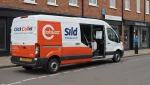
- Most operations end up running both, with the van covering the predictable core routes and a courier absorbing the peaks and the awkward ones. Metrobi is a local delivery platform built for exactly this pattern in food, floral, catering and wholesale, with multi-stop route optimization for the routes you run and courier capacity for the days you can’t.
When a parcel carrier or a 3PL makes more sense
Hand the order to a carrier or a third-party logistics provider when the goods are durable, the destination is outside your delivery radius, and the timing is flexible.
That’s a narrow set of conditions. Check each one. Durable rules out most fresh food and all cut flowers. Outside your radius is the trigger that matters: shipping a parcel three miles when you have a van going that way is money burned. Flexible timing matters because a parcel network gives you a service level, not a time. That works for a gift box and fails for a lunch order.
A 3PL adds warehousing and picking on top of transport. That becomes worth paying for when storage is constraining you, or when pick-and-pack has grown past what your own staff can absorb between customers. The trigger isn’t a particular order count. It’s the point where fulfillment starts costing you sales in the shop.
How to decide which orders go down which path
Write the rule down once, in plain language, and let it decide instead of deciding per order.
A workable rule has three inputs: what the item is, where it’s going, and when it’s needed. Something like this, adjusted to your own numbers:
- Perishable, within the delivery radius — own route if it’s a scheduled day, courier if it isn’t.
- Perishable, outside the radius — decline it, or quote a courier price honestly before accepting.
- Durable, within the radius, customer is nearby anyway — offer pickup first; it’s cheaper for both of you.
- Durable, outside the radius, no deadline — parcel carrier.
- Anything with a hard time on it — same-day courier, priced into the order rather than absorbed.
The point of writing it down isn’t tidiness. It’s that a written rule can be followed by whoever is in the building at 2pm, which an unwritten one cannot. It also makes your quoted delivery promises consistent, which is where fulfillment stops being an operations question and starts being a marketing one.
What getting fulfillment wrong costs at checkout
The bill for bad fulfillment arrives at checkout, before you ever pack anything.
Baymard Institute’s synthesis of 50 studies puts the average documented cart abandonment rate at 70.22%. Once you strip out the 42% who were simply browsing, the leading reasons are exactly the two things fulfillment controls: 40% abandon over extra costs, mostly shipping, and 20% abandon because delivery is too slow (Baymard Institute). No amount of channel expansion fixes a checkout that quotes an unaffordable fee or a date the customer won’t wait for.
The opposite case is measurable too. Harvard Business Review’s study of 46,000 shoppers found that customers who used multiple channels spent 4% more in store and 10% more online than single-channel shoppers (Harvard Business Review). The value isn’t in having more channels. It’s in the channels agreeing with each other, which is a fulfillment property before it’s a marketing one.
Telling customers what you actually offer
A fulfillment setup nobody knows about performs exactly as badly as one that doesn’t exist.
Once the paths are running, the remaining work is making the same promise everywhere: the cut-off time on the website matches the one you give on the phone, the delivery radius on your social profile matches the one your driver actually covers, and the pickup window you advertise is one the counter can hit on a Saturday. That alignment work (channel choice, messaging, and keeping the promise identical across every place you sell) is covered in detail in omnichannel retail marketing best practices.
Frequently asked questions
What is the difference between omnichannel fulfillment and multichannel fulfillment?
Multichannel means you sell in several places, each with its own stock and process. Omnichannel means those places share one stock pool and one order flow, so a customer can order in one channel and collect or receive through another without anything being retyped or double-sold.
Do I need a warehouse management system for omnichannel retail fulfillment?
Not at small scale. What you need is one system that holds an accurate stock count and that every sales channel reads from. For most single-location businesses that’s the point-of-sale or the e-commerce platform, not a dedicated WMS. Warehouse software becomes worth its cost when picking and storage, rather than selling, are what’s limiting you.
Which fulfillment path is cheapest?
Counter pickup, by a wide margin, because there’s no transport cost and no failed delivery attempt. It’s also the only path where the customer’s trip can generate an extra sale. The trade-off is that it only works for customers who were going to be nearby anyway.
How fast does local delivery need to be?
Fast enough that the date you quote is one the customer will accept at checkout, which is usually same-day or next-morning for perishables and within a few days for everything else. Speed matters less than accuracy: a reliable Thursday beats an optimistic Tuesday that slips.