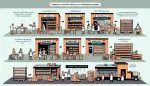


Business expansion rarely fails because the idea was wrong. It fails because it happened eight months too early, funded by a good quarter rather than a proven pattern.
The mechanics are brutally consistent. Expansion costs arrive immediately (inventory, payroll, a lease, a build-out) while the revenue they’re supposed to produce lags behind. Around 82% of small business failures trace back to cash flow rather than a lack of profitability (SMB Compass). That’s the trap: a profitable business that ran out of money at the wrong moment.
So this post is about timing, not ambition. What signals actually mean you’re ready, what the cash test looks like, and how to sequence expansion moves so the cheap reversible ones come before the expensive permanent ones.
The Bottom Line
- Readiness is about repeatability, not a good month. Steady, predictable revenue across four full seasons proves a model; one strong quarter proves a season.
- Hold roughly six months of combined operating expenses in reserve before you commit to a new lease (Pursuit).
- If the business only works because you’re in it every day, it cannot be duplicated. The moment you’re split across two sites, both get worse.
- Expand in order of reversibility: wider delivery zone, then wholesale accounts, then new products, then a second location. Most owners start at the most expensive end.
Metrobi drivers are rated 4.97/5
Trusted by local businesses for:
- Background-checked professionals
- Specialized in business deliveries
- Same drivers for consistency
- 4.97/5 average delivery rating
Six signals you’re actually ready to expand
Readiness shows up as a cluster of conditions, not a single green light. You want most of these true at the same time.
- You’re turning away business consistently. Running out of stock, space or staff is the clearest demand signal there is. The word doing the work is consistently: a seasonal spike is not a pattern (One Park Financial).
- The business runs without you. The real test is whether it functioned while you were away. If your daily presence is the reason quality holds, a second site will halve the thing that’s making the first one work.
- You’ve had several consecutive profitable years. Not months. Multiple years of substantial profit is what lets you predict cash flow through the transition rather than guess at it.
- Revenue is steady across all four seasons. A business that has delivered predictable revenue through a full cycle has demonstrated a repeatable model, which is a different thing from a busy summer.
- You trust your team with more responsibility. If you can’t name the person who’d run the new operation, you don’t have a staffing plan, you have a hope.
- Your current advantage would survive being copied at a new site. Expansion amplifies whatever you already have. If what you have is easy to replicate, you’re funding a bigger version of a weak position, which is why an advantage that actually lasts is worth confirming before you scale it.
Miss two or three of these and the answer isn’t “no”, it’s “not yet, and here’s the thing to fix first.”
The cash reserve test that decides the timing
This is the single number that most often separates a survivable expansion from a fatal one.
Before signing a new lease, have about six months of combined operating expenses in reserve, covering the existing operation plus the new one (Pursuit). Combined is the word people skip. The new site will not cover its own costs for a while, and the old site has to carry both.
The pressure is well documented from the funding side too. The Federal Reserve’s 2026 Small Business Credit Survey found insufficient cash flow or revenue behind roughly a third of cases where firms were denied or only partly granted the financing they sought. And 51% of small businesses report uneven cash flow as a recurring challenge, with 56% saying paying operating expenses is difficult (Preferred CFO). Expanding into that environment on a thin buffer is how a profitable business dies.
Two things to model before committing:
- The lag. Write down when each cost starts and when the matching revenue realistically arrives. Payroll and rent start in month one. Meaningful revenue often starts in month four. The gap is the amount you need in the bank.
- The downside case. Assume the new operation reaches 60% of your projection. If that still survives, proceed. If only the optimistic case works, you’re not funding an expansion, you’re placing a bet.
Business expansion strategies compared by cost and reversibility
There’s more than one way to get bigger, and they differ enormously in what they cost you if they don’t work. Reversibility matters more than upside when you’re deciding what to do first.
| Expansion move | Upfront cost | Time to payback | If it fails | Reversible? |
|---|---|---|---|---|
| Widen your delivery zone | Very low | Weeks | You pull the zone back | Yes, immediately |
| Add wholesale or B2B accounts | Low cash, high time | 2–6 months | You lose the time invested | Yes |
| Extend the product range | Low to medium | 1–4 months | Unsold inventory | Mostly |
| Market penetration — sell more to existing customers | Low | 1–3 months | Marketing spend | Yes |
| New geographic market, no premises | Medium | 3–9 months | Wasted marketing and travel | Largely |
| Second physical location | High | 6–18 months | Lease liability, staff, build-out | No |
Strategy language splits the top rows from the bottom ones: market penetration means selling more of what you have to the market you’re already in, while market expansion means taking existing products into new geography (Pipedrive). Penetration is nearly always cheaper and faster, and nearly always where the unclaimed revenue is.
Why a wider delivery zone is usually the right first move
It’s the cheapest form of expansion available, and it’s the only one you can undo on a Tuesday.
Widening your radius adds new customers without new premises, new staff or a new lease. If the economics don’t work, you shrink the zone back and you’ve lost a few weeks of learning rather than a five-year commitment. The route data you get from it is also the best possible input for a later decision about a second site. You’ll know exactly where demand clusters, because you’ve been driving there.
The discipline is to add density before area, and to watch cost per stop as the zone grows. Optimised multi-stop routing is what keeps that number falling instead of rising, and it’s the mechanism that makes a wider zone profitable rather than merely bigger. For the fuller picture of how delivery drives growth in the first place, the growth levers worth pulling first put this in context against ads, retention and wholesale.
What goes wrong when you expand too fast
Three failure modes account for most of it.
Cash runs out before revenue arrives. Covered above, and it’s the leading cause. The costs of hiring, inventory and marketing land now; the return lags (Scharf Pera).
Quality breaks under load. When growth outruns operational capacity, when you’re winning customers faster than you can serve them, quality is the first casualty. It shows up as defects, slower responses, and late deliveries, which is exactly the damage that costs you the repeat customers the expansion was supposed to win.
The owner becomes the bottleneck twice over. A business that runs well because of one person’s daily presence cannot be duplicated. Split that person across two locations and performance drops in both. Profitability at site one is also no guarantee of profitability at site two. The second unit has its own catchment, rent and staffing reality.
The common thread is that expansion doesn’t create capability, it exposes whether capability was already there.
How to sequence your first expansion move
A practical order that keeps optionality as long as possible:
- Push penetration first. Sell more to the customers you already have: higher order values, more frequent orders, a delivery option they didn’t have last quarter. It’s the cheapest revenue in the building.
- Widen the delivery zone. Reversible, fast, and it generates the demand map you’ll want later.
- Add wholesale or standing accounts. Recurring weekly volume, lower cost per stop, and predictable cash flow, which is the exact input the later, expensive moves require.
- Extend the range. Only once the operation absorbs current volume comfortably.
- Then, and only with the reserve in place, consider premises. By this point you have demand data, proven operations, a team that runs without you, and six months of combined expenses banked.
Most expansion regret comes from doing step five first because it feels like the real answer. It’s the only step you can’t walk back.
Frequently asked questions
When should I expand my business?
When demand consistently exceeds what you can serve, the business runs without your daily presence, you’ve had several consecutive profitable years with revenue steady across all four seasons, and you hold around six months of combined operating expenses in reserve. Missing any of those makes it a timing problem rather than a no.
How much cash should I have before expanding?
Roughly six months of combined operating expenses, covering both the existing operation and the new one, before committing to a lease (Pursuit). Model the downside case at 60% of your revenue projection and check it still survives.
What’s the difference between market penetration and market expansion?
Market penetration means increasing sales of existing products in the market you already serve. Market expansion means taking those products into new geography or new customer groups (Pipedrive). Penetration is cheaper, faster and usually where the untapped revenue sits.
Is a second location the best way to expand?
Usually it’s the last option to consider, not the first. It’s the most expensive, slowest to pay back and the only move you can’t reverse. A wider delivery zone or a wholesale channel often reaches the same new customers without the lease.
What’s the biggest risk in business expansion?
Running out of cash while waiting for new revenue. Around 82% of small business failures come down to cash flow rather than profitability (SMB Compass), and expansion is when the gap between outgoing and incoming is widest.
The decision, simplified
Expansion is a timing question wearing the costume of a courage question. The owners who get it right aren’t bolder, they’ve just established that the pattern is repeatable and the buffer is real before they commit.
Work through the six signals. Run the combined-reserve number. Then take the cheapest reversible step that reaches new customers, and let what you learn from it decide whether the expensive one is worth taking at all.