
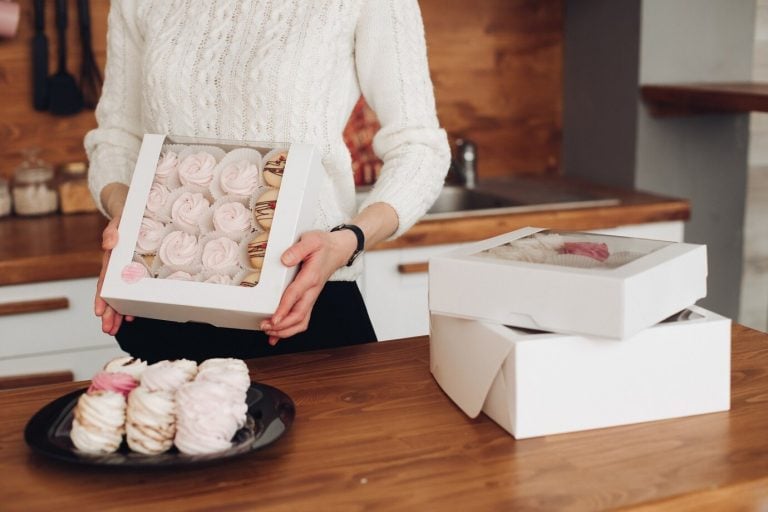

The cake was finished at nine. The photograph is on your phone. Forty minutes later it is at the customer’s house with a fingerprint-sized dent in one side and the top tier leaning half an inch to the left, and nothing about the baking caused any of it.
Learning how to transport a cake for delivery is a separate craft from decorating one, and it is the half most bakers pick up by accident, usually after a bad Saturday. A cake is a soft, top-heavy object with a fragile surface, sitting on a slick board, in a box, in a moving vehicle. Every one of those is a problem you can solve before you put the key in the ignition.
This is the whole trip, start to finish: choosing the board and the box, chilling, securing the cake inside, where it sits in the car, how to drive, what changes for tiered cakes and hot weather, and what to carry for the repairs you will occasionally still need. If you are doing this as a business rather than a favor, it pairs with the two things on either side of it: the licence that lets you sell what you bake, and what each of those deliveries actually costs you.
Key Takeaways
- Chill the cake 20–30 minutes before it moves. A firm surface resists smudging; a room-temperature buttercream records every touch.
- Use a cake board at least two inches wider than the cake, and glue the cake to it with a swipe of buttercream so it cannot slide.
- Match the box to the board, not to the cake, and fill any slack with a non-skid mat rather than letting the board travel.
- Transport tiered cakes disassembled, one tier per box, and build on site.
- The floor of the car is the flattest, coolest, most level surface you have. Never the seat, never the seatbelt.
Boost customer satisfaction with just a few clicks
Most-Loved Features:
- On-demand drivers
- Real-time GPS tracking
- Delivery confirmation photos
- Over 50% of customers report a smoother delivery experience
What actually damages a cake in transit
Three forces do essentially all the damage, and each has a different countermeasure.
- Sliding. The cake moves relative to its board, or the board moves relative to the box, or the box moves relative to the car. Every sudden stop or corner is an opportunity. The fix is friction and fit: buttercream under the cake, a mat under the board, a snug box.
- Impact. Potholes, hard braking, a box set down too quickly. The fix is driving and packing: reinforced corners, a level surface, gentle inputs.
- Heat. Warm buttercream softens, ganache shines and slumps, and decorations lose their edges. The fix is temperature: chilling before, cold air during.
There is a fourth that catches people out on long trips: condensation. Take a cold cake into warm humid air and moisture forms on the coldest surface it can find. If that surface is your frosting, the finish is ruined. The standard workaround from cake decorators is to wrap the box tightly in several layers of plastic wrap before chilling, so that when it comes out, the box sweats and the cake does not (Sugar & Sparrow).
Choosing the cake board and box for the trip
The board is structural, not decorative. It has to carry the cake’s full weight when held from underneath by one person, without flexing.
Two rules cover almost everything. The first is to use a board at least two inches wider than the cake, so a 10-inch board under an 8-inch cake. That extra ring gives you somewhere to hold and keeps decorations clear of the box walls (Wilton). The second is to tape two or three boards together for heavier or tiered cakes, which stops any flex at all.
The box should match the board, not the cake. A three-tier cake on a 14-inch drum wants a 14-inch box, so the board cannot travel inside it. Where you cannot get an exact match, put a non-skid mat in the bottom of the box and let friction do what the fit does not.
| Cake diameter | Board size | Box size | Notes |
|---|---|---|---|
| 6 in | 8 in | 8 in | Single tier, tall box for piped tops |
| 8 in | 10 in | 10 in | Most common birthday cake |
| 10 in | 12 in | 12 in | Double board if filled and stacked |
| Tiered on a drum | Drum + 0 | Match the drum | One box per tier, assembled on site |
A final check before you commit: measure the internal height, not just the width. Tall buttercream swirls, toppers and drip decorations are the first casualty of a lid that clears by half an inch, and that damage happens before the cake has moved at all.
Chilling a cake before transport
Chill the cake in the fridge for 20 to 30 minutes before packing it. A cold surface is firm, and a firm surface survives contact with a box wall, with a hand, and with the lid coming off at the other end. Room-temperature buttercream takes a mark from almost anything.
How far you take this depends on the finish. Buttercream chills well and travels well. Whipped cream and cream cheese frostings need to stay cold the entire way and should be treated as a cold-chain item, not a cake. Fondant does not love the fridge, since condensation on it produces a tacky surface, so chill the cake before covering, or keep fondant work cool and dry rather than cold.
For anything over about an hour in the car, or anything in summer, wrap the boxed cake in plastic before it goes in the fridge. That is what keeps the condensation on the box instead of the frosting.
How to secure a cake inside the box
Assume the box will be tilted, knocked and set down hard, and pack so that none of that reaches the cake.
- Glue the cake to the board. A swipe of buttercream or royal icing under the bottom layer stops the cake sliding off its base, which is the single most common failure.
- Put a non-skid mat under the board. A drawer liner or a piece of yoga mat does the job for pennies.
- Reinforce the box. Tape the corners and the lid seam; cardboard corners are where boxes fail under weight.
- Leave nothing loose inside. Toppers, ribbons and cake picks travel in a separate bag and go on at the destination.
- Carry the box from underneath, with both hands. Never by the sides, never by the lid. You are holding the cake’s weight, not the box’s.
Where to put a cake in the car
The flattest, most level surface in a vehicle is the floor, usually the rear footwell or the boot floor of an SUV. That is where the cake goes.
Not the seat: car seats are contoured, sloped and upholstered, and every one of those works against a flat board. Not the seatbelt: a belt tightens under braking and crushes a box that was never designed for compression (Four Palates). Not the passenger’s lap, which sounds safe and is the least stable place in the car.
Before the cake goes in, get the car itself ready. Run the air conditioning for a few minutes so the cabin is cold rather than merely on its way there. Clear the footwell completely. Put a non-skid mat down. If you are carrying more than one box, give each its own footprint rather than stacking them, unless the boxes are rated for it and the bottom cake is dense enough to take the load.
How to drive with a cake in the car
Driving is the part bakers underestimate, because the forces that damage a cake are the ones a driver barely notices.
Brake early and gently, take corners slower than feels necessary, and give yourself following distance so you never have to stop hard. Avoid potholes, speed bumps and rough surfaces even at the cost of a longer route. A decorated cake on a bad road surface is being shaken continuously, and decorations loosen. Keep the cabin cold the whole way rather than cooling it at the start.
Plan the route with the same care. For a delivery business, the practical rule is to make the cake the first or only drop on a run: every additional stop is more time at ambient temperature, more door slams and more braking cycles. Where a route has several cakes, sequence by fragility rather than by distance, and accept the extra mile.
Transporting a tiered or wedding cake
Do not transport a tiered cake assembled. Package each tier separately in its own box, move them as individual cakes, and stack on site (Amycakes Bakes).
Assembled tiers concentrate every force at the dowels and the joins between layers, and a lean that starts in the car cannot be undone at the venue. Disassembled, each tier is a small, stable, easily handled cake, and you have a controlled ten minutes at the destination to build it properly.
That on-site build has its own short checklist. Bring the dowels, the central support, a small offset spatula, a piping bag of the frosting used on the cake, and any border that covers the seam between tiers. Level the table before you begin, because venue tables often are not, and a tiered cake will tell you about it within the hour. Do the final touches after the last tier is set, never before.
Delivering cakes in hot weather
Heat changes the whole plan, and the margin for error in summer is smaller than at any other time.
Chill harder and longer before loading. Run the air conditioning hard, and point the vents toward the footwell rather than at the windscreen. Deliver early in the day where the customer’s schedule allows. Avoid leaving the cake in a parked car for even a few minutes, since an unshaded cabin heats faster than almost anyone expects.
Specify the finish for the weather at the point of order, which is the real fix. Swiss meringue buttercream, ganache under fondant, and structurally reinforced tiers handle heat far better than whipped cream or a soft American buttercream. Telling a customer in July that a particular design is not a July design is a better conversation than the one you have after it slumps.
The cake repair kit to carry on every delivery
Even done properly, some deliveries need a touch-up. Carrying the kit turns a disaster into two minutes of work at the customer’s kitchen counter.
- A piping bag of the exact frosting used on the cake, with the tip that made the border
- A small offset spatula and a bench scraper
- Spare decorations, a few extra sprinkles, and any dust or paint used on the finish
- Paper towels, a damp cloth in a sealed bag, and disposable gloves
- A spare cake board, in case one flexes or gets damp
- A small spirit level for tiered builds
Keep it assembled and in the vehicle rather than made up per delivery. The days you need it are the days you are already running late.
Handing the cake over at the door
The last thirty seconds are a failure point, because the cake changes hands and nobody is thinking about it any more.
Carry it in from underneath with both hands and set it down on the surface it will stay on, because moving it twice doubles the risk for no benefit. Open the box in front of the customer so that the condition of the cake is established while you are there. Tell them how to store it and how far in advance to bring it out of the fridge; a cake served straight from cold tastes worse than one that has come back to room temperature, and that judgement will be attributed to you either way.
If you are leaving it with someone who is not the customer, photograph it in place. It costs a second and settles any question about when a dent appeared.
Frequently asked questions
How do you transport a cake without ruining it?
Chill it for 20–30 minutes, secure it to a board at least two inches wider than the cake with a swipe of buttercream, put the board in a box that matches the board’s size, set the box on a non-skid mat on the flattest floor space in the car, run the air conditioning, and drive gently. Those six steps prevent nearly all transit damage.
Should a cake be refrigerated before transport?
Yes, for most finishes. 20 to 30 minutes in the fridge firms the surface so it resists smudging. Wrap the boxed cake in plastic wrap before longer chilling so that condensation forms on the box rather than on the frosting. Fondant is the exception, preferring cool and dry to cold.
Where is the safest place in a car for a cake?
The floor, meaning the rear footwell or the boot floor. It is the flattest and most level surface available, and it is usually the coolest. Seats are contoured and sloped, and a seatbelt compresses the box rather than securing it.
Can you transport a tiered cake already assembled?
It is not recommended. Package each tier in its own box, transport them separately, and stack the cake on site. Assembled tiers put all the strain on the dowels and joins, and a lean that develops in transit cannot be corrected at the venue.
How do you keep a cake cold during a long delivery?
Pre-chill thoroughly, pre-cool the vehicle, keep the air conditioning running with vents directed toward the cake, and deliver at the coolest part of the day. For long trips or perishable fillings, treat it as a cold-chain item with insulation and cold packs positioned so they never touch the cake directly.
What should I do if the cake gets damaged on the way?
Repair it at the destination with the kit you carried: matching frosting in a piping bag, an offset spatula, and spare decorations. Most transit damage is a smudge or a scuffed border, both of which take under two minutes. Tell the customer what happened and what you did. Discovering it later costs far more than the repair.
Getting it there in one piece, every time
Cake transport rewards preparation over reaction. Almost everything that goes wrong in the car was decided in the kitchen: the board that was too small, the box that was too big, the cake that went out warm, the design that was never going to survive August.
Build the routine once and it stops being a worry: board two inches over, glued down, matched box with a mat, thirty minutes in the fridge, cold car, floor of the vehicle, gentle driving, kit in the boot. Then the only thing your customer sees is the cake you photographed before you left.