
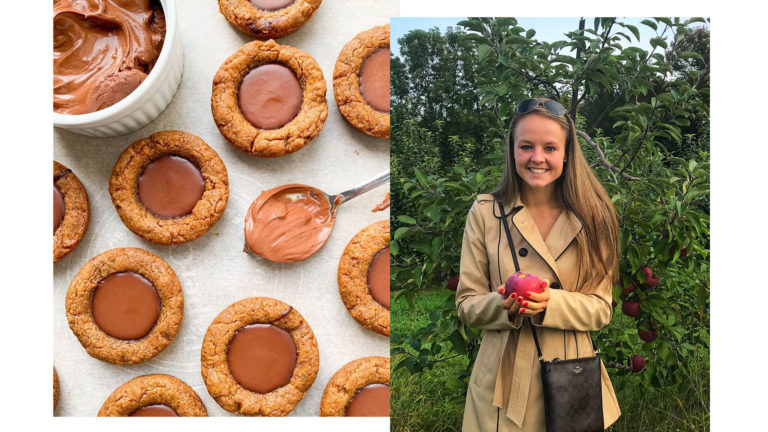

Most food creators who launch a product launch a cookbook. Addison LaBonte launched a manufacturer.
The story starts with a medical problem. A marathon runner, she was diagnosed with compartment syndrome; on her aunt’s suggestion she went gluten free, and the pain went away. That personal fix became the subject of her content, Whole30 and paleo recipes photographed well, and the content became a digital food business reaching over a million monthly page views, with a following that has been reported in the hundreds of thousands to over a million across platforms. She studied at the University of Maine, where she was a soccer walk-on, and she hosts the Organically Addison podcast interviewing entrepreneurs and health and wellness experts.
Then in January 2024 she launched Sweet Addison’s, making gluten-free and dairy-free cookies. What began as recipe testing in a 700-square-foot Dallas apartment has become a multi-seven-figure business with six employees and products sold in dozens of coffee shops, hotels and specialty stores across the country.
That transition from audience to inventory is what this profile in our series of food maker and creator interviews is about, and it is much harder than the success stories usually admit.
Metrobi drivers are rated 4.97/5
Trusted by local businesses for:
- Background-checked professionals
- Specialized in business deliveries
- Same drivers for consistency
- 4.97/5 average delivery rating
What an audience actually gives a food founder
A creator launching a product starts with advantages that are real but narrower than they look.
Demand validation. Years of recipe engagement data tells you what people actually want to eat, which is information most food startups pay consultants for and still get wrong.
A launch that is not a cold start. The first thousand customers already exist and already trust you. That solves the single hardest problem in consumer packaged goods, and it is why creator-founded brands can hit revenue numbers quickly that would take a conventional startup years.
Free, permanent marketing. No customer acquisition cost on the owned channel, and content production capability already in-house.
Product credibility. A gluten-free cookie from someone who has been publishing gluten-free recipes for years is a more believable proposition than the same cookie from a brand that appeared last month.
What an audience does not give you is any of the hard part. It does not give you a co-packer, a shelf-stable formulation, a nutrition panel, a distributor, a fulfilment operation or a wholesale sales function. Those have to be built from zero, and the audience gets impatient while you build them.
Why the manufacturing step breaks most creator brands
A recipe that works in a home kitchen is not a product. Turning one into the other is the step where the creator-to-founder path usually stalls.
The formulation has to be re-derived for scale and for shelf life. A cookie that is perfect warm from a home oven and stale in two days cannot ship. Making it last without preservatives, which is the whole point of a clean-label brand, means reworking water activity, fats and packaging rather than adding anything.
Removing gluten and dairy simultaneously makes this harder. Gluten provides structure; dairy provides fat, flavour and browning. Take out both and the default result is dry and crumbly. Getting a cookie that survives shipping and still eats well is a genuine technical achievement, and it is why the launch took recipe testing rather than just a recipe.
Then there is the co-packer problem. Small volumes are unattractive to contract manufacturers, minimum order quantities are high, and the first production run usually requires paying for more inventory than you can sell quickly. Many creator brands die in exactly this gap, the audience is ready and the supply chain is not.
Wholesale is a different business from direct-to-consumer
Sweet Addison’s selling through coffee shops, hotels and specialty stores is the part that most distinguishes it from a typical creator merchandise line.
Direct-to-consumer is what an audience naturally produces: they see a post, they buy a box. The margins are good and the operation is simple until it is not.
Wholesale requires almost nothing you already have. You need a case pack, a wholesale price list, a spec sheet, distributor relationships or a direct sales effort, terms of thirty days or more, and, critically, reliable delivery to accounts that will drop you if you miss. Your customer is now a buyer with a budget and an alternative, not a fan.
This is the same terrain L’Nando Bakery crossed going from a family recipe to frozen product in Whole Foods and specialty stores, and the sequencing lesson is identical: prove sell-through in independents, then use that data to argue your way into the bigger accounts.
Coffee shops and hotels are a smart channel choice for a cookie specifically. Both buy in predictable repeat quantities, both are route-friendly if they cluster geographically, and both put the product in front of people in a moment when they want exactly that thing. It is a considerably better fit than fighting for shelf space in grocery.
What creators should know before launching a product
The honest checklist, in the order it bites:
- Can the recipe survive scale and shipping? Test this before you announce anything.
- Can you fund the first production run? Minimum order quantities are usually the largest cheque a creator-founder has written.
- Who handles fulfilment on launch week? An audience-driven launch produces a spike that a person with a garage cannot absorb.
- Is there a second act after the launch spike? The audience buys once out of loyalty. They buy again only if the product is good.
- Can you keep making content while running operations? The content is the marketing engine, and it is the first thing that gets dropped.
That last point is underrated. Christine LaPuma’s account of professionalising a food feed describes how much work the content alone becomes; adding a manufacturing business to it is why most creator brands quietly stop posting within a year.
The claims problem for a health-positioned product
A brand built on a medical story — gluten free resolved a diagnosed condition — has to be careful about how that story is used commercially.
The founder’s own experience is hers to tell. Extrapolating it into a general health claim about the product is a different act, and it needs a credential. This is exactly why registered dietitian Diana Savani can make nutrition statements a lifestyle creator cannot, and why a health-positioned product should pair personal narrative with credentialed voices rather than relying on the narrative alone.
On the content side, a recipe creator like Nancy of NourishByNancy, working within gluten-free and dairy-free constraints, reaches precisely the audience that already reads labels. Reviewers such as Tea Kingley and Leslie Kiszka answer the question that ultimately decides repeat purchase for any better-for-you product: does it actually taste good.
What to take from the Sweet Addison’s path
The audience is the unfair advantage, and it only pays off if the operational business behind it is real.
LaBonte spent years building demand before there was a product, solved a formulation problem that most people underestimate, and picked wholesale channels that fit the product rather than the ones with the most prestige. The content came first, the manufacturing came second, and the second one is where the business actually lives.