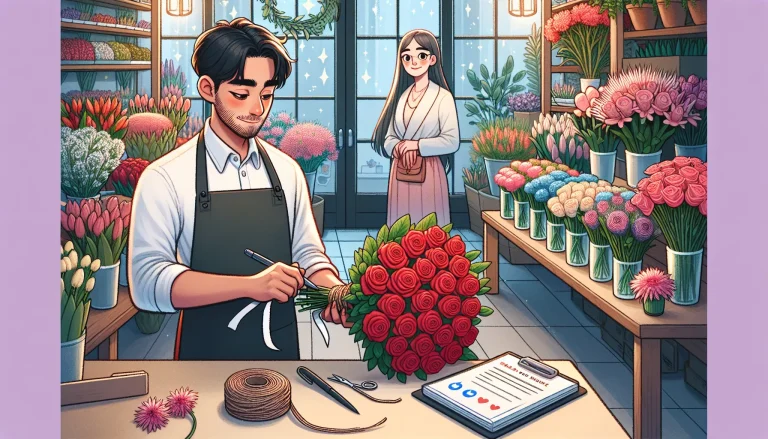

A customer sending flowers to their mother two states away cannot smell your stems, inspect your mechanics or admire your colour work. They have no way to judge you. So they borrow somebody else’s judgement instead, which is why your star rating is doing more selling than your website, your window display and your Instagram grid combined.
That makes reviews less of a reputation exercise and more of a line item. This guide covers what customer reviews for florists are actually worth, the single best moment to ask for one, where to put them so they do some work, and what to write when a delivery goes wrong in public.
The Bottom Line
- 97% of consumers read reviews for local businesses, and the average person checks around six different review sites before deciding (BrightLocal, 2026, n=1,002).
- Four stars is now the floor. 68% of consumers require a four-star minimum and 31% won’t use a business below 4.5, up from 17% a year earlier.
- Recency beats volume. 74% want to see reviews posted within the last three months, and 32% look for feedback from the last two weeks.
- 89% expect a business to reply to their review, and 81% expect that reply within seven days.
- The best moment to ask a florist customer is 24 to 48 hours after delivery, while the recipient is still photographing the flowers.
Save 80% of delivery management time
We handle everything:
- Dedicated operations manager
- Real-time tracking dashboard
- Automated customer notifications
- Urgent issue resolution
What customer reviews are worth to a florist in real terms
Reviews are the cheapest conversion lever available to a flower shop, because they work on traffic you have already paid for.
BrightLocal’s 2026 Local Consumer Review Survey found that 97% of consumers read reviews for local businesses, with 41% saying they always do. More usefully for a florist: 68% require a minimum of four stars before they’ll use a business at all, and 31% now hold the line at 4.5 or better, a figure that jumped from 17% in a single year. That is a hard gate. Below four stars you aren’t losing a competitive edge, you’re being filtered out before anyone reads a word you wrote.
The ranking effect compounds the conversion effect. Review count, rating and recency all feed into how prominently your shop appears in Google’s local results, so reviews don’t just convert the people who find you, they increase how many find you. That second-order benefit is covered properly in the guide to SEO for florists; here, treat it as the reason why review work pays twice.
And reviews sit inside a very short decision window. BrightLocal’s companion research on search behaviour found 28% of local searchers decide in under five minutes. Your rating is not something a buyer weighs over a weekend. It’s a snap filter applied on a phone in a car park.
Metrobi is transforming flower deliveries
Specialized solutions for flower businesses:
- Flower-trained drivers
- Proper handling equipment
- Peak day delivery support
- 23% average cost reduction
Why florist reviews rise and fall on the delivery, not the bouquet
Read a page of one-star florist reviews and you’ll notice how few of them are about floristry.
They’re about a bouquet that arrived a day late, an arrangement left on a doorstep in August heat, a substitution nobody mentioned, a delivery marked complete that never happened, a sympathy order that missed the service. The design was fine. The handover failed. Flowers are the rare retail product where the customer never sees what they bought, so the recipient’s experience of the delivery becomes their verdict on your craft.
Three practical consequences:
Your delivery promise is a review-management tool. If your same-day cutoff is 1pm, say 1pm and mean it. The shop that promises noon and delivers at four collects worse reviews than the shop that promises tomorrow and delivers tomorrow.
Substitutions need a message, not a note in the box. Flower availability moves. A customer told in advance that the garden roses became peonies will usually say yes. A customer who finds out from a photograph will often say so publicly.
Proactive contact beats damage control. A text saying “your flowers are with the driver, arriving before 2pm” turns an anxious sender into a calm one, and calm senders leave better reviews even when something slips.
This is also where your operational choices show up in your marketing results, which is the quiet argument running through the whole florist marketing playbook: the channels don’t rescue a shaky handover, they amplify whatever it already is.
The best time to ask a flower shop customer for a review
Ask 24 to 48 hours after delivery. Not at the counter, not a week later, and not in a monthly newsletter.
The timing logic is specific to flowers. At the moment of purchase the customer has nothing to review, because they haven’t seen the product. By day seven the arrangement is dropping petals and the emotional peak has passed. In between sits a window where the recipient has just sent a thank-you photograph to the sender, and the sender is feeling rather pleased with themselves. That is the moment.
How to actually do it, in rough order of effectiveness for a small shop:
- A text message the day after delivery with a direct link to your Google review page. Highest response rate by a distance, because it’s one tap on the device they’re already holding.
- An automated email 24 to 48 hours post-delivery, triggered by order status rather than sent in a batch. This is one of the four flows to build in email marketing for florists, and once set up it asks every customer forever without you remembering to.
- A QR code on the card or the box, with a line like “we’d love to know how these landed”. Catches the recipient as well as the sender, which doubles your pool.
- Asking in person at the counter for walk-ins, immediately after they’ve said something nice. Awkward, and still effective.
Two rules that matter more than the method. Send one request, not three. A nagging shop gets fewer reviews, not more. And never gate the ask on sentiment by asking “were you happy?” first and only routing the happy ones to Google. Review platforms treat that as gating and it can cost you the reviews you already have.
How to respond to a bad florist review
Respond to all of them, quickly, and write for the next reader rather than the angry one.
89% of consumers expect a business to respond to their feedback, and 81% expect it inside a week. Those people are not the reviewer. They’re prospective customers reading how you behave when something goes wrong, which is far more informative than a wall of five-star praise.
A response that works has four parts and fits in four sentences: name the specific thing that went wrong, don’t dispute the experience, say what you’re doing about it, and move the resolution offline. “Hi Dana, you’re right that your Thursday arrangement arrived after the service, and I’m sorry. We’ve changed how we schedule sympathy deliveries so they go out on the first run of the day. I’ve emailed you directly to put this right.” No defensiveness, no policy quotation, no paragraph about how much you care.
What to avoid: arguing about whether the flowers were wilted, explaining your refund terms in public, blaming the courier, or copy-pasting the same reply under every complaint. Google readers spot a template instantly and it reads worse than silence.
There is an upside here. A well-handled complaint trail is persuasive in a way that perfection isn’t. A 4.6 average with a visible, gracious response to a bad week reads more credible than a suspicious 5.0.
Where to display reviews so they actually convert
Reviews only work where the decision happens. For a flower shop, that is four places.
Your Google Business Profile. Non-negotiable, and the one that feeds both conversion and local ranking. If you only do one thing, do this.
Your product pages. Star ratings next to an arrangement do more than a testimonials page nobody visits. Buyers are deciding between your $85 and your $120 option, and social proof at that exact point moves the choice, which is one of the conversion levers in the guide to increasing online flower sales.
Your checkout. A single line of reassurance near the payment button, such as a short quote about on-time delivery, addresses the one fear a first-time flower buyer has.
Your social feed. A recipient’s photo plus their words outperforms your own studio shot, because the audience knows which one you art-directed. Reposting customer photographs is one of the highest-performing formats in florist social media.
A testimonials page, by contrast, is mostly decorative. It ranks for nothing and converts almost nobody, because a buyer deciding in five minutes never clicks it.
What good looks like, by the numbers
Rough benchmarks for an established independent shop, useful mainly as a sanity check:
| Metric | Weak | Healthy | Strong |
|---|---|---|---|
| Google average rating | Under 4.0 | 4.3–4.6 | 4.7+ |
| Total Google reviews | Under 25 | 60–150 | 200+ |
| New reviews per month | 0–1 | 4–8 | 12+ |
| Share of reviews answered | Under 30% | 80% | 100% |
| Median response time | Over 2 weeks | Under 7 days | Under 48 hours |
The column that matters most is “new reviews per month”. Given that 74% of buyers want feedback from the last three months, a shop adding five reviews a month at 4.5 stars will out-convert a shop sitting on 300 reviews from 2021. Flow beats stock.
Who else should be reviewing you
One blind spot: your retail reviews say nothing to a wedding venue or a restaurant group deciding whether to put you on contract.
Those buyers want a different kind of proof: reliability at volume, on a date that cannot move. Testimonials from a venue coordinator, an event planner or a restaurant manager are worth more to that audience than fifty bouquet reviews, and they’re easier to get because business buyers are used to giving references. Collect them deliberately, keep them on a single page you can send, and treat them as a separate asset from your consumer reviews. How those accounts get won in the first place is the subject of the guide to florist partnerships.
Frequently asked questions
How many Google reviews does a flower shop need?
Enough to clear the credibility threshold, then a steady trickle forever. Around 60 reviews is where most buyers stop questioning whether the rating is real, and the maintenance target matters more than the total. Four to eight new ones a month keeps you inside the three-month recency window that 74% of consumers look for. A shop with 80 fresh reviews beats a shop with 400 stale ones.
Can a florist remove a bad review?
Only if it breaks the platform’s rules: spam, hate speech, a conflict of interest, or a review of the wrong business. You cannot remove a review for being unfair or inaccurate, and attempting to usually wastes a week. Flag clear policy violations, respond publicly to the rest, and dilute the damage by adding new reviews faster than you collect bad ones.
Should florists offer a discount for reviews?
No. Paying for reviews with discounts, free delivery or entries into a prize draw violates Google’s policies and can get your reviews filtered or your profile penalised. Asking is free and works. If you want to incentivise something, incentivise the ask. Give staff a small bonus tied to review volume rather than giving customers a reward tied to review content.
Do reviews on Yelp and Facebook still matter for a flower shop?
Less than Google, but not zero, because consumers consult around six platforms before deciding. Keep Google first and best. Then claim your Yelp and Facebook pages so the information is accurate, respond to anything that appears there, and don’t spend active effort soliciting on secondary platforms until Google is healthy.
What’s the fastest way to get more florist reviews this month?
Export the last 90 days of orders and send one text message to each customer with a direct Google review link, then switch on an automated post-delivery request so it never has to be a project again. A single pass through recent customers typically produces more reviews in two weeks than the previous year of waiting for them.
The short version
Your star rating is a gate, not a garnish. Below four stars a large share of buyers never see your work; above 4.5 you clear a bar most of your competitors don’t.
Getting there is three habits, not a campaign. Ask every customer a day or two after delivery, by text if you can. Reply to everything inside a week, especially the complaints. And make your delivery promise one you can keep, because that, far more than your design skill, is what people write about.