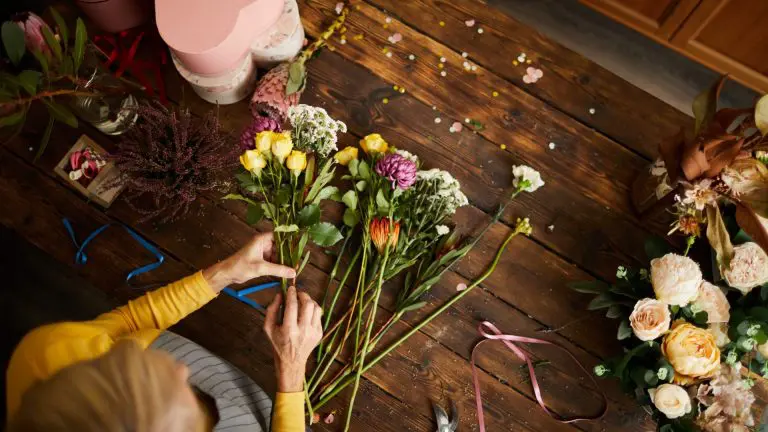

Florist supplies and equipment break down into five groups: the hand tools you cut with, the mechanics that hold an arrangement together, the cold storage and processing gear that keeps stems alive, the containers and packaging that finish the work, and the delivery equipment that gets it to the door intact. Miss one group and the others stop paying off. A shop with beautiful containers and no cooler is throwing away flowers it already bought.
This is the buying list, item by item, with what each thing actually does and what it tends to cost. It’s aimed at a florist opening a shop or replacing gear that’s worn out, not at a hobbyist arranging on a kitchen table.
The Bottom Line
- Florist supplies and equipment fall into five groups: tools, mechanics, processing and cold storage, containers and packaging, and delivery gear.
- The cooler is the single biggest line item. Commercial floral coolers run roughly $1,500 to $7,000, and walk-ins $8,000 to $20,000 or more.
- Cold storage pays for itself through shrink. Flowers held at 18–20°C lose vase life two to three times faster than the same stems at 4–8°C.
- Sanitation costs almost nothing and recovers real product. A dirty bucket alone can cut vase life by as much as 20%.
- Budget $30,000 to $75,000 for a small brick-and-mortar shop including coolers, fixtures and working capital.
Metrobi drivers are rated 4.97/5
Trusted by local businesses for:
- Background-checked professionals
- Specialized in business deliveries
- Same drivers for consistency
- 4.97/5 average delivery rating
The five categories of florist supplies and equipment
Every purchase in a flower shop does one of five jobs. Sorting your buying list this way stops the common mistake of over-buying pretty things and under-buying infrastructure.
| Category | What it covers | Typical setup cost |
|---|---|---|
| Hand tools | Shears, floral knife, wire cutters, stem strippers, ribbon scissors | $1,500–$4,000 for basic tools and supplies |
| Mechanics | Floral foam, wire, stem wrap, waterproof tape, adhesives, cages, bouquet holders | Ongoing consumable spend |
| Processing and cold storage | Buckets, flower food, bucket sanitizer, work tables, sinks, cooler | $2,000–$8,000 for worktables, shelving and sink; cooler separate |
| Containers and packaging | Vases, pots, baskets, boxes, sleeves, cellophane, ribbon, enclosure cards | Ongoing, priced into each arrangement |
| Delivery equipment | Transport buckets, crates, non-slip trays, vehicle racks, box inserts | Varies with delivery volume |
The scale of the business these supplies serve is worth knowing before you spend. The Society of American Florists counts 11,744 retail florist shops in the US, and total spending on floral products reached $78.1 billion in 2025, or $289.52 per capita (Society of American Florists). This is a mature trade with established supply channels, which is good news when you’re buying: almost everything on this list has a competitive wholesale market behind it.
Where that gear comes from is its own subject. Most of what follows is bought through a wholesale account rather than retail, and the terms of that account shape what you can afford to stock. What a florist wholesaler does and how to pick one covers the sourcing side in detail.
Metrobi is transforming flower deliveries
Specialized solutions for flower businesses:
- Flower-trained drivers
- Proper handling equipment
- Peak day delivery support
- 23% average cost reduction
The florist tools you use every day
Buy these once, buy them sharp, and replace them when they stop cutting cleanly rather than when they break.
Floral shears are the workhorse. Sharp, high-quality shears make clean cuts without crushing the stem, which matters because a crushed stem can’t draw water properly and the bloom dies early. Dull shears are a shrink problem disguised as a tool problem.
A floral knife does the precision work: trimming, shaping, angling a cut. Most experienced designers reach for a knife over shears for fine stem work because the blade gives more control.
Wire cutters keep your shears alive. Cutting wire with floral shears is the fastest way to ruin them, so a dedicated pair is a cheap insurance policy.
Stem strippers pull thorns and lower foliage in one pass. Leaves left below the waterline rot and foul the water, which shortens vase life for everything in the bucket.
Ribbon scissors stay in a drawer and never touch a stem. Sap and plant residue on the blades will mark ribbon and fabric.
A sturdy work table with tool storage is part of this group rather than furniture. Expect $200 to $2,000 depending on size and build (Hana Florist POS).
Floral mechanics: what actually holds an arrangement together
Mechanics are the invisible half of floral design. The customer never sees them, but they decide whether the arrangement survives a car ride.
Floral foam stabilizes stems and holds water against the cut, keeping blooms hydrated and in position. It’s the default mechanic for anything that has to travel upright.
Florist wire supports and secures stems. It comes in different gauges and colours so you can match the weight of wire to the weight of what it’s holding: heavy gauge for a structural stem, fine gauge for a boutonniere.
Stem wrap and waterproof floral tape bind stems and hold support in place. Waterproof tape is the one to stock, because it keeps working in the wet conditions a flower shop actually operates in.
Cages, bouquet holders and adhesives cover the specialty work: sympathy pieces, installations, anything mounted rather than placed.
These are consumables, and they all get priced into the finished arrangement. The floral industry’s standard approach is to mark up hard goods around 2.5x wholesale cost and fresh product around 3.5x, with a labour charge of roughly 25% on top (Florists’ Review). Fresh product carries the higher multiple because it spoils; foam and wire don’t.
Flower processing and hydration supplies for the workroom
This is the least glamorous group on the list and the one with the clearest return.
Buckets, heavy-duty plastic or rubber, hold flowers through hydration and storage. Buy more than you think you need, because a crowded bucket is a damaged bucket of flowers.
Bucket sanitizer and cleaning supplies matter more than most new shops expect. A dirty bucket can reduce the vase life of cut flowers by as much as 20% (Florists’ Review). That is a fifth of your product’s useful life lost to something a brush and a sanitizing solution would have prevented.
Commercial flower food feeds the stems and keeps bacteria down in the water. Mixed at the right dilution, it’s doing chemistry, not marketing.
A deep sink with good drainage is non-negotiable for processing. Worktables, shelving and a sink area together run $2,000 to $8,000 (Hana Florist POS).
Conditioning is the process of cutting, stripping, hydrating and resting stems before they go into the cooler, and it’s where this gear earns its keep. Done properly, conditioning delivers 40–70% more vase life than skipping the step (Lacybird). No arrangement technique recovers a stem that was never conditioned.
How to choose a floral cooler for your shop
The cooler is the most expensive thing you’ll buy and the one that most directly controls your margin, because it governs how much product you throw away.
Target 36°F with 90 to 95% relative humidity and gentle airflow for general cut-flower storage (Florists’ Review). Temperature discipline is the whole game: a flower held at 18–20°C loses vase life two to three times faster than the same flower at 4–8°C (Lacybird). Every hour a box sits on the workroom floor instead of in the cooler is measurable shrink.
Cost depends almost entirely on format:
| Cooler type | Typical cost | Best for |
|---|---|---|
| Small reach-in | $1,500–$3,000 | Studios, low-volume shops, overflow |
| Floral display cooler | $3,000–$8,000 | Retail floor, impulse and grab-and-go sales |
| Walk-in, used | $3,000–$6,000 | Volume storage on a tight budget |
| Walk-in, new | $8,000–$12,000 | Full-service shops with weekly wholesale deliveries |
| Large walk-in or cold room | $8,000–$20,000+ | Event and wedding work, multi-cooler operations |
Source: Hana Florist POS, StartupCostHub
A used walk-in is usually the better buy over a new display cooler if you have to choose, because storage protects inventory you’ve already paid for while display drives sales you might make. Shops that sell heavily off the floor eventually need both.
Containers, vases and flower shop packaging supplies
Containers and packaging are where design intent meets physical protection, and they’re the supplies you’ll reorder most often.
On the container side: glass vases, ceramic pots, baskets, boxes and liners, in a range narrow enough to buy in volume and wide enough to price at different tiers. Shops that stock forty container styles tie up cash and lose the volume discount.
On the packaging side: waterproof wrapping paper, cellophane, foil, sleeves and bags, ribbon, corsage wristlets, enclosure cards and card holders. All of it goes into the cost of goods for the arrangement, alongside the foam, tape and wire, which is why a proper materials count matters before you set a price (Florists’ Review).
Packaging also does double duty as delivery protection. A sleeve that looks good on the counter and keeps blooms off each other in a van is worth more than one that only does the first job. Food-adjacent trades make the same calculation about transport-safe packaging, and the thinking transfers directly. The breakdown in our guide to catering supplies covers that same tension between presentation and protection.
Florist delivery equipment that gets arrangements there intact
Most equipment lists stop at the workroom door. That’s a mistake, because the delivery leg is where finished, fully-costed product gets destroyed.
The gear worth owning:
- Transport buckets and crates sized to your vehicle, so arrangements can’t slide into each other
- Non-slip trays and mats for the cargo floor
- Vehicle racks or shelving to stop stacking, which is what crushes blooms
- Box inserts and cardboard cradles for vase arrangements that must stay upright
- Water-tight carriers for anything travelling in a container of water
- A cooler-to-van routine that minimises how long product sits at ambient temperature
That last one is a procedure rather than a purchase, and it’s the highest-return item on the list given how fast vase life drops outside cold storage. Loading in temperature order and keeping the van out of direct sun costs nothing.
What you stock also changes how hard the delivery leg is. Some varieties simply handle transport better than others, which is worth factoring into buying decisions. See types of flowers every florist should keep in stock.
What florist supplies and equipment cost to set up
Totals vary enormously by format, which is why single-number estimates are useless. A studio working from a garage and a full-service retail shop are different businesses buying different lists.
Broad ranges to plan against:
- Floral design or studio operation: roughly $10,000 to $50,000 initial investment
- Small brick-and-mortar shop: $30,000 to $75,000, including lease deposits, coolers, fixtures and operating capital
- Basic tools and supplies: $1,500 to $4,000
- Front counter and checkout hardware: $1,000 to $5,000
- Worktables, shelving, sink and storage: $2,000 to $8,000
Sources: StartupCostHub, Hana Florist POS
The sequence matters more than the total. Cold storage and processing gear first, because they protect every flower you buy afterwards. Tools and mechanics second, because they’re cheap relative to their effect on quality. Display and container range last, scaled to what’s actually selling. A shop that buys display before storage spends its first season watching inventory die on the floor.
Once the gear is in, the constraint shifts from equipment to demand, and the spend moves from capital to customer acquisition. Our guide to florist marketing picks up at that point.
How to buy florist supplies without over-ordering
Three habits keep a supply budget under control.
Separate one-time buys from consumables. Shears, coolers and work tables are capital. Foam, wire, tape, sleeves and flower food are recurring, and they should be ordered against actual usage rather than restocked out of habit.
Standardise before you diversify. A tight range of containers and a consistent ribbon palette buy you volume pricing and less dead stock. Range creep is the most common way a supply budget gets wasted.
Open a proper wholesale account. Trade wholesalers price differently from retail suppliers, and most require a resale certificate before they’ll open an account. The relationship also affects delivery days, substitution policy and what you can get during a shortage week, and all of those decide whether your supply list is theoretical or actually on the shelf.
Frequently asked questions
What equipment do you need to open a flower shop?
At minimum: a cooler, processing buckets, a deep sink and work table, floral shears and a knife, wire cutters, mechanics (foam, wire, waterproof tape, stem wrap), flower food and bucket sanitizer, a working container and packaging range, and transport gear for deliveries. Everything beyond that list is scale or presentation rather than capability.
How much does a floral cooler cost?
Roughly $1,500 to $7,000 for a commercial floral cooler. A small reach-in runs $1,500 to $3,000, a display cooler $3,000 to $8,000, a used walk-in $3,000 to $6,000, and a new walk-in $8,000 to $12,000, with large cold rooms going past $20,000 (Hana Florist POS).
What temperature should a flower cooler be set to?
About 36°F, with 90 to 95% relative humidity and gentle airflow for general cut-flower storage (Florists’ Review). Some tropicals and a few specific varieties want warmer storage, so check by crop rather than applying one setting to everything.
What is the difference between floral supplies and floral mechanics?
“Floral supplies” is the broad category covering everything a shop buys. “Mechanics” is the narrower subset that structurally holds an arrangement together: foam, wire, stem wrap, waterproof tape, adhesives, cages and bouquet holders. Mechanics are invisible in the finished piece but decide whether it survives handling and transport.
Do you need a licence to buy florist supplies wholesale?
Usually yes. Trade-only wholesalers generally ask for proof of business, most often a state resale certificate or seller’s permit, before opening an account, which also lets you buy without paying sales tax at the point of purchase (Mayesh). Suppliers that sell openly to the public don’t require it.
Where to start
If you’re building this list from nothing, buy in the order that protects product: cold storage, then processing and sanitation, then tools and mechanics, then containers, then delivery gear. Sharp tools and clean buckets cost almost nothing next to a cooler and recover a surprising share of the vase life most shops lose by default.
The supply list is only half the problem, though. What you can actually keep on the shelf depends on the wholesale account behind it: the minimums, the delivery days, the substitution policy and whether your supplier picks up the phone during Valentine’s week.