
Almost everyone who visits a brewery website wants one of two things: to know whether you are open, and to know what is on tap. Most brewery websites make both of those hard to find and lead instead with a full-screen video of grain being poured.
Good brewery website design starts from that reality. The site is not a brochure for your brand, it is the operational front door of a taproom, and the measure of it is whether someone on a phone at 6pm can decide to come in within about ten seconds.
This guide covers what a working brewery site needs to contain and how to build it, for a founder starting from nothing. If you are still earlier in the project, the full sequence is in how to start a brewery, and two things your site will advertise get settled before it goes live: the building and site you choose and the licences that set what you can sell.
The Bottom Line
- Hours and the tap list are the two highest-value elements on a brewery site. Put both above the fold on mobile and make them easy to update yourself.
- Date-stamp the tap list. A list with “updated Thursday” on it is trusted; an undated, stale list costs you the customer who drove over for something you blew through last week.
- Mobile first, not mobile also. Taproom research happens on a phone, usually close to the time of the visit.
- Mobile ordering by QR code is used by 40% of breweries and cloud taproom platforms by 78%, so build the site to connect to real systems rather than duplicate them.
- Local search is where the traffic comes from. “Brewery near me” beats your brand name as a discovery path for anyone who has not heard of you yet.
Boost customer satisfaction with just a few clicks
Most-Loved Features:
- On-demand drivers
- Real-time GPS tracking
- Delivery confirmation photos
- Over 50% of customers report a smoother delivery experience
What a brewery website has to do
A brewery website has four jobs, and they are not equally weighted.
First, convert a nearby stranger into a visit. Second, keep regulars informed about what is pouring and what is happening. Third, sell beer, merchandise, and event bookings where the law allows. Fourth, be the place every other channel points to.
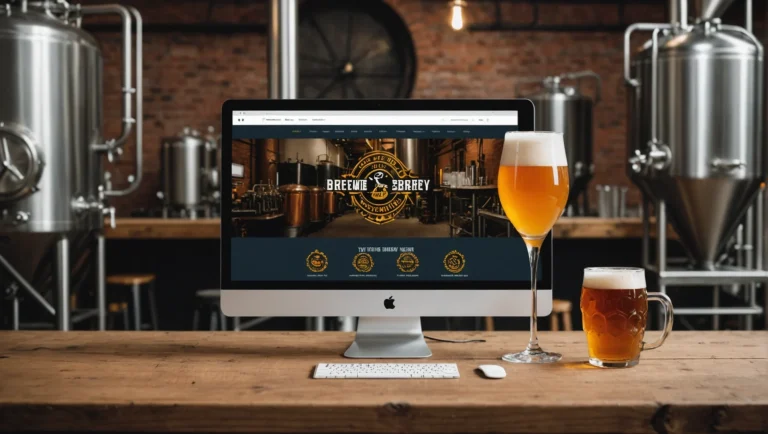
That ordering matters because it decides your homepage. The best sites in any local business category earn trust quickly, lead with real visuals of the actual place, and point at one clear action (Wildcore Studio). For a brewery the clear action is almost always “come in”, and the trust signal is a photograph of your actual taproom with actual people in it rather than a stock photo of a hop field.
The brewery’s own room is doing real commercial work here: 58% of craft drinkers said they bought more of a brewery’s product after visiting its taproom, up from 51% the year before (Brewers Association). The site’s main job is simply to produce that first visit.
Metrobi is transforming beverage deliveries
Specialized solutions for beverage businesses:
- Beverage-trained drivers
- Proper handling equipment
- Peak day delivery support
- 23% average cost reduction
The pages every brewery website needs
Keep the structure small. A brewery does not need fourteen pages and a brewery with fourteen pages usually has four that are out of date.
| Page | What it must answer | Common mistake |
|---|---|---|
| Home | Are you open, what is on, where are you | Full-screen video, hours three clicks deep |
| Tap list / beers | What can I drink right now | No date, no ABV, never updated |
| Visit | Address, hours, parking, dog and kid policy | Address only in a map embed |
| Events | What is happening this week | A dead calendar from last season |
| Shop / order | Cans to go, merch, gift cards | Launched and then abandoned |
| About | Who you are and why this beer | Three paragraphs of founder mythology |
| Contact | Phone, email, private events enquiry | Form only, no phone number |
The contact page is worth one specific decision: use a real business line rather than a founder’s mobile. Private event enquiries and distributor calls both come in this way, and a number that can be answered by whoever is on shift is more useful than one that rings in a car. If you do not have one yet, there are straightforward ways to get a business phone number that forward to whoever is working.
The home, tap list, and visit pages carry nearly all the value. Build those three properly before you build anything else, and resist the urge to add a blog you will not maintain.
The tap list is the page people actually came for
Your beer menu is one of the most visited sections of any brewery site, which makes it the one worth over-engineering slightly.
Three requirements. It needs a dead simple editor so a taproom manager can change it in 30 seconds from a phone. It needs a visible last-updated date, because “updated Thursday” is honest and an undated stale list quietly costs you customers (Wildcore Studio). And it needs the practical details next to each beer: style, ABV, and whether it is available in cans to go.
If your taproom runs a cloud point-of-sale, connect the tap list to it rather than maintaining two lists. Cloud-based taproom management platforms are now used by 78% of breweries (Raspberry Pints), and most of them can feed a website directly. Two lists always diverge, and the website is always the one that goes stale.
Hours deserve more care than they get
Hours are the single most-searched fact about your brewery and they change more often than anything else on the site.
Put them in text on the homepage, not inside an image and not only in a map embed, because text is what search engines and AI assistants can actually read back to someone asking. Keep holiday hours current, and if you close early for a private event, the site should say so. A brewery that is reliably accurate about its hours earns a kind of trust that is difficult to buy any other way.
Designing for mobile and for speed
Mobile-first design is essential for a brewery, and the site should load quickly (Seahawk Media).
The context explains why. Brewery research happens on a phone, often outdoors, often on a weak connection, frequently while a group is deciding where to go. That user has no patience for an autoplaying hero video and no interest in scrolling past your brand story to find out if you are open.
Practical rules that follow from it:
- Hours and tap list above the fold on a phone screen, not behind a hamburger menu.
- Tap-to-call and tap-for-directions as actual buttons, since those are the two things a phone is best at.
- Compress the photography. Brewery sites are image-heavy by nature and uncompressed taproom photos are the usual cause of a slow site.
- Skip the full-screen video. It is the most common brewery homepage choice and the most expensive one in load time.
Taking orders and payments online
Online ordering is where a brewery site stops being marketing and starts being revenue, and it is also where the legal constraints bite hardest.
What you can sell online depends entirely on your state licence: cans to go, growler fills, shipping, and local delivery are separately regulated and some are not available to you at all. Confirm what your manufacturer licence permits before you build a checkout for it.
Where it is permitted, three things are worth building:
- Order ahead for pickup, which is low friction and works with the way people already use taprooms.
- Gift cards and merchandise, the simplest money a brewery website makes.
- Local delivery, if your licence allows direct-to-consumer delivery in your area.
On the in-room side, mobile ordering via QR code is used by 40% of breweries, and customers use it about 40% of the time when it is offered, while still preferring to order in person when they have questions (Raspberry Pints). Treat QR ordering as an option alongside the bar, not a replacement for it.
Checkout is the part worth being careful with. An abandoned cart on a brewery site is usually a usability problem rather than a pricing one: too many form fields, a surprise fee at the last step, or a pickup time nobody can find.
Getting found: local search for breweries
Local search is the main discovery path for a brewery, because the highest-intent query in the category is not your name, it is “brewery near me”.
Three things do most of the work:
- A complete Google Business Profile, with hours that match your website exactly, current photos, and the right category. For a brewery this profile often outperforms the website itself as a first touchpoint.
- Location-specific content and local business schema, including city and neighbourhood names in your titles, headings, and meta descriptions (Seahawk Media).
- Consistent name, address, and phone number across the site, your profile, delivery platforms, and beer directories. Inconsistency here is a quiet, common ranking problem.
A note on measurement: expect your analytics to undercount. Browser privacy defaults and the ad blockers people run on Safari and other browsers stop a meaningful share of analytics scripts from ever loading, so the gap between the visits you record and the visits you get is real and permanent. Use trends rather than absolute numbers, and treat your point-of-sale data as the source of truth for what the website actually produced.
Building it: platform and budget
Most breweries are well served by a mainstream site builder or WordPress, and the deciding factor is who will maintain it.
If the answer is a taproom manager between shifts, choose the platform with the simplest editor and accept the design constraints that come with it. A slightly plainer site that stays current beats a beautiful one that still shows last autumn’s tap list, every time.
Budget realistically against the rest of the project. A competent brewery website is a small line item next to a brewhouse, and it is one of the few pre-opening expenses that starts working before you open, which is why it belongs in the brewery startup cost model rather than in a vague marketing bucket.
Launch it during the buildout. A site with construction photos and an email signup collects an opening-week audience for months, and that list is the cheapest marketing asset a new brewery will ever own.
Frequently asked questions
What should a brewery website include?
At minimum: hours and address in readable text, a dated tap list with styles and ABVs, directions and parking, an events page, and a contact method including a phone number. Online ordering and merchandise come next, limited by what your state licence permits.
How much does a brewery website cost?
A self-built site on a mainstream builder runs a few hundred dollars a year. A designed custom site from an agency typically runs into the low thousands. Against a brewery buildout, either is a rounding error, and the ongoing cost that matters is whoever keeps the tap list current.
Do breweries need an online shop?
Only if your licence permits direct sales and you will actually fulfil them. Gift cards and merchandise are almost always worth it. Beer sales online depend on state rules for cans to go, shipping, and local delivery, so check before building a checkout.
How do breweries show up in “brewery near me” searches?
Mostly through a complete, accurate Google Business Profile backed by a website whose hours and address match it exactly, with local business schema and city names used naturally in page titles and headings. Consistency between your profile, your site, and third-party listings matters more than volume of content.
How often should a brewery update its website?
The tap list whenever the taps change, which for most breweries is weekly. Hours whenever they change, including holidays. Everything else can sit for months. Design the site so the frequent updates take seconds and the rare ones take an afternoon.
Where to start
Build three pages properly before you build anything else: a homepage that puts hours and what is pouring in front of a phone user immediately, a tap list with a date on it, and a visit page with the address in text.
Then connect the tap list to whatever system your taproom already runs on, so nobody has to remember to update it twice. Everything else on a brewery website is optional. Those three things are the site.