Beer has one of the best gross margins in food and drink. Breweries, as businesses, do not.
That gap is the whole story. A pint costs a couple of dollars to make and sells for seven, which looks like a license to print money until rent, payroll, excise tax and a distributor’s cut have taken their turn. Accountants who work only with breweries put the average craft gross margin near 45% and the average net margin near 9% (U-Nique Accounting, 2026). Same beer. Thirty-six points of difference.
So “do you have a profitable brewery?” isn’t really one question. It’s three: what margin you earn on each barrel, which channel you sell that barrel through, and how much fixed cost sits underneath the whole operation. This page works through all three with the numbers brewers actually report, and finishes with the arithmetic to run on your own books.
The Bottom Line
- Craft breweries average roughly 45% gross margin and around 9% net margin, so a brewery can have healthy beer economics and still barely clear a profit (U-Nique Accounting, 2026).
- Channel mix sets your margin before anything else does. A half-barrel poured in your own taproom can return around $600, against roughly $150 for the same keg sold to a distributor (Microbrewery System, 2026).
- 2025 was a correction year: craft production fell about 4%, with 481 closings against 300 openings, yet craft’s share of beer volume still ticked up from 13.2% to 13.4% (Brewers Association, 2026).
- Break-even usually lands somewhere between 18 months and three years, and stretches to five in an oversupplied market or an undercapitalized build.
- Federal excise tax is $3.50 per barrel on your first 60,000 barrels if you brew under two million, and it’s owed when beer leaves for sale, not when it’s brewed (TTB).
Boost customer satisfaction with just a few clicks
Most-Loved Features:
- On-demand drivers
- Real-time GPS tracking
- Delivery confirmation photos
- Over 50% of customers report a smoother delivery experience
What counts as a good brewery profit margin
Two numbers get called “the margin,” and confusing them is how brewers end up surprised at year end.
Gross margin is what’s left after the cost of making the beer: grain, hops, yeast, water, packaging, and the brewing labor tied to a batch. Craft breweries average around 45% here, and individual products run far higher, with reported markups of roughly 75% on bottled beer and 80% on draft (U-Nique Accounting, 2026).
Net margin is what’s left after everything else: rent, taproom staff, insurance, utilities, marketing, delivery, debt service, excise tax. That’s the number that tells you whether the business works. Reported ranges vary by source and sample, but most land between 4% and 15%, with well-run operations at 10% to 20% and a meaningful share of breweries sitting at 5% or less (Startups Cost, 2026).
Here’s the practical benchmark table.
| Metric | Weak | Typical | Strong |
|---|---|---|---|
| Gross margin (all channels) | Under 35% | 40-50% | 55%+ |
| Net profit margin | Under 5% | 8-12% | 15-20% |
| Taproom share of revenue | Under 25% | 30-50% | 60%+ |
| Cost per barrel produced | $200+ | $120-180 | Under $120 |
| Months to break-even | 48+ | 24-36 | 18-24 |
Sources: U-Nique Accounting (2026), Startups Cost (2026). Treat these as orientation rather than targets. A 300-barrel taproom and a 15,000-barrel production brewery are different businesses wearing the same word.
One honest warning about that strong column: a 20% net margin usually means a small, taproom-heavy brewery with a paid-off brewhouse and an owner who brews. It rarely survives contact with a distribution expansion.
Metrobi is transforming beverage deliveries
Specialized solutions for beverage businesses:
- Beverage-trained drivers
- Proper handling equipment
- Peak day delivery support
- 23% average cost reduction
Are breweries profitable in 2026?
Profitable, yes, but on a much thinner margin for error than five years ago.
The Brewers Association’s 2025 data describes a category in correction. Craft production fell roughly 4%, there were 481 closings against 300 openings for a net loss of 181 breweries, and 60% of breweries reported declining volume while 39% grew (Brewers Association, 2026). Craft’s share of total beer volume still edged up, from 13.2% to 13.4%, because the overall beer category shrank faster.
Where the pain landed matters more than the headline. Distribution-led breweries took the worst of it, while taprooms gave up about 3.9% of volume and held comparatively steady. Taprooms and brewpubs now make up roughly 73% of all craft businesses while accounting for about 15% of total volume (Brewers Association, 2026). The industry has quietly reorganized itself around the high-margin channel.
Read that as a margin signal, not a demand signal. Beer didn’t stop selling. The expensive way of selling it stopped paying.
Brewery profit margins by sales channel
This is the single biggest lever on your margin, and most brewers underrate it because the volume numbers flatter distribution.
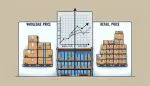
The same half-barrel is worth wildly different money depending on who hands over the cash. Sold across your own bar it can return around $600; sold to a distributor, roughly $150 (Microbrewery System, 2026). Your cost to brew it didn’t change.
| Channel | Typical gross margin | What you give up | What you take on |
|---|---|---|---|
| Taproom pints | 70-80% | Nothing but seats and hours | Staffing, licensing, footfall risk |
| To-go cans and crowlers | 50-65% | A little retail price | Packaging gear, shelf life |
| Direct local delivery and online orders | 45-60% | Fulfillment cost | Routing, state rules, driver cover |
| Self-distribution to accounts | 30-40% | Retail margin | Your own vehicles, invoicing, keg chasing |
| Distributor wholesale | 15-25% | Retail and distributor margin | Volume commitments, slow pay |
Sources: Startup Cost Hub (2026), Microbrewery System (2026). Ranges are directional and move with your pricing and labor model.
Distributors then add their own 15% to 30% markup before a bar ever sees the keg, and that bar sells your $150 half-barrel as roughly 124 pints at $6 to $9 each. You keep the thinnest slice of the biggest number in that chain.
None of which makes wholesale wrong. It buys reach, brand presence and the volume that justifies a bigger brewhouse. It just has to be priced as what it is: a volume and awareness channel with a margin to match, not the engine of profitability. The breweries that got hurt in 2025 were mostly the ones who had it backwards.
What eats a brewery’s margin between the tank and the bank
Five costs do most of the damage, and four of them are controllable.
Cost of goods per barrel
Grain, hops, yeast and packaging. Packaging is often the surprise, because cans, labels and shrink can rival the liquid they hold. Calculate a true cost per barrel that includes packaging loss, not brew-sheet assumptions.
Yield loss
Beer lost to trub, transfer, foam and failed batches never earns anything but was fully paid for. A few points of recovered yield drops straight to the bottom line.
Taproom and brewhouse labor
The brewhouse is one bill; the taproom is another, and it scales with opening hours rather than with sales. Thin weeknights are where taproom margin quietly disappears.
Federal excise tax on beer
$3.50 per barrel on the first 60,000 barrels for brewers producing under two million, then $16 per barrel on the next tier (TTB). It’s triggered by removal for sale rather than by brewing, and it’s reported on the Brewer’s Report of Operations. Modest per barrel, but it belongs in your cost of goods, not in the footnotes.
Fixed overhead
Rent, insurance, loan payments, utilities. This is the uncontrollable one, which is exactly why it has to be small relative to the beer you can actually sell. Overbuilt capacity is the most common way a brewery with good beer and good margins still fails.
How long a new brewery takes to reach break-even
Plan on three years and be pleasantly surprised.
That’s the commonly cited average for a new brewery reaching profitability, and the spread around it is wide and predictable. Well-capitalized, taproom-led breweries with a real local following often break even in 18 to 24 months, while undercapitalized builds or breweries opening into a saturated market can take three to five years (Dojo Business, 2026). Nano-scale operations brewing 200 to 500 barrels a year on a $250,000 to $400,000 investment have reached break-even inside two years when the taproom carried the revenue.
Two things shorten that timeline more than anything else. Opening with a taproom-first model, so your first barrels sell at the best margin available. And keeping the initial build at the low end of what you can get away with, because every dollar of equipment debt is a dollar the beer has to repay before anyone calls it profit.
If you’re still at the planning stage, this is the number that belongs in the financial section of your plan. Not a hockey-stick volume curve, but an honest month in which cumulative cash turns positive. The sequence that gets you to that month, from business model through licensing to first pour, is laid out step by step in our guide to how to start a brewery.
How to calculate your own brewery’s profit margin
Five steps, one evening, a spreadsheet.
- Get your true cost per barrel. Add ingredients, packaging, brewing labor and lost yield for a real batch, then divide by the barrels that actually left the tank saleable. Not the batch size. The saleable yield.
- Work out revenue per barrel by channel. Take last quarter’s actuals for taproom, to-go, delivery, self-distribution and wholesale separately. One blended number hides the problem.
- Calculate contribution per barrel for each channel. Revenue per barrel, minus cost per barrel, minus the variable cost of serving it in that channel: taproom labor, delivery cost, keg handling. This tells you which channel is funding the business.
- Divide fixed overhead by total barrels. Rent, insurance, salaries, debt service and utilities, divided by annual production. That’s your overhead cost per barrel, and it falls when you grow and spikes when you don’t.
- Compare the result against your mix. Contribution per barrel, weighted by your actual channel mix, minus overhead per barrel. Positive and you have a profitable brewery. Marginal and your mix is the fastest thing to change.
Run this quarterly rather than annually. Channel mix drifts on its own, and a new distributor account or one slow taproom quarter will move your net margin before your accountant notices.
The same arithmetic travels well across food and drink. If you also run events or a kitchen alongside the taproom, the contribution-per-unit approach behind a profitable catering business plan is the same calculation with covers in place of barrels.
The levers that move a brewery’s margin
In rough order of how fast they work:
- Shift mix toward direct sales. Moving even five percent of volume from wholesale to the taproom or direct delivery does more for net margin than any cost-cutting exercise available to you.
- Price the taproom properly. Most taprooms sit a dollar under what their market tolerates. That dollar is almost pure margin.
- Fix yield before buying tanks. Recovering lost beer is cheaper per barrel than brewing more of it.
- Cut dead hours, not staff. Closing a consistently empty weekday afternoon protects margin without touching service quality.
- Charge for the last mile. If you run beer out to accounts or customers yourself, each stop has a real cost. Breweries that price delivery, or route it tightly, keep the margin self-distribution is supposed to earn.
- Audit your distributor economics every year. Volume that loses money at scale is still volume that loses money.
Brewery profit margin questions brewers actually ask
What is a good profit margin for a brewery?
Around 10% to 15% net is a solid result for an established brewery, and 15% to 20% is strong. Gross margin should sit in the 40% to 50% range across all channels. If gross looks healthy and net doesn’t, the problem is overhead or channel mix, not the beer.
How much do breweries make?
It depends on scale and channel mix far more than on beer quality. A taproom-led nano brewery selling 400 barrels at direct prices can out-earn a 2,000-barrel brewery that moves most of its volume wholesale, because the first one keeps four to five times as much per barrel.
Is a taproom more profitable than distribution?
Per barrel, yes, by a wide margin: roughly $600 against $150 for the same half-barrel (Microbrewery System, 2026). Distribution wins on reach and total volume. Most profitable breweries use wholesale to be known and the taproom to get paid.
Why did so many breweries close in 2025 if margins are good?
Because gross margin isn’t profit. With production down about 4% and 481 closings against 300 openings, the breweries that struggled were mostly carrying fixed costs built for volume that never arrived (Brewers Association, 2026).
What a profitable brewery looks like on paper
It isn’t the one with the best beer or the biggest brewhouse. It’s the one with a low cost per barrel, a mix weighted toward whoever pays retail, overhead sized to the volume it can actually sell, and an owner who knows contribution per barrel by channel without having to look it up.
All four are adjustable, and none of them need a new fermenter. Work out your real numbers this quarter, then change the mix before you change the capacity.