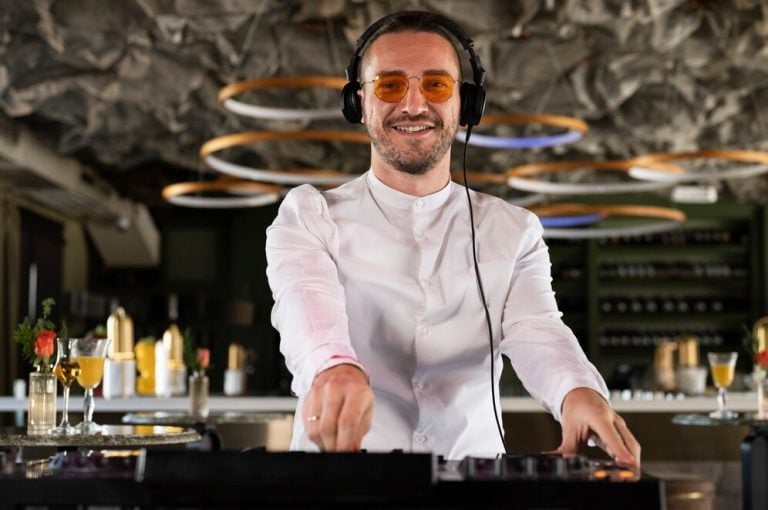

A guitarist in the corner on a Thursday does something no playlist can: it gives people a reason to choose a night. Not a restaurant. A night. “There’s a band at eight” is a plan. “They have good food” is an option.
That is the whole case for live music for restaurants, and it is a strong one. It is also the expensive one. A standing music programme means act fees every week, a licensing position that changes the moment a human being performs, permits in some cities, and two to four hours of someone’s week spent on a calendar nobody else can maintain.
This guide is the operator’s version of the decision: what a music night actually changes about your covers and your bar, what the acts cost, how to book and schedule them, what the licensing and permit exposure looks like, and the cases where the honest answer is don’t.
The Bottom Line
- Solo acoustic acts generally run $200 to $400 per show, duos $300 to $600, trios and full bands $500 to $1,500 and up, DJs $200 to $800 per set.
- A three-night-a-week programme costs most restaurants $3,000 to $6,000 a month once act fees, licensing and management time are counted.
- Live performance changes your music licensing position. Performing rights organizations price entertainment differently from background music, and some cities require a separate entertainment permit.
- The payoff is a reason to visit on a specific night, longer sits and more bar spend, not a higher food check.
- Entertainment programming is now the fastest-growing part of the bar business, with live music and themed nights driving 22% of visits at urban bars.
Metrobi drivers are rated 4.97/5
Trusted by local businesses for:
- Background-checked professionals
- Specialized in business deliveries
- Same drivers for consistency
- 4.97/5 average delivery rating
Five payoffs of a live music night at your restaurant
It creates an appointment. A recurring act gives locals a repeatable plan. The strongest version is the same night every week, because a Thursday residency becomes a habit in a way a one-off Saturday booking never does.
It extends the sit, which sells drinks. Guests who stay for a set order another round, and bar sales are where that shows up. Independent music venues earn about 60% of their gross turnover from food and drink rather than tickets (Nightlife Association, retrieved 2026-11-13). That is the same dynamic a restaurant is renting when it books a performer. Recorded music moves the same lever more cheaply; the mechanics of tempo, volume and dayparting are covered in the full guide to restaurant music.
It fills the nights nobody else wants. A Tuesday that runs at 40% capacity is the cheapest night to experiment with and the one where a $250 act has the clearest shot at paying for itself.
It differentiates a room that otherwise competes on menu. Three restaurants on the same block can serve similar food. One of them has a singer on Friday. That is a hard thing for the other two to copy quickly, because it depends on relationships with local performers.
It gives you something to market. A music calendar is content: posts, stories, an email, a sandwich board. It also slots into whatever else you run to fill a room, the same muscle as in-store events, and easier to sustain, because the act does the programming for you. Entertainment programming is the fastest-growing application in the bar and nightclub sector, and live music, themed nights and interactive games now drive 22% of visits at urban bars (Nightlife Association, retrieved 2026-11-13).
What live music does not reliably do is raise the food check. Expect it to influence traffic on a chosen night and spend at the bar. Budget against those two numbers.
What live music for restaurants actually costs
Act fees are the visible cost and roughly a third of the real one. Industry booking data puts typical hospitality rates here:
| Act type | Typical fee per show | Fits |
|---|---|---|
| Solo acoustic (guitar or keys) | $200–$400, most $200–$300 | Dinner service, small rooms, patios |
| Duo | $300–$600 | Weekend dinner, wine bars, breweries |
| Trio or full band | $500–$1,500+ | Late service, bar-led rooms, events |
| DJ | $200–$800 per set | Late night, brunch parties, private buyouts |
Then the costs that do not appear on an invoice (GigFinesse, retrieved 2026-11-13):
- Licensing: low-to-mid four figures a year for a venue with live performance, which amortizes to roughly $150 to $350 a month. This is the line most first-time programmes forget, and the one with the worst downside if you skip it. The detail is in restaurant music licensing.
- Sound equipment: $1,500 to $5,000 once, for a house PA, mics and stands. Without it you are limited to acts that bring their own rig, and you will pay for that in fees.
- Management time: two to four hours a week on booking, confirming, rescheduling and chasing. At a manager’s cost that is $1,500 to $3,000 a month of real labour.
- Marketing assets: $30 to $100 per graphic from a freelancer, or five to eight hours a week if you make them in-house.
Put together, a three-night-a-week programme lands at $3,000 to $6,000 a month for most restaurants: $2,500 to $4,500 in act fees, $150 to $350 in amortized licensing, and $1,500 to $3,000 in management time. Full-service booking agencies charge $1,500 to $3,500 a month and up to take the calendar off your hands.
One warning from the booking side: unusually cheap quotes correlate with cancellations. A no-show on a promoted night costs you the staffing you scheduled and the guests who came for the act, which is more than the $80 you saved on the fee.
How to book live music for a restaurant
Start with the room, not the act. Measure what your space can absorb. A 40-seat dining room with hard surfaces cannot take a drummer, and booking one anyway is how a music night turns into a complaint night. Solo or duo for dinner service; a band only if you have the volume headroom and a bar crowd to use it.
Find acts where they already play. The fastest sources are other venues’ calendars, local open mics, music school noticeboards, and the performers your own staff know. Booking apps and agencies exist and work, and they cost more than a direct relationship.
Audition before you book. Watch a set somewhere else, or listen to a live recording rather than a studio one. Studio polish tells you nothing about whether someone can hold a dining room for two hours.
Put it in writing. A short agreement covering date, set times and lengths, fee and payment timing, who provides the PA, load-in and sound-check windows, volume limits, and the cancellation terms on both sides. Flat fee is cleanest for restaurants; fee-plus-door only makes sense once you are charging a cover.
Book months out, then rebook the good ones. Calendars for decent local acts fill weeks ahead. The goal is not a parade of new performers. It is two or three reliable acts you can rotate, because reliability is worth more than novelty on a Thursday.
Agree the volume before the first song. Set a decibel ceiling, tell the act where the dining room’s limit is, and have one manager empowered to ask for less. This is the single most common point of friction between restaurants and performers.
Licensing and permits for live music
Live performance changes three things at once, and all three are worth checking before you promote a date.
Performing rights licences are priced differently when there is live music. ASCAP, BMI, SESAC and GMR each quote on venue specs and programming, and a room with live entertainment is quoted above one playing background music. Covers are the usual trap: when a performer plays someone else’s songs, those songwriters are owed, and the obligation sits with the venue rather than the musician.
Local rules come next. Check your noise ordinance for the hours and levels that apply, and check whether your certificate of occupancy or liquor licence carries entertainment restrictions. Some cities require a separate live entertainment permit on top of everything else.
Then the practical one: amplified sound after 9pm in a mixed residential block is a neighbour-relations project. Talk to the neighbours before the first show, not after the first call.
How to schedule and promote a recurring music night
Pick one night and keep it. Rotating the night each week destroys the habit that makes the programme work, and the habit is the entire asset you are building.
- Choose your weakest viable night, not your best. A packed Saturday does not need help; a soft Wednesday does.
- Set the time against your service, not the act’s preference. A set starting at 7pm catches the dinner rush and the second round. A 9:30pm start catches a bar crowd, if you have one.
- Publish a calendar a month ahead so regulars can plan and your staff can prep. A month of dates also makes the programme look permanent, which helps it become permanent.
- Promote the act, not the concept. “Live music tonight” is wallpaper. A name, a photo and a genre gives people something to decide about.
- Brief the floor. Servers should know who is playing, when the set breaks are, and how to answer “is it loud in there tonight?” honestly.
- Give the night a reason to repeat. A music night is a natural pairing for anything that rewards coming back, including a restaurant gift card program. The guest who discovers your Thursday act is the one most likely to buy a card for someone else.
- Track it properly. Covers, bar sales and average check on music nights against the same night without music, over at least six weeks. One good Thursday proves nothing either way.
Between sets and on the nights without an act, the room still needs a soundtrack that matches, which is what the best restaurant music playlists are for.
When live music is the wrong call for your restaurant
- Your room cannot take the volume: small, hard-surfaced dining rooms where the music has nowhere to go turn into noise complaints.
- Your guests come for conversation. A fine-dining room built on long, quiet dinners has nothing to gain from amplification.
- Your bar is small or absent: live music monetizes through drinks and time. If your margin is a lunch counter, the arithmetic rarely works.
- Nobody owns the calendar. The programmes that fail are the ones where booking is everyone’s job. Two to four hours a week has to belong to a named person.
- You will not get licensed. Running live music without the right licences is a cost deferral, not a saving.
Frequently asked questions
How much does it cost to have live music at a restaurant?
Act fees run $200 to $400 for a solo acoustic performer, $300 to $600 for a duo and $500 to $1,500 or more for a band. Once licensing, a house PA, promotion and the management hours are counted, a three-night-a-week programme costs most restaurants $3,000 to $6,000 a month.
Do restaurants need a licence for live music?
Yes, in almost every case. Performing rights organizations licence live performance separately from background music and price it on your venue and programming, and the obligation for cover songs sits with the venue. Some cities also require a live entertainment permit, and your liquor licence or certificate of occupancy may carry its own restrictions.
Is live music worth it for a small restaurant?
It can be, on the right night and with the right act. A $250 solo performer on a soft weeknight has a realistic shot at paying for itself through covers and bar spend. A band on a night that is already busy usually does not. Start with one act on your weakest viable night and measure for six weeks before committing to a schedule.
How do restaurants find local musicians?
Other venues’ calendars, open mic nights, local music schools, and staff recommendations are the fastest routes and the cheapest. Booking apps and agencies handle the admin for a fee, which is worth it once the calendar is more than one night a week.
Where to start
Book one solo act, on your softest night, for a two-hour set at a fee you can lose without flinching. Sort the licensing first, agree a volume ceiling in writing, promote the performer by name, and compare that night’s covers and bar sales against the four previous weeks.
That one booking tells you more than any projection. If the numbers move, build the calendar out to a standing weekly slot with two or three acts you can rotate. If they don’t, you have spent $250 to learn that your room is better served by a well-programmed playlist.