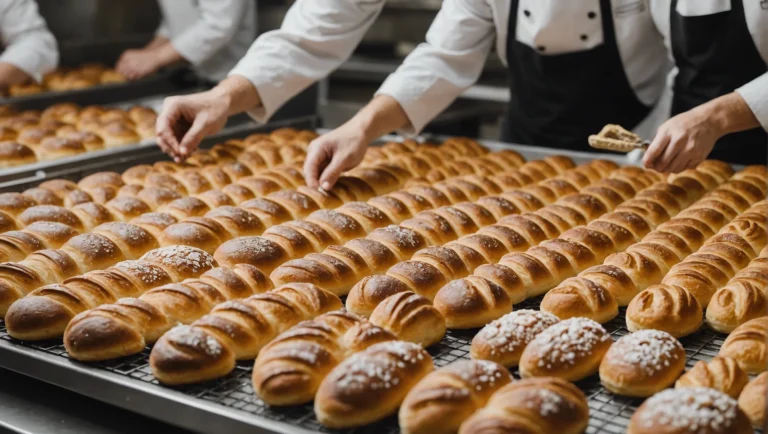

Review your bakery suppliers on a schedule, not when something goes wrong. The useful rhythm for most bakeries is a 15-minute price check every month, a proper scorecard review every quarter, and a full re-quote on your top three spend lines once a year. The reason for the schedule is simple: supplier performance decays quietly. Prices drift up a line at a time, a fill rate slips from 98% to 92% over a few months, and a delivery that used to arrive at 7am starts arriving at 11. None of it is dramatic enough to trigger a phone call on its own, and all of it is costing you money by the time you notice.
For a bakery that delivers, the cost lands somewhere worse than the margin. A shorted case of flour on Tuesday is a production shortfall on Wednesday and a shorted wholesale order on Thursday, and your customer experiences that as your failure, not your supplier’s. That is why the review is an operating control rather than a procurement chore.
The Bottom Line
- Benchmarks to judge against: on-time delivery of 95% or better is the standard target, with strong distribution operations at 98%+, and fill rates in B2B grocery wholesale running 96–99% (Xorosoft, Xorosoft).
- A workable weighting for a foodservice supplier scorecard: quality consistency 30%, on-time delivery 25%, cost stability 20%, responsiveness to special requests 15%, documentation accuracy 10% (GoodSource).
- Most of the data you need is already in your own invoices and delivery notes. You do not need a system to start.
- Ingredient markets move in both directions, so a “market increase” is a claim to test: cocoa has held near record highs while butter fell from $4.79 to $3.96 a pound between September 2025 and September 2026 (Vesper, NPR).
- Review is not the same as switching. Most reviews should end in a conversation and a correction, not a new supplier.
Metrobi drivers are rated 4.97/5
Trusted by local businesses for:
- Background-checked professionals
- Specialized in business deliveries
- Same drivers for consistency
- 4.97/5 average delivery rating
Why supplier reviews get skipped
Because nothing breaks. A supplier relationship that is 10% worse than it was last year still delivers most of the time, and a bakery owner’s attention goes to the things that are on fire. The three failures that build up in the gap:
- Price creep. Increases arrive on single lines, often without notice, and each one is too small to argue about. Across a year on 200 SKUs, they are not small.
- Service drift. Delivery windows slip, a reliable rep leaves, substitutions start arriving unannounced. Nobody decided this; it just happened.
- Range mismatch. Your product line moved and your supplier’s did not. You are buying three items from a specialist you opened an account with for one, and paying specialist prices for the other two — a channel problem rather than a supplier one, and the reason it helps to know which channel each category of bakery supplies and equipment belongs in.
A scheduled review catches all three, because it compares this quarter to last quarter rather than to your impression of how things used to be.
Metrobi is transforming bakery deliveries
Specialized solutions for bakery businesses:
- Bakery-trained drivers
- Proper handling equipment
- Peak day delivery support
- 23% average cost reduction
The review cadence that actually gets done
Three loops, each sized to fit the time you will realistically give it.
Monthly, 15 minutes. Pull your top 10 spend lines and compare unit price to last month. You are looking for changes you were not told about. Flag anything up more than a couple of percent and ask the rep why, by email, so you have the answer in writing.
Quarterly, an hour. Score each supplier on the five dimensions below using the quarter’s invoices and delivery notes. This is where you find service drift, because the numbers show it and memory does not.
Annually, half a day. Re-quote your three biggest spend categories against at least one alternative. You do not have to move. You do have to know what moving is worth, and your incumbent should know that you know. If you are short of alternatives to quote against, the best bakery suppliers breakdown names who covers each category.
A bakery running growth or a new wholesale account should tighten the monthly check to fortnightly for the first quarter. Volume changes are exactly when minimums, break points and delivery schedules stop fitting.
The five things to score
| Dimension | Weight | What you measure | Where the data is |
|---|---|---|---|
| Quality consistency | 30% | Rejected or substandard deliveries; batch variation you had to work around | Production notes, credit requests |
| On-time delivery | 25% | Deliveries inside the agreed window, as a percentage | Delivery notes, receiving log |
| Cost stability | 20% | Unit price change over the period on your top lines | Invoices |
| Responsiveness | 15% | Time to answer a shortage, a credit or a rush request | Email and call history |
| Documentation accuracy | 10% | Invoice errors, wrong quantities, missing specs or lot codes | Invoices, spec sheets |
Weighting adapted from a foodservice supplier scorecard structure published by GoodSource.
Two notes on using it. First, quality sits at the top for a reason: a cheaper bag of flour that changes your crumb is not cheaper, it is a different product. Second, score the same way every quarter even when it feels mechanical, because the value is in the trend line, and a scorecard you only fill in during a bad quarter tells you nothing.
The numbers that tell you a supplier is slipping
Three measures do most of the work, and all three come out of paperwork you already have.
Fill rate. Of the lines you ordered, how many arrived complete? Count by line, not by invoice value. Average fill rate for food orders sits around 98%, and B2B grocery wholesale generally runs 96–99% (Xorosoft, AisleStock). A supplier at 90% is shorting you one line in ten, which on a 40-line order is four production problems a week.
On-time delivery. The standard target across distribution is 95% or better, and the strongest wholesale foodservice operations reach 98%+ (Xorosoft). Measure against the agreed window, not against when the truck usually turns up.
Price variance on your top lines. Track the 10 items that make up most of your spend. Wheat and butter alone account for 45–65% of raw material cost across most bakery products, so movement there outweighs everything else on the invoice (Vesper).
Combined, fill rate and on-time give you the measure distributors use on themselves: on-time in-full, or OTIF. It is the honest single number for “did I get what I ordered when I was told I would”, and it is the one to open a conversation with.
Testing a price increase instead of accepting it
When an increase arrives, the claim is usually “the market”. Sometimes that is true. Cocoa powder has held above $10,000 per tonne in Europe and near $9,000 in the US, and nobody is absorbing that quietly (Vesper). But markets also fall, and butter dropped from $4.79 to $3.96 a pound in the year to September 2026 (NPR). An increase on a falling input is not the market; it is your account.
Three questions that settle it quickly:
- Which inputs moved, and by how much? A supplier who can answer this is passing through a cost. One who cannot is testing you.
- Is the increase on everything or on selected lines? Selective increases on your highest-volume items are a margin decision about you specifically.
- What does a competing quote say this week? One live quote converts the conversation from opinion to evidence.
And note which direction the increases have been going versus your menu prices. If supplier costs have moved and your prices have not, the review has just found you a pricing job as well as a procurement one.
Deciding between a conversation and a switch
Most reviews should end in a conversation. Switching a core supplier costs you set-up time, trial batches, a new delivery rhythm and the goodwill you have built, and that goodwill is worth real money on the week you need a favour, which is the subject of building a wholesale bakery supplier relationship.
Raise it with the incumbent when:
- Fill rate or on-time has slipped but is recoverable, and they can name the cause.
- The price gap to an alternative is inside roughly 5% and quality is equal.
- The problem is a process one (substitutions, delivery window, who to call) rather than a capability one.
Move when:
- They cannot serve your current volume or schedule, and said so.
- Quality has changed on an ingredient that defines your product and they cannot guarantee the spec.
- Shortages are repeating on your top items across two quarters after you raised it.
- The paperwork does not hold up. If you supply grocery or foodservice customers, traceability matters: the FDA’s Food Traceability Rule now carries a compliance date of 20 July 2028, and the requirements themselves (lot codes, key data elements, records retrievable within 24 hours) were unchanged by the extension (FDA rule summarised by Tive). A supplier who cannot produce lot-coded documentation is a problem you will inherit.
When you do move, overlap rather than cut over. Run the new supplier on part of the order for a few weeks while the incumbent still has the rest, and check it against your scorecard before you commit the whole list.
Reviewing what you buy, not just who you buy it from
A review is also a chance to check the list itself. Items accumulate: a pan size you no longer use, a filling from a product you discontinued, a box size that fits nothing you currently sell. Cross-check your standing order against what you are actually producing, and against the categories in the most needed bakery supplies and equipment checklist, which is the clearest way to see whether you are over-stocked in one category and improvising in another.
This is also where you notice a channel problem rather than a supplier problem: three items bought at specialist prices that a broadliner carries, or a weekly delivery that could be one fortnightly order.
Frequently asked questions
How often should you review your bakery suppliers?
A price check on your top lines monthly, a scored review quarterly, and a full re-quote of your biggest categories annually. Tighten the monthly check to fortnightly during periods of growth or when you add a wholesale account.
What should a supplier scorecard measure?
Quality consistency, on-time delivery, cost stability, responsiveness and documentation accuracy, weighted roughly 30/25/20/15/10 (GoodSource). Use the same weights every quarter so the trend means something.
What is a good fill rate for a food supplier?
Around 98% is the average for food orders, with B2B grocery wholesale generally in the 96–99% band (Xorosoft). Below about 95% on your core lines, you are planning production around shortages.
Should you tell a supplier you are getting competing quotes?
Yes, plainly and without threat. A good rep would rather know than lose the account, and most increases that are about your account rather than the market soften once a live quote exists.
Where to start
Pull last quarter’s invoices for your biggest supplier and count two things: how many lines arrived short, and how many unit prices changed. That is twenty minutes of work, and it will tell you whether your next conversation is a routine one or an overdue one.