
Table six ordered two entrees, a bottle of wine and dessert. The check went down at 9:40. At 9:52 the table is empty, the coats are gone, and your server is standing there holding a bill nobody is going to pay.
A dine and dash is a small loss that lands in an expensive place. The food is gone, the labor is spent, the seat was occupied for ninety minutes, and the money that was supposed to cover all of it left through the front door. Most of the advice written about this is a list of cameras and signage. The useful version is narrower: there are about four moments in a service where a walkout becomes possible, and nearly every control that works does so by closing one of them. This guide covers what a dine and dash is, how often it happens, the layout and payment changes that prevent it, exactly what to do while one is happening, and who is legally allowed to absorb the cost afterwards. Walkouts are also only one of the ways a food business loses margin it already earned. The quieter version arrives monthly on an invoice, and it is covered in our breakdown of hidden fees in last-mile delivery.
Key Takeaways
- A third of UKHospitality’s surveyed members had experienced customers refusing to pay for their food (CLH News, 1 August 2025). There is no equivalent US industry survey, which is part of why the problem goes unmeasured.
- Most walkouts are not thefts. In a survey of 1,500 UK adults, 39% of those who had left without paying said they simply forgot, against 11% who did it for the thrill (takepayments UK Restaurant Report, September 2025).
- Payment timing is the strongest control you have. Moving money to the front of the transaction (counter ordering, pay-at-table, a card on file for large parties) removes the window rather than policing it.
- You almost certainly cannot charge the loss to the server. Federal law bars deductions that push an employee’s pay below minimum wage, and several states ban walkout deductions outright.
- Never let staff chase anyone. A $90 check is not worth an assault, and no insurer or prosecutor will thank you for the pursuit.
Metrobi drivers are rated 4.97/5
Trusted by local businesses for:
- Background-checked professionals
- Specialized in business deliveries
- Same drivers for consistency
- 4.97/5 average delivery rating
What does dine and dash mean?
A dine and dash is when a customer eats or drinks and then leaves without paying the bill. The service has already been delivered, which is what separates it legally from shoplifting: there is no object in a pocket, only an obligation walking out the door. Most US states prosecute it as theft of services or under an older “defrauding an innkeeper” statute.
Be precise about the term inside your own building, because three different things get called a dine and dash and only one of them is deliberate:
- The deliberate walkout. The table intended not to pay, and often shows signs of it: a seat near the door, an unusual order pattern, staggered departures.
- The forgotten check. Someone assumed a dining companion had settled, or walked out on autopilot after a long meal. This is the largest group, and it resolves with a phone call.
- The dispute that becomes a walkout. The guest was unhappy, nobody dealt with it, and leaving felt easier than arguing. This one is a service failure wearing a theft costume.
Your response has to be different in each case, and the single most expensive mistake operators make is treating the second as the first in front of a dining room.
How common is dine and dash in restaurants?
There is no reliable US-wide figure, and anyone quoting one should be asked for the methodology. The best available data is British. UKHospitality reported that a third of its surveyed members had experienced customers refusing to pay for their food (CLH News, 1 August 2025).
From the customer side, a survey of 1,500 UK adults aged 18 and over found that nearly 8% admitted to having left a restaurant without paying, splitting 9% of men and 7% of women (takepayments UK Restaurant Report, September 2025).
The more useful number in that survey is the reason. Among people who had left without paying, 39% said they forgot, 12% blamed slow service, and 11% said they did it for the thrill and excitement. Read that distribution again before you buy a camera: the largest cause of unpaid checks is not criminality, it is inattention, and the second is your own pacing. Both are fixable with floor process. Only the last third of the problem is a security question.
What one walkout costs a restaurant
The check total is the smallest part of the number. Take an $85 walkout in a restaurant running a 4% net margin, which is ordinary for independent full service. Recovering $85 of profit at that margin takes roughly $2,125 in additional sales, or twenty-five more covers to get back to level on the one table that left.
That arithmetic is why walkouts feel disproportionate to their size, and why the response has to be preventive rather than investigative. Chasing an $85 loss through a police report and camera review costs more management hours than the loss itself. Changing the moment you take payment costs nothing per incident and applies to every table forever.
| What the loss includes | Why it compounds |
|---|---|
| Food and beverage cost | Gone, unrecoverable, already consumed |
| Labor for 90 minutes of service | Paid regardless of whether the check settled |
| The seat itself | A turned table that produced no revenue during peak hours |
| Manager time after the fact | Footage review, incident report, police call |
| Staff morale | The server often feels personally responsible, and sometimes is told they are |
Why customers walk out without paying
Walkouts cluster in predictable conditions rather than arriving at random. Across operator accounts and the survey data above, the same openings keep appearing.
- A long gap between the last touch and the check. If nobody has been to the table in twelve minutes, leaving stops feeling like an event.
- Slow service that has already annoyed the table. Twelve percent of self-reported walkouts named slow service, which makes pacing a loss-prevention control and not only a hospitality one.
- Patio, sidewalk and street-facing seating. An outdoor table with its own exit to the pavement is the highest-risk seat in the building, and it is the one most restaurants watch least.
- Multiple unlocked exits. Any second door that is not being watched is a second decision point for a table that is considering it.
- Shift change and server handoffs. When a section transfers, the table briefly belongs to nobody. Walkouts find that gap reliably.
- Large groups with separate checks. Diffuse responsibility, long settlement, and a plausible excuse built in. Everyone assumed someone else had paid.
Notice how few of those are about the customer’s character. Most are about where your attention was.
Payment timing changes that prevent walkouts
If you do one thing from this guide, change when money moves. Every other control on the list manages the window in which a walkout is possible; payment timing deletes it.
| Service model | Payment change that closes the window | Guest friction |
|---|---|---|
| Counter and fast casual | Take payment at order, before food is made | None — it is the expected norm |
| Casual full service | Pay-at-table via QR or handheld terminal at check drop | Low, and it speeds up turns |
| Bar service | Card held open on every tab, no exceptions for regulars | Low, widely understood |
| Large parties and set menus | Card on file at booking plus a deposit for groups over a threshold you set | Moderate, normal for group bookings |
| Fine dining | Card details at reservation with a stated no-show and walkout policy | Low if disclosed at booking |
| Patio and street seating | Tab held open with a card, or payment at order during busy services | Low |
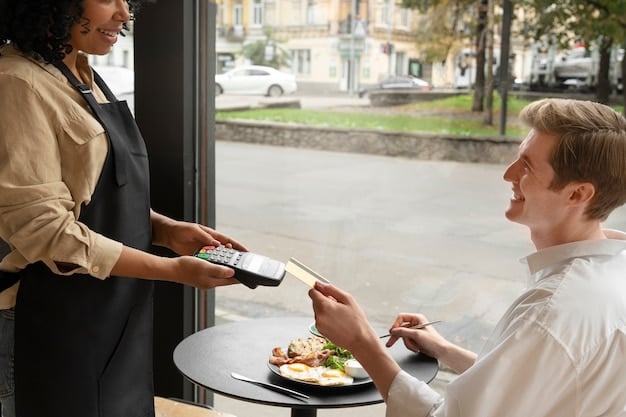
Two notes on executing this. First, a handheld terminal that settles the check at the table is the quietest version of the fix, because the guest never sits alone with an unpaid bill. Second, if you hold cards or take deposits, say so in writing at booking and on the menu. A policy nobody disclosed is a dispute waiting to happen, and in some jurisdictions an unenforceable one.
Floor layout and sightlines that make walking out hard
Layout does the work when nobody is watching, which is most of a Friday night.
- Give the room one working exit. Keep other doors locked where fire code allows, and make sure the open one passes a staffed position.
- Put a body at the door. A host stand that is occupied through service is the most effective physical deterrent in the building, and it pays for itself in seating quality too.
- Seat high-risk tables away from the exit. Walk-ins with no reservation, large groups you do not know, and late-night parties go to the back of the room, not the two-top beside the entrance.
- Cover the entrance and the lot, not just the register. Cameras pointed at the till protect against internal loss. Cameras pointed at the door and the parking area are what produce a usable description or plate number.
- Light the exterior approach. Darkness is the main asset a walkout has after it clears the door.
- Treat the patio as a separate zone. Assign it explicitly to one server per shift, with a rule that it is never left unwatched during a turn.
Signage matters less than most vendors claim, with one exception: a visible, plainly worded notice that the premises are recorded has a documented deterrent reputation and costs almost nothing. Do not expect it to work on anyone determined.
Server habits that stop a dine and dash before it starts
Walkout prevention is mostly a pacing discipline, and it belongs in training rather than in a policy binder.
- Keep the table touched. A visit every few minutes removes the uninterrupted stretch a walkout needs. This is also just good service, which is why it is the easiest habit to embed.
- Drop the check promptly and settle it fast. The dangerous interval is between the check landing and the payment being taken. Shorten it deliberately.
- Name the handoff. When a server leaves the floor, the covering server is told which tables are open and which have checks down. No table should be unowned.
- Watch the sequence, not the person. One guest leaving for the restroom is nothing. One guest leaving with a bag while a second starts gathering coats is a pattern worth a manager’s attention.
- Agree a quiet signal. A short code over the headset or a phrase at the pass lets a server flag a table without announcing it to the room.
- Never make it the server’s financial problem. If staff believe a walkout will cost them money, they will chase people into car parks. That is how a $90 loss becomes an injury claim.
What to do the moment a table walks out
The order of operations here matters more than any of it, and the first rule is the one most often broken.
- Do not chase, and do not let staff chase. No check total justifies a physical confrontation in a street or a parking lot. Say this out loud in training so it is already decided when it happens.
- Call first, accuse never. If you have a reservation name or phone number, ring it and open with the assumption of a mistake: the check appears unsettled, can we take payment over the phone. Given that forgetting is the most commonly reported reason, this recovers a share of unpaid checks at zero cost.
- Write down what you have while it is fresh. Time, table, check total, number of guests, descriptions, direction of travel, vehicle and plate if visible. Memory degrades within the hour.
- Pull the footage the same night. Most systems overwrite on a cycle, and a clip you meant to export on Monday is often gone by Monday.
- Report it if the amount or the pattern warrants it. Police interest in a single small check is realistically limited, but a repeat offender working a neighborhood is a different matter, and a documented series is what makes that case. Operators in the same area who share descriptions tend to catch serial dashers faster than any single restaurant does.
- Log it as a loss line, not an anecdote. Record every walkout with the shift, section and cause. Three months of that data will tell you whether you have a crime problem or a check-drop problem.
Who pays when you dine and dash: the server or the restaurant?
The restaurant absorbs it. This is the part of the subject where operators create legal exposure for themselves, usually without meaning to.
Federal wage law does not allow the cost of running a business to be pushed onto employees below the wage floor. The Department of Labor’s guidance on deductions is explicit that employees “may not be required to pay for any of the cost of such items if, by so doing, their wages would be reduced below the required minimum wage or overtime compensation,” and it names a cashier being required to reimburse a cash drawer shortage as an illegal example (US Department of Labor, Fact Sheet #16). For a tipped server whose cash wage already sits near the floor, almost any walkout deduction runs into that rule immediately.
Several states go further and prohibit it outright. New York’s wage deduction statute limits permitted deductions to an enumerated list covering benefits, insurance, transit and similar, and separately bars an employer from making “any charge against wages, or require an employee to make any payment by separate transaction” unless it appears on that list. Customer walkouts do not (N.Y. Labor Law § 193). Asking a server to settle the check in cash is the same act as deducting it, and is treated that way.
So the practical rule is simple: the loss is the house’s. Check your own state’s wage statute before writing any policy, and if you currently expect staff to cover walkouts, that is the first thing to change in this entire article, ahead of cameras, layout and anything else. It is a legal risk, and it guarantees the chasing behavior you least want.
Is dine and dash illegal, and what is the punishment?
Yes, in every US state, though the charge and the severity vary. Leaving without paying is generally handled as theft of services rather than ordinary theft, because what was taken was the service and not an item.
Penalties in most states range from an infraction up to misdemeanor charges, with some notable variation: New York treats theft of services at a restaurant as a misdemeanor, California prosecutes it as petty theft, and Mississippi makes a repeat refusal to pay a restaurant bill over $25 a felony (LawInfo). Civil recovery of the amount is sometimes available in addition.
For an operator, two things follow. The threshold that matters is usually the dollar value of the check, so a group running a large bill is a materially different legal case from a single walked two-top. And none of this is legal advice. Statutes differ by state and change, so confirm your local position with counsel before you build a policy around a charge.
Beyond walkouts: the fees that take the same margin
A walkout is visible, memorable and small. The other way the same margin leaves is invisible, forgettable and recurring: surcharges on a courier invoice, a platform commission tier that moved, a processing rate that drifted up after a pricing change nobody announced. One $85 walkout a month is roughly $1,000 a year. A 3% rate creep on delivery orders in a business doing $400,000 through those channels is twelve times that, and nobody ever stands in the dining room talking about it.
If you are already running the floor discipline in this guide, the invoice side is where the next money is, and it is laid out in detail in our guide to hidden fees in last-mile delivery.
A dine and dash prevention checklist
Run this in one week, in this order.
- Remove any practice of charging walkouts to staff, and tell the team it is gone. Legal exposure first.
- Pick one payment-timing change from the table above and implement it for your highest-risk service, whether that is the patio, late night, or large parties.
- Audit your exits. Count them, lock what fire code allows, and confirm the remaining one passes a staffed position.
- Staff the host stand through service, especially during the late turn.
- Check camera coverage of the door and the lot, and confirm you know how to export a clip.
- Set the check-drop standard. Decide the maximum acceptable gap between check down and payment taken, then hold it.
- Write the walkout response on one page: do not chase, call the reservation, record the details, pull footage, log the loss.
- Add a walkout line to your weekly numbers, with shift and section, so that in ninety days you know what is causing them.
Frequently asked questions
What happens if you dine and dash?
For the customer, it is usually charged as theft of services, ranging from an infraction to a misdemeanor depending on the state and the amount of the bill, with felony exposure in some places for repeat offenses (LawInfo). For the restaurant, the practical outcome is that the loss stays with the business unless the guest can be contacted and pays voluntarily.
Is dine and dash still a thing?
Yes, and it persists in table-service formats specifically, because that is where the payment happens after consumption. Counter service and delivery largely engineered the problem out by collecting money first. UKHospitality found a third of its surveyed members had dealt with customers refusing to pay (CLH News, 1 August 2025).
Can a restaurant make a server pay for a dine and dash?
Generally no. Federal law prohibits deductions that reduce an employee’s pay below the minimum wage (US Department of Labor, Fact Sheet #16), and some states bar deductions for customer walkouts entirely regardless of wage level (N.Y. Labor Law § 193). Asking the server to hand over cash instead of deducting it is the same thing legally.
Can you hold a customer’s card before they eat?
Yes, if you disclose it. Holding a card on an open tab is standard bar practice, and taking card details at reservation for large parties or set menus is common. What creates problems is charging a card without a clearly stated and accepted policy, so put the terms at the booking step and on the menu.
Should staff chase a customer who walks out?
No. The amount at stake is almost never worth the risk of injury or an assault claim, and a pursuit can complicate both insurance and prosecution. Train it as an absolute rule, because the moment itself is not when you want anyone deciding.
Does CCTV actually prevent dine and dash?
It helps at the margins. Visible recording with plain signage deters opportunists and produces the descriptions and plate numbers that make a police report useful. It does nothing about the largest cause of unpaid checks, which the survey data puts at guests who simply forgot. That is solved by check-drop timing and a phone call, not footage.
The short version
Walkouts are a timing problem dressed as a security problem. Most unpaid checks come from people who forgot or who had already given up on your service, and both of those are closed by taking payment earlier, touching tables more often, and shortening the gap between the check landing and the money moving. Cameras, locked second doors and a staffed host stand handle the deliberate minority. And before any of it, take the loss off your staff. It is the house’s money, in most states it is legally the house’s problem, and a server who fears a deduction is a server who will run into traffic over an $85 bill.