
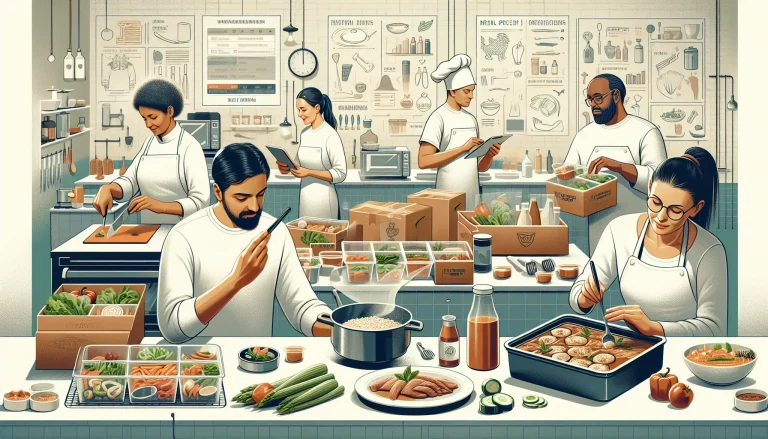

A meal prep business cooks, portions and packages meals in advance, then sells them to customers who reheat rather than cook. The customer is not buying food exactly. They are buying back the planning, shopping and cooking that a week of eating normally costs them, which is why the business is usually sold weekly, by subscription, inside a single delivery radius.
That is the short definition. The useful part is underneath it, because “meal prep business” covers four quite different operations with different kitchens, different costs and very different margins. This page is for someone deciding whether to run one. If you have already decided, the step-by-step launch sequence for a meal prep business picks up from there.
Key Takeaways
- A meal prep business sells pre-cooked, portioned meals for reheating. A meal kit business sells raw ingredients and recipes for the customer to cook. The kitchen, the shelf life and the packaging are all different.
- Four models dominate: ready-to-eat prepared meals, raw meal kits, subscription built on either, and corporate or B2B volume.
- Food margin is healthy, business margin often is not. Blue Apron’s 2022 filing showed a 33.5% gross margin against a negative 23.9% net margin, with marketing taking 18.3% of revenue.
- Meal kit subscriptions average 10.8% monthly churn, roughly 73.6% a year (RetentionCheck), and historical acquisition costs of $85 to $94 per customer mean retention decides profitability.
- The small operator’s advantage is a tight radius and a narrow audience, not menu variety.
Lower your delivery costs by 23%
How we reduce costs:
- No delivery vehicle expenses
- Optimized local routes
- Pay-per-delivery model
- Average 23% delivery cost reduction
What a meal prep business actually does
Production happens in batches against a deadline. Orders close on a cutoff day, the operator shops and cooks in one or two concentrated sessions, meals are portioned into sealed containers, labelled with ingredients and a prepared-on date, chilled, and delivered in a single window. Then it repeats.
Two features of that cycle define the whole business. The first is that demand is known before production starts, which is why meal prep has far less waste than a restaurant. The second is that everything is perishable on a clock: under the FDA Food Code, refrigerated ready-to-eat TCS food gets a seven-day maximum at 41°F or below, with the preparation day counting as day one (FDA Retail Food Protection). A meal prep business is a logistics operation with a kitchen attached, not a restaurant with a delivery add-on.
The equipment list is shorter than people expect, since batch cooking rewards sheet trays, scales and cold storage over specialist machinery, and most of the equipment a meal prep business needs can be bought secondhand or rented with kitchen hours.
It is also almost never legal from a home kitchen. Cooked perishable meals and anything containing meat are excluded from cottage food law in effectively every state (Homegrown), so the realistic starting facility is a commissary or licensed commercial kitchen.
Metrobi is transforming meal prep deliveries
Specialized solutions for meal prep businesses:
- Meal prep-trained drivers
- Proper handling equipment
- Peak day delivery support
- 23% average cost reduction
The four meal prep business models
Most confusion about this industry comes from treating these as one thing. They are not, and they suit different people.
| Model | What the customer gets | Kitchen demand | Where the money is made | Hardest part |
|---|---|---|---|---|
| Ready-to-eat prepared meals | Cooked, portioned meals to reheat | High: full cook, chill and pack cycle | Weekly order volume in a tight radius | Cold chain and consistency at volume |
| Raw meal kits | Pre-portioned ingredients plus a recipe | Moderate: portioning, minimal cooking | Packaging efficiency and ingredient sourcing | Packaging cost and spoilage |
| Subscription | Either of the above on a recurring plan | Same as the underlying model | Lifetime value over many weeks | Churn and menu fatigue |
| Corporate or B2B | Bulk lunches for offices, gyms, clinics | High but predictable | Large repeat orders, low acquisition cost | Winning the first contract |
Ready-to-eat prepared meals
The default, and the model most local operators run. You cook, you portion, you chill, you deliver. Margins per meal are the clearest of the four and the customer’s reason to buy is the strongest, because nothing is asked of them. The constraint is production: every meal passes through your hands, so growth is capped by kitchen hours until you hire.
Raw meal kits
You portion ingredients and supply a recipe card; the customer cooks. Less cooking labour, but considerably more packaging, more SKUs per box and more ways for a box to arrive wrong. This is the model where packaging choices for meals in transit move the margin most, because a kit can need a dozen separate components held at temperature.
Subscription
Not a separate product so much as a billing structure laid over one. It smooths cash flow and makes production predictable, which matters more than it sounds. It also makes churn your central metric rather than a background worry.
Corporate and B2B
Offices, gyms, clinics and co-working spaces buying lunch for a group. One sale covers twenty meals, acquisition cost per head collapses, and delivery is a single stop instead of twenty. The trade is a longer sales cycle and concentration risk: lose one account and you lose a fifth of your revenue.
How meal prep businesses make money
Revenue is simple: meals per week multiplied by price per meal, usually with a minimum order of four to six. A local operator charging $13 to $18 a meal with 50 subscribers taking six meals is doing roughly $4,000 to $5,400 a week in revenue.
The costs are where the business is decided, and they fall into four groups:
- Food cost, typically the largest single line and the one operators track best.
- Packaging and labels, which is a per-meal cost, not overhead. Containers, lids, printed labels and cold packs on every order.
- Kitchen and labour: commissary hours at roughly $15 to $45 an hour or $250 to $750 a month on membership, plus the time to cook, portion and pack.
- Acquisition and delivery, the two that quietly take the margin. Historical meal kit customer acquisition costs have run $84.60 at Blue Apron and $94 at HelloFresh, and delivery cost per drop depends entirely on how clustered your stops are.
The most instructive number in the category is Blue Apron’s 2022 annual filing: a 33.5% gross margin on the food, and a negative 23.9% net margin on the business, with marketing alone consuming 18.3% of revenue. The food worked. The customer maths did not.
Is a meal prep business profitable?
It can be, and the local version is more often profitable than the venture-funded one, for a specific reason: a small operator in a tight radius pays almost nothing for acquisition and very little per delivery, which are exactly the two lines that sank the national brands.
Three conditions separate the profitable ones:
- Retention over acquisition. At 10.8% average monthly churn, roughly 73.6% a year, a subscriber who stays six months is worth several times one who stays three weeks. Menu repetition drives about a third of cancellations, so a planned rotation is a financial decision.
- Route density. Delivery cost per meal falls as stops cluster. A $14 meal delivered in a tight zone can out-earn an $18 meal spread across a county.
- Honest per-container costing. Food, container, lid, label, kitchen minutes, labour, processing fee, delivery cost per stop. Pricing that skips the last three looks profitable and is not.
Expect the first three months to lose money, not because something is wrong but because kitchen hours and packaging are paid before subscriptions compound.
Meal prep, meal kits, catering and personal chefs
These get used interchangeably and shouldn’t be.
- Meal prep delivers cooked, portioned meals for reheating, usually weekly and usually by subscription.
- Meal kits deliver raw pre-portioned ingredients with a recipe. The customer cooks.
- Catering serves one event at one time, priced per head, with no recurring relationship.
- Personal chef cooks for a single household, often in the client’s own kitchen, tailored to that client. Very high price per hour, no scale.
The practical difference for an owner is recurrence. Catering restarts the sale every time; meal prep sells once and bills repeatedly, which is why the subscription model dominates the category.
Who buys from a meal prep business
Four groups buy reliably, and they want different things:
- Fitness and macro-focused customers, who want specified protein and calorie counts and will tolerate repetition.
- Time-poor professionals and parents, who want the week solved and care most about reliability.
- Medical and dietary customers, eating for a condition such as diabetes, renal disease or post-surgical recovery, who value accuracy above all and churn least.
- Corporate buyers, purchasing for a team.
Pick one. A narrow audience is cheaper to reach, easier to cook for and simpler to describe, and finding the first of them is a concrete process covered in getting your first meal prep customers. Trying to serve all four at launch is the most common strategic error in the category, because the menu that satisfies a bodybuilder and a renal patient does not exist.
What a week in a meal prep business looks like
The shape is consistent across operators:
- Monday to Wednesday: marketing, customer messages, next week’s menu planned, ingredients ordered.
- Thursday: order cutoff. Counts become a production plan and a shopping list.
- Friday and Saturday: cook, portion, label, chill. Usually the longest days of the week.
- Sunday: deliver, in one batched window.
Most of the business is admin and logistics rather than cooking, which surprises people who entered because they liked cooking. Taking orders and payments reliably is its own piece of work, and building a meal prep site that takes orders covers the ordering flow and cutoff mechanics in detail. Some operators would rather not spend a production week on it at all, in which case the trade-offs in this guide to outsourcing web development are a useful reality check on cost and timelines before you hire anyone.
Is a meal prep business right for you?
The honest signals that it suits you: you are comfortable with repetitive production to a deadline, you want recurring revenue more than variety, you can be dependable on the same day every week for a year, and you have or can reach a specific group of people with a specific eating problem.
The signals that it does not: you want creative menu freedom, you dislike driving or scheduling, you cannot commit to a fixed weekly window, or you are hoping to run it entirely from a home kitchen without checking your local rules.
Frequently asked questions
What is the difference between a meal prep business and a meal kit business?
A meal prep business delivers fully cooked, portioned meals the customer reheats. A meal kit business delivers raw, pre-portioned ingredients with a recipe for the customer to cook. Meal prep needs more kitchen capacity and a stricter cold chain; meal kits need more packaging per order.
Is a meal prep business profitable?
Food margins are usually healthy and net margins often are not, with acquisition and delivery doing the damage. Local operators with a tight delivery radius and low marketing spend are generally more profitable than the large national services, which have historically paid $85 to $94 to acquire a customer against high monthly churn.
Do you need a commercial kitchen for a meal prep business?
In nearly every US jurisdiction, yes. Cooked perishable meals and anything containing meat are TCS foods excluded from cottage food law, so production normally has to happen in a licensed commissary or commercial kitchen. Confirm with your county health department, as a few areas permit limited home production.
How much do meal prep businesses charge per meal?
Local operators commonly sit between $13 and $18 a meal with a minimum order of four to six meals. The right figure for any given business comes from costing one complete container, including packaging, labour, payment fees and the delivery cost per stop.
How long do prepped meals last?
The FDA Food Code allows refrigerated ready-to-eat TCS food up to seven days at 41°F or below, counting the day of preparation as day one. Frozen meals last considerably longer but change the packaging and reheating instructions.
The short version
A meal prep business is a weekly production and delivery cycle selling solved meals to a narrow audience. The cooking is the visible part; the economics live in retention and route density. Choose one model and one audience, cost a single container completely, and keep the radius small enough that delivery stays cheap.
If that sounds like the business you want, the next step is the legal and kitchen groundwork, in the order it has to happen.