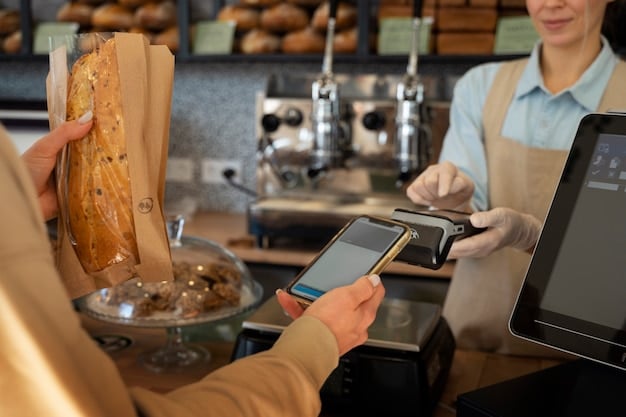

Most coffee shop POS systems cost between $0 and $160 a month in software, plus roughly 2.3% to 2.9% of every card sale. The monthly fee is the number people compare. The processing rate is the number that actually decides what you pay, because on a $5 drink the percentage does more damage than the subscription.
The second thing that decides it: whether app orders show up in your normal ticket queue or on a separate tablet somebody has to remember to watch. That one feature is the difference between delivery helping your afternoon and delivery wrecking your morning, so it runs through every entry below. If you haven’t settled the channel question yet, start with how to start coffee shop delivery and come back, because the POS choice is downstream of it.
Prices below come from each vendor’s own pricing page where that page publishes them, and from dated third-party reviews where it does not. Every one is linked so you can check it against today’s page, because POS pricing moves and this post will eventually be wrong.
The Bottom Line
- Square for Restaurants has a free tier you can run a bar on, at 2.6% + 15¢ in person, which is why it shows up in most small cafes.
- Dripos is the only system here built specifically for coffee shops: $160/month flat, no per-device software fee, with delivery integrations as a $50/month add-on.
- Processing rates between 2.3% and 2.9% are a 0.6-point spread. On $400,000 of card volume that’s $2,400 a year, more than most of these subscriptions.
- Ask one question on every demo: do DoorDash and Uber Eats orders print where counter tickets print? If the answer involves a tablet, keep asking.
- Modifier speed matters more than feature count. A barista ringing up “large oat latte, extra shot, half syrup” in three taps beats every analytics dashboard on the market.
Metrobi drivers are rated 4.97/5
Trusted by local businesses for:
- Background-checked professionals
- Specialized in business deliveries
- Same drivers for consistency
- 4.97/5 average delivery rating
What a coffee shop needs from a POS that a restaurant doesn’t
A cafe POS gets judged on different ground than a restaurant POS, and most roundups miss it because they’re written for full-service dining.
Four things matter at a coffee bar:
- Modifier depth with speed. Milk type, shot count, syrup pumps, temperature, decaf, size. A drink has four modifiers on average and the till has to handle all four in a couple of taps while the customer is still talking.
- Throughput at one terminal. You are ringing 60 to 120 transactions in the morning block through one or two registers. Table management, coursing and seat numbers, the things restaurant POS vendors lead with, do nothing for you. Where the terminal physically sits matters as much as what it runs, which is part of smart coffee shop design.
- One ticket queue for every channel. Counter, kiosk, order-ahead, marketplace delivery. They all have to land in the same place or your bar runs on two sources of truth.
- Regulars and loyalty. Coffee is a habit business. A system that remembers a customer’s order and runs a simple stamp-card equivalent earns its fee back faster here than in any other food category.
Everything else is negotiable. If a vendor’s pitch is mostly about floor plans and reservations, you’re looking at a restaurant system wearing a cafe landing page. Useful if you run a dining room, which is a different shortlist covered in the best POS systems for restaurants.
One more thing to settle before you buy: who administers it. Menu changes, price updates, voids, staff logins and the end-of-day reconciliation all belong to one person, and that person is usually the manager, which is a reason to read how to hire a coffee shop manager before you hand someone a system they didn’t choose.
Metrobi is transforming coffee deliveries
Specialized solutions for coffee businesses:
- Coffee-trained drivers
- Proper handling equipment
- Peak day delivery support
- 23% average cost reduction
The 10 coffee shop POS systems worth comparing in 2026
| System | Software per month | In-person processing | Best for |
|---|---|---|---|
| Square for Restaurants | $0 / $49 / $149 | 2.6% + 15¢ | Fast, simple counter service |
| Toast | $0 / $69 | 2.49% + 15¢ | Cafes with a real food menu |
| Dripos | $160 flat | 2.6% + 15¢ | Coffee-specific, all-in-one |
| SpotOn | $0 / $99 / $135 | 2.89% + 25¢ entry, 1.99% + 25¢ paid tiers | First-time owners wanting setup help |
| Lightspeed Restaurant | $69 / $189 / $399 | 2.6% + 10¢ | Inventory depth, multiple sites |
| Clover | From $90 | 2.3% + 10¢ | Lowest in-person card rate |
| KORONA POS | $59 / $79 | Varies by processor | Bringing your own processor |
| TouchBistro | $69 / $119 | Payments quoted separately | Cafes that also run table service |
| Shopify POS | $27–$399 plan + $89 per location | Varies by plan | Shops selling beans online and in store |
| Epos Now | Quote only | Quote only | Buyers who want hardware bundled |
Sources: vendor pricing pages where published, plus Fit Small Business (March 31, 2026) and NerdWallet (August 31, 2026) for systems that publish pricing by quote. Processing rates assume the vendor’s own payment processing.
Square for Restaurants
The default answer for a small cafe, and usually the right one. Square’s restaurant plans run free, Plus and Premium, with custom pricing for businesses processing more than $250,000 a year. Fit Small Business and NerdWallet both put the paid tiers at $49 and $149 a month with in-person processing at 2.6% + 15¢.
What makes it work for coffee: no long-term contract, hardware you can buy one piece at a time, and an integrated online store that comes with the account rather than as a project. Square also routes DoorDash and Uber Eats orders into the POS and kitchen display directly, with menu changes syncing out to the marketplace storefront (Square).
Use it when you want to be taking payments this week and you’d rather not negotiate anything.
Toast
Toast is the most common system in coffee shops that also sell real food. Fit Small Business lists a $0 starter kit and a $69/month Point of Sale plan, with processing at 2.49% + 15¢ when you buy hardware upfront or 3.09% + 15¢ on the pay-as-you-go route (March 31, 2026). NerdWallet reports the same $69 and 2.49% + 15¢ (August 31, 2026).
The food-forward tooling is the reason to pick it: kitchen routing, prep times, drive-thru handling. Toast’s hardware is also built for a wet, hot counter, which is not true of every tablet stand on this list.
Use it when sandwiches and pastries are a real part of the ticket, not an afterthought.
Dripos
The only system here designed for coffee shops specifically. Dripos charges $160 per month for the core subscription with no additional software cost per device, and publishes its processing at 2.6% + 15¢ card-present and 2.6% + 30¢ online. The core package covers ordering, team management, marketing and admin, and the page lists a coffee menu builder and inventory management.
The add-ons are priced separately and worth reading before you commit: payroll at $30 base plus $6 per employee, bookkeeping from $50/month, a branded app at $100/month, and delivery integrations at $50/month.
Use it when you’d rather pay one flat fee for the whole stack than assemble five tools.
SpotOn
Pitched hardest at owners who want a human to set the thing up. Fit Small Business lists a $0 Quick Start tier, $99 counter-service and $135 full-service, with processing at 2.89% + 25¢ on Quick Start and 1.99% + 25¢ on the paid tiers (March 31, 2026). That is an unusual structure, where paying more monthly cuts the per-swipe rate.
Use it when this is your first POS and guided setup plus 24/7 support is worth a monthly fee. SpotOn publishes its feature list and routes you to a consultation rather than self-serve signup, so budget a sales call.
Lightspeed Restaurant
Lightspeed is the inventory system of the group. Fit Small Business lists Starter at $69, Essentials at $189 and Premium at $399 per month, with Lightspeed Payments at 2.6% + 10¢, plus an Order Ahead tool and support for multiple processors (March 31, 2026).
Use it when you track bean lots, run a second location, or want real cost-of-goods reporting rather than a sales summary.
Clover
Clover carries the lowest in-person card rate here: NerdWallet reports 2.3% + 10¢ in person and 3.5% + 10¢ online, with software from $90/month (August 31, 2026). On $400,000 of annual card volume, the gap between 2.3% and 2.9% is about $2,400, which is enough to justify sitting through the sales call.
The catch is that Clover is sold through banks and resellers, so your actual rate, contract length and hardware price depend on who signs you up. Get the terms in writing.
Use it when card volume is high enough that a third of a point matters, and you’re willing to read a contract.
KORONA POS
KORONA prices at $59 for Core and $79 for Retail per month, with payment processing left open so you can bring your own processor, plus month-to-month contracts and a la carte modules (Fit Small Business, March 31, 2026).
Use it when you already have a merchant account with a rate you like and don’t want the POS vendor owning your payments.
TouchBistro
TouchBistro publishes Point of Sale at $69/month with hardware required, an Essentials Bundle at $119/month with hardware and payments included, and a custom tier by quote. Its own page notes hardware, payment processing and additional fees apply on the base plan.
Use it when your cafe has table service in the afternoon and counter service in the morning.
Shopify POS
The retail answer rather than the cafe answer, and the right pick if bagged beans and merch bring in money you would miss. Shopify’s plans run $27, $72 and $399 per month, with POS Pro at $89 per month per location billed yearly for retail-grade features.
Where it wins is one catalog across your counter, your web store and your wholesale orders, which helps if your bags carry origin and certification details, which is increasingly what ethically sourced coffee buyers look for before they add to cart. Where it loses is drink modifiers: it was not built for a barista ringing a four-modifier latte at speed.
Use it when retail bean sales and shipping are a meaningful share of revenue.
Epos Now
Epos Now does not publish plan pricing. Its US pricing page shows a hardware promotion, a complete POS system advertised at $399, down from $1,099, and routes you to a sales call for software and processing rates. Treat any monthly figure you read elsewhere as unconfirmed until it’s in your quote.
Use it when you want hardware bundled into the deal and you’re comfortable buying through a sales conversation.
How much does a coffee shop POS cost in year one?
Budget $1,500 to $4,500 for the first year on a single-register cafe, and check which of these four line items your quote actually includes:
- Software subscription: $0 to $160 a month. Per-device fees are the trap here. Ask whether a second register or a kitchen display adds a monthly charge.
- Hardware: a terminal, card reader, cash drawer and receipt printer. Bundles run a few hundred to a few thousand dollars depending on whether you buy or finance.
- Processing: 2.3% to 2.9% plus 10¢ to 25¢ per transaction. At $250,000 of card volume, every 0.1% is $250 a year.
- Add-ons: payroll, loyalty, a branded app, delivery integrations. Dripos publishes these openly; most vendors don’t, so ask for the full list before you sign.
The register is one line in a bigger build-out. For where it sits against the espresso machine, refrigeration and smallwares, see the coffee shop equipment checklist.
Which POS handles delivery and online orders best?
The feature to insist on is order injection: marketplace orders arriving as normal tickets in your normal queue, with menu and stock changes flowing back out automatically.
Square states this plainly. DoorDash and Uber Eats orders route into the POS and the kitchen display without a separate tablet, and marking an item out of stock in Square syncs to the Uber Eats storefront (Square). Dripos sells delivery integrations as a $50/month add-on, which is at least an honest price tag on a feature other vendors bury.
For the rest, verify it rather than assume it. Three questions that settle it on a demo call:
- Do third-party orders print on the same printer as counter tickets, or appear on the same screen?
- When we mark oat milk out of stock, does the marketplace menu update, and how fast?
- Is the integration direct, or through a middleware service like Deliverect or OrderOut, and who pays for that?
That last one matters. Middleware works fine, but it’s a second subscription and a second support queue, and it should appear in your cost comparison rather than in a footnote.
One thing no POS does is move the cup. If you deliver your own orders instead of handing them to a marketplace courier, the register only has to produce a clean ticket and a packing list. The route is a separate problem, solved either by staff or by a local courier service in your metro, the way shops in cities like Atlanta use courier services in Atlanta, GA for recurring office runs.
Running a POS on top of a WooCommerce or Shopify store
If you already sell beans, brew gear or subscriptions through your own website, the cleanest setup is often a register that reads the same catalog rather than a second system you reconcile by hand.
On Shopify, that’s POS Pro at $89 per location per month. On WordPress and WooCommerce, the equivalent is a POS plugin that turns your existing store into a counter: stock, prices and orders all stay in the WooCommerce database, so a counter sale and a web sale are the same kind of record.
MultiPOS for WooCommerce is one of these. Its own page describes a counter interface with barcode scanning, split payments and returns, where every till transaction becomes a standard WooCommerce order in the same database, with no sync step. There’s a free version on WordPress.org with unlimited cashiers for a single outlet, and Pro licences listed at $139 a year for one site, $599 for five and $799 for ten, with an annual fee rather than per-sale commission. It requires WordPress 6.5+, WooCommerce 9.0+ and PHP 7.4+.
The trade-off is honest to state. A plugin-based register is cheaper and keeps one catalog, but it is not built for espresso-bar throughput. Nobody is ringing a morning rush faster on a WooCommerce counter than on Square. Shops that do this well use the plugin for retail and a dedicated cafe POS for drinks, or accept slower tickets on a low-volume counter in exchange for one inventory.
What to ask on a POS demo call
Bring this list. Vendors answer specific questions honestly and vague questions optimistically.
- What is my all-in processing rate, including any gateway or statement fee?
- Is there a contract term, and what does early termination cost?
- Does a second terminal, a kiosk, or a kitchen display add a monthly fee?
- Do marketplace delivery orders arrive in the main ticket queue?
- How many taps to ring a large oat latte with an extra shot and half syrup?
- If my internet drops at 7:45am, can I still take card payments?
- What does hardware cost outright, versus financed over the contract?
That last pair catches most regrets. Offline card acceptance is the feature nobody asks about until the morning it matters, and financed hardware is how a $69 subscription becomes a $250 monthly commitment.
Bring your real daily rhythm to the call, too. A vendor demo looks great at 2pm and tells you nothing about 8:10am, so describe what it actually takes to operate a coffee shop through a rush and make them show you the till doing it.
Frequently asked questions
What is the best POS system for a small coffee shop?
For most small cafes, Square for Restaurants: free entry tier, 2.6% + 15¢ in person, no contract, and delivery orders route into the POS. Dripos is the better pick if you want one coffee-specific system covering ordering, staff and marketing for a flat $160 a month.
How much does a coffee shop POS system cost per month?
Software runs $0 to $160 a month across the systems here. Processing adds 2.3% to 2.9% plus 10¢ to 25¢ per card transaction, which is the larger cost for almost every shop. Hardware is separate and is usually a few hundred to a few thousand dollars.
Do I need a POS that integrates with DoorDash and Uber Eats?
If you take marketplace orders, yes. Without integration, someone watches a separate tablet and retypes orders, which slows the bar and produces cold drinks and wrong tickets during exactly the hours you can least afford either.
Can I use Square or Shopify POS for a coffee shop?
Square, yes. It’s built for counter service and handles drink modifiers at speed. Shopify POS is better suited to retail bean and merch sales than to a morning drink rush, so shops with both sides often run Shopify for retail and a cafe POS for the bar.
Which POS has the lowest card processing fees for cafes?
Of the published rates here, Clover’s 2.3% + 10¢ in person is the lowest, with SpotOn’s paid tiers at 1.99% + 25¢ cheaper still on larger tickets and more expensive on small ones. Run both against your own average ticket before deciding. At $5.50, a 25¢ fixed fee outweighs a half-point of percentage.
Picking one this week
Shortlist two systems, not six. Take your own numbers to each demo, including average ticket, daily transaction count and last year’s card volume, and make them quote an all-in monthly figure including processing. Then ask the delivery question and watch how fast they answer.
A till that rings a four-modifier drink in three taps and drops app orders into the same queue as the counter will do more for your mornings than any dashboard on any of these websites.