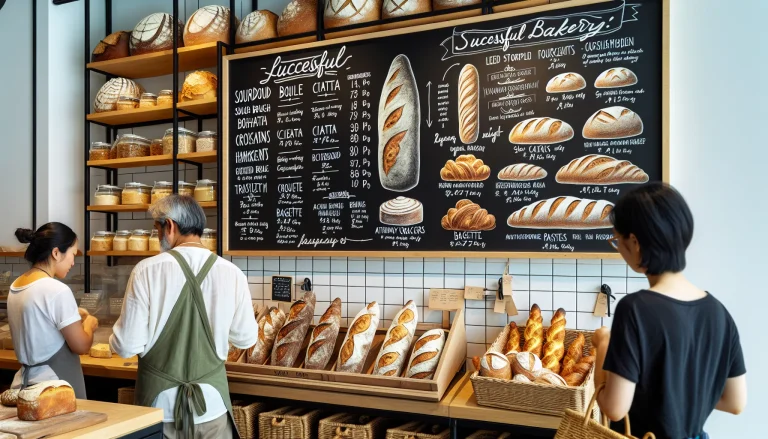

Most bakery menus grow by accretion. Someone’s grandmother’s lemon bar gets added in March, a wholesale customer asks for focaccia in June, a staff member suggests a matcha cookie in September, and by the following spring the board above the counter lists forty-one items that three people have to produce before 6 a.m.
A bakery menu is two documents pretending to be one. It is a sales tool pointed at a customer who has about eight seconds of patience, and it is a production schedule pointed at a kitchen with a fixed number of oven decks and a fixed number of hands. Every item that fails one of those two jobs is costing you something, usually both money and sleep.
This guide covers the whole thing: which categories a complete menu needs, how many items to carry, how to price and describe them, how to lay them out, which formats you need, and what the labeling rules require. Where a topic has its own guide, I keep it short here and point you at it. If you want a layout to start from instead of a blank page, the best bakery menu templates will save you the design work, and if your menu already exists and simply is not earning, start with bakery menu engineering instead of adding anything new.
The Bottom Line
- Six categories make a complete bakery menu: breads, pastries and viennoiserie, cakes and celebration items, cookies and bars, savory, and drinks. A free-from line now sits across all of them rather than in its own ghetto at the bottom.
- Item count matters more than item choice. A tight menu that one morning crew can actually produce beats a long one that generates waste and 5 a.m. triage.
- Margin varies enormously by category. Cookies and bars are the highest-margin impulse buy; custom cakes carry the highest ticket; bread is the daily-habit driver that gets people through the door.
- Descriptions earn their space. Name, size, and one concrete detail per item is the whole formula, and dropping the dollar sign from prices is a small, well-documented nudge.
- Calorie labeling is federally required only at chains with 20 or more locations, so a single-shop bakery is exempt, but state allergen rules are tightening.
Metrobi drivers are rated 4.97/5
Trusted by local businesses for:
- Background-checked professionals
- Specialized in business deliveries
- Same drivers for consistency
- 4.97/5 average delivery rating
The six categories a complete bakery menu needs
Across the operator guides and supplier resources that cover menu composition, the same block structure keeps appearing: breads, pastries, cakes and cupcakes, cookies and bars, savory items, and drinks, with free-from options woven through. You do not need all six. You do need to decide which ones you are in, because each carries a different margin profile and a different production demand.
Breads. The habit category. Baguettes, a country sourdough, sandwich loaves in white and wheat, rye, and a roll program: onion, ciabatta, pretzel, dinner. Bread rarely carries the best margin on the board, but it is what makes someone a Tuesday-and-Thursday customer instead of a birthday customer.
Pastries and viennoiserie. Croissants, danishes, cinnamon rolls, cream puffs, éclairs, turnovers, and whatever regional item your neighborhood expects. This is the morning-rush engine and the category most sensitive to being sold out by 9 a.m.
Cakes and celebration items. Cupcakes, slices, whole cakes, and custom orders. Cakes are consistently described as the most profitable product line in a bakery, and custom work carries the highest ticket of anything you sell. It is also the category that demands a deposit, a lead time, and a conversation.
Cookies and bars. Chocolate chip, oatmeal, shortbread, sandwich cookies, brownies, blondies, lemon bars. Highest margin, lowest spoilage risk, and the easiest thing to add to a transaction at the register.
Savory. Quiche, hand pies, sandwiches on your own bread, soup in winter. Savory extends your trading day past 11 a.m. and converts a pastry stop into a lunch stop. It also introduces refrigeration, holding, and food-safety work you did not have before.
Drinks. Coffee, tea, and something cold. Even a minimal drinks program raises average ticket substantially, because almost nobody buys a croissant and declines coffee.
Then there is the free-from question, which has stopped being optional. Gluten-free, vegan, and reduced-sugar options are now treated as baseline market coverage rather than a specialty. The better pattern is to put one credible free-from item inside each category you already run instead of a separate “special diet” section that reads like an apology.
Metrobi is transforming bakery deliveries
Specialized solutions for bakery businesses:
- Bakery-trained drivers
- Proper handling equipment
- Peak day delivery support
- 23% average cost reduction
How many items should a bakery menu have?
There is no magic number, but there is a correct method for finding yours, and it starts in the kitchen rather than at the counter.
Count your constraints first. How many oven decks, how many proofing racks, how many pairs of hands before open, how much display case frontage. Then count how many distinct processes your current list requires. A menu where eleven items share one laminated dough is a different animal from a menu where eleven items need eleven procedures, even though both say eleven.
The operator consensus on composition is useful here: successful bakery menus tend to hold roughly 70% to 80% of items constant and rotate the remaining 20% to 30% seasonally. That split gives you two things at once. The constant core is what regulars come for and what your crew can produce half-asleep. The rotating fifth is where you test, follow the season, and generate a reason for someone to look at the board again.
The practical ceiling is the one your 5 a.m. shift sets. If your crew is making judgment calls about what to skip because there is not enough time, your menu is already longer than your kitchen, and the fix is subtraction rather than better scheduling.
Bakery menu items by category, with margin and effort
A comparison is more useful than a list here, because the decision you are actually making is where to spend limited production capacity.
| Category | Typical margin | Production load | What it does for the business |
|---|---|---|---|
| Breads | Low to moderate | High (long fermentation, oven time) | Builds daily habit and basket frequency |
| Pastries / viennoiserie | Moderate | High (lamination, early start) | Drives the morning rush, highest sell-out risk |
| Cakes (counter) | Good | Moderate | Raises average ticket, strong impulse |
| Custom cakes | Good, highest ticket | Variable, scheduled | Pre-paid revenue, deposits, lead time |
| Cookies and bars | Highest | Low, batchable | Register add-on, long shelf life, low waste |
| Savory | Moderate | Moderate, plus holding | Extends the day into lunch |
| Drinks | Very high | Low | Lifts ticket on nearly every transaction |
Read that table as a portfolio rather than a ranking. A menu of nothing but cookies and coffee would show lovely margins and no reason for anyone to come twice.
How to price and describe bakery menu items
Pricing starts with a real cost per unit, which means ingredients plus the labor minutes and the oven time the item consumes, and ends with what your street will pay. Between those two numbers there is more room than most owners use.
Two pricing details are worth getting right:
- Drop the dollar signs. It is one of the better-documented findings in menu research: customers ordering from menus without dollar signs spend measurably more than those reading prices with them. Write 4.25, not $4.25.
- Reprice on ingredient moves, not on the calendar. Butter, eggs, flour, and cocoa do not wait for your annual menu refresh, and a menu priced against last year’s butter is quietly donating margin on every laminated item.
Descriptions do real work and almost nobody writes them. The formula is short: name, size or count, and one concrete detail a stranger can act on. “Morning bun — laminated dough, orange zest, rolled in cinnamon sugar” tells someone what they are buying. “Morning bun” tells them nothing and sells to regulars only. Skip the adjectives that describe your feelings about the item, and keep the ones that describe the item.
How to lay out a bakery menu so the right items sell
Layout is where menu design and menu profitability meet, and the advice that circulates is more confident than the evidence behind it. The common guidance places high-margin items in the center of the page, then upper right, then upper left, and uses visual cues (a box, a photo, a small mark) to draw the eye to what you want to move.
It is the same ordering problem every food business faces. The guide to the essentials of a brewery menu works through it with beer lists, where the sequence of the list changes which beer moves, and the honest summary is that reading order matters more than any mythical sweet spot on the page.
What is not in dispute is that emphasis works and that unmarked lists get skimmed in order. So: give your best items a line of their own rather than burying them mid-paragraph, use photography sparingly and only where it is genuinely good, and do not try to highlight nine things at once. Everything emphasized is nothing emphasized.
Choosing which items get that treatment is a data question rather than a design question, and it belongs to the menu engineering process: you need unit sales and contribution margin per item before you know which lines deserve the box.
Which bakery menu formats you actually need
Most bakeries need three versions of the same menu, and the mistake is treating them as one file.
- The counter board or case labels. Read at a distance by someone in line with limited time. Short, large, and honest about what is sold out.
- The printed card or takeaway sheet. Where custom cake pricing, lead times, allergen notes, and wholesale or large-order information live, because none of that fits above a display case. This is the version most bakeries build from a template rather than from scratch, and the bakery menu template roundup covers which sources suit print sizes and which are screen-only.
- The online menu. Now the one most customers see first, whether through your site, a QR code at the counter, or your Google Business Profile. Getting it right is its own job: platform choice, photos, item setup, and pickup or delivery windows. Creating an online bakery menu walks through that build, including how to keep sold-out items from taking orders you cannot fill.
Keep one source of truth. When prices live in three places that are edited by three different people, the price a customer gets quoted stops being a decision you made.
Calorie and allergen rules for bakery menus
Federal menu labeling applies to restaurants and similar retail food establishments that are part of a chain of 20 or more locations, which the FDA requires to disclose calories for standard menu items on menus and menu boards. The FDA is explicit that a single bakery or a small regional group under 20 locations is not covered, though it becomes covered once it crosses that line. Full guidance sits in the FDA’s menu labeling requirements.
Allergens are moving faster than calories, and in the other direction. Federal allergen labeling law is aimed primarily at packaged food and excludes most unpackaged items sold over a counter, but states are filling that gap. California’s SB 68 brings chains of 20 or more locations into mandatory disclosure of nine major allergens from July 1, 2026.
For an independent bakery, the practical read is this: you are probably not legally obliged to print calories, you almost certainly should list allergens anyway, and you should keep a current ingredient sheet behind the counter that any staff member can hand to someone who asks. A bakery that can answer an allergen question in ten seconds converts a customer that a shrug loses.
How often to update a bakery menu
Two cadences, not one.
Review the full menu every six to twelve months against actual sales and margin data. That is the structural pass, the one where items get cut, repriced, or promoted on evidence.
Refresh the seasonal fifth continuously. The common operator rhythm is one or two new items a month with larger changes quarterly, which keeps the board interesting without destabilizing production. The failure mode to watch for is a menu that never changes and still lists things you stopped making, because being told “we don’t make that anymore” at the counter is a trust problem rather than an inventory problem.
Frequently asked questions
What should be on a bakery menu? At minimum: breads, pastries, cookies or bars, something cake-shaped, and a drink. Add savory if you want trade after 11 a.m. Include at least one gluten-free and one vegan option inside your existing categories rather than in a separate section.
How many items should a small bakery offer? As many as one morning crew can finish before open, with capacity left for a rush. Hold 70% to 80% of the list constant and rotate the rest seasonally.
What is the most profitable item in a bakery? Cookies and bars carry the best margin and the lowest waste risk; custom cakes carry the highest ticket; drinks lift the margin of almost every transaction they attach to.
Do I have to put calories on my bakery menu? Not under federal rules unless you are part of a chain of 20 or more locations. Check your state and city, and check again if you open your twentieth shop.
Should the online menu match the counter menu? In price and availability, yes, always. In length, not necessarily; the online version can carry the detail that will not fit above a display case.
Where to start if your menu needs work
If you are opening, build the smallest menu that covers your categories and lets you run a clean morning. You will add items; nobody has ever struggled to add items.
If you are already open and something feels off, resist the urge to add. Pull your item-level sales and margin, find out which lines are quietly losing money, and cut before you create. Then rewrite the descriptions, reprice against today’s ingredient costs, and make sure the version customers see on their phones says the same thing as the board above your counter.